
A dent at the infeed star wheel and a soft label edge are two readings of one event. The force behind both is set at one place, which is the contact the star wheel and the wrap pad make with the panel. Separating bottle stiffness from clamp force and guide setting is a sequence, not a formula. Run unlabeled bottles first, then labeled bottles, then a second bottle lot. Change one variable per pass. Write two thresholds in the same units on one sheet. The first threshold is the force at which the panel first dents. The second is the force below which the wipe stops bonding the edge. A 12 g PET bottle holds a narrow band between the two thresholds. According to ASTM D2659, a crush reading holds only under conditions approximating the test which produced that reading.
Why Do a Dent and a Soft Label Edge Come From One Contact?
A wrap-pad contact is one mechanical event with two records. The pad deflects the panel, and the label is then pressed onto a face which no longer matches the shape the die-cut was made for. The dent is the panel’s record of the deflection. The soft edge is the adhesive line’s record of the same deflection, because leading and trailing edges land on a curved face and lift before the adhesive wets out.
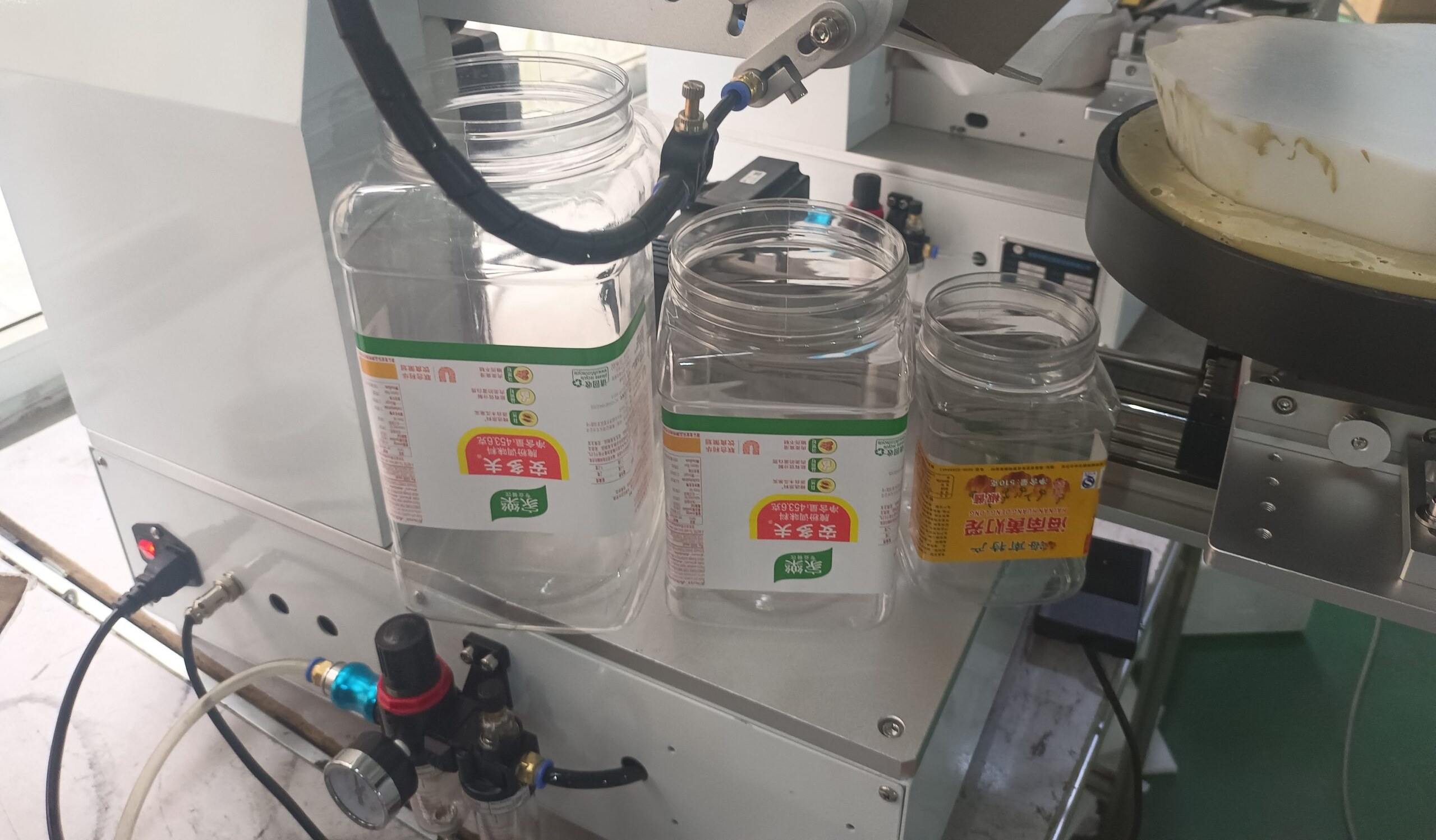
Rebound does not clear the finding. A dent which springs back before the next bottle arrives still produced a label applied to a deflected panel, so a rebound check and an edge check are two separate pass or fail items. For example, a plant which records rebound alone releases bottles whose edges lift at the customer. One contact explains both symptoms, and one contact also explains the argument that follows, where the pad is blamed for the dent and the label supplier for the edge.
Which Source Is Moving the Panel: Star Wheel, Pad or Bottle?
Panel movement has three candidate sources on a pressure-sensitive line, and each one leaves a different mark. First, the infeed star wheel and the guide rails can interfere with the bottle before any label contact, so the panel is already deflected when the pad arrives. Second, the wrap pad and the wipe belt can load the panel during the wrap. Third, the bottle can arrive with a panel which is oval, seamed in the wrong place or unevenly distributed.
The order that separates the sources is fixed, and one variable changes per pass. Run three passes: 1. unlabeled bottles at jog speed with the pad backed off, 2. labeled bottles at the same setting, 3. a second bottle lot from another cavity. Watch where the panel moves first in each pass. A dent which follows the second lot points at the bottle. A dent which stays put points at the machine. The bottle-varies question is answered in the cavity diameter decision; this article answers the machine-deforms question.
Which Symptom Points to Which Source?
Six patterns cover most thin-wall cases before any gauge is fitted.
The Symptom, Source and Confirmation Table
A symptom table is a decision aid, not a diagnosis, and each row names the test which confirms the reading.
| Symptom at the pad | Source the pattern points to | The test that confirms | What is recorded |
|---|---|---|---|
| Dent at one fixed spot before label contact | Star wheel or guide rail interference | Jog unlabeled bottles, pad backed off | Spot height, lot, cavity |
| Dent moves with the pad during the wrap | Pad force, contact width or dwell | Step pad force down at the same speed | Force at first dent, deflection |
| Dent on empty bottles, not on filled | Panel support or radial stiffness | Same bottle, empty and filled | Fill level, both deflections |
| Bottle stable, no dent, edge lifts | Wipe quality or pad alignment | Peel the edge by hand | Edge at three positions |
| Skew and dent on one bottle | Pocket squeeze or tilt at entry | Bottle axis against pocket center | Skew direction, pocket number |
| Cracks later in storage | Local strain at the contact | Retained sample under strong light | Interval used, storage position |
What Goes on the Sheet With Each Symptom?
A record is useful when a second person can repeat the reading from the sheet alone. Each row carries the bottle lot, the cavity number, the speed at the time, the station where the panel moved, the force reading and the gauge identification. The gauge matters as much as the figure, because a force read from a regulator setting is not a force at the contact point. According to NIST, a reading becomes assignable only after the gauge has been compared with a reference standard, and the intercomparison behind a calibrated gauge is set out in the NIST calibration design page. Add the rebound interval, the pad width and a photo of the dent at pad height. A wrinkle following an oval trailing edge is a different defect, and those lines sit in the oval trailing-edge post.
The Operating Window Has Two Edges
A window with one edge is not a setting.
The Upper Edge: First Dent, Whitening and Non-Recovery
The upper edge is the force at which the panel takes a permanent change, and three readings mark the approach to it. The first is the force at which a dent becomes visible under grazing light. The second is whitening or crazing at the contact, which shows local strain before permanent set appears. The third is the force at which the panel fails to recover, read at an interval fixed on the sheet. All three are recorded in force and in panel deflection at pad contact height. According to ASTM D2659, a ductile container may not exhibit a crushing load at failure although a crushing yield load value is normally present, and the standard limits such readings to conditions approximating its own test. Yield behavior therefore carries more than a failure load on a thin panel.
The Lower Edge: Where the Wipe Stops Bonding the Edge
The lower edge is the force below which the wipe no longer makes a continuous bond, and the lower edge is measured with the same instrument as the upper one. Work in three steps: 1. drop pad force in small steps at production speed, 2. peel the leading, center and trailing edge by hand after each pass, 3. record the force at which the bond stops. The same run at crawl speed gives a different result, because entry impact at line speed is not the static force measured with the machine stopped. Both edges are therefore taken at the contracted speed rather than at jog. Pad wear moves the lower edge between campaigns, so the lower edge is re-taken after a pad change. Recording the two edges closes the loop which the symptom table opens.
What Do You Do When the Two Edges Cross?
The crossed case is the one where the wipe threshold sits above the dent threshold for a given pad, contact width and label. Raising force bonds the edge and dents the panel. Lowering force protects the panel and lifts the edge. Three changes remain in 2026, and each has a different owner. 1. The machine side can fit a softer or wider pad and a progressive lead-in, which spreads the load. 2. The label side can move to a narrower or more forgiving die-cut and a different adhesive. 3. The bottle side can stiffen the panel, even out wall distribution or use a heavier preform. In practice the cheapest change is often the pad. No setting makes a thin panel stiff. Before a change is bought, the cross is confirmed 3 times: with the machine stopped, at jog speed and at the contracted speed. A worn pad changes the compliance underneath all three answers, which is why replacement triggers sit in the three-shift wear ledger.
How Does the Window Reach the Purchase Documents?
A purchase document which carries the window is the only version that survives a lot change. The specification states the rigidity precondition, measured with the same pad width and contact height at the contracted speed. A first-bottle item records dent, rebound and edge bond together with the bottle lot and cavity. Without a written band, the next operator inherits a single number and no reason for it.
The window is found on the buyer’s own bottles, because a supplier demonstration bottle cannot stand in for a production lot. HiPaks runs trial labeling on the buyer’s own bottles with video returned, and works with buyers in more than 50 countries and more than 500 factories. The video shows where the panel moves and which edge lifts. Two people sign the record, one from production and one from quality. Test-run video is arranged through the labeling test video page, and a quote follows from the contact page. The recipe stores the band rather than one target.
Which Bottle-Side Numbers Does This Article Not Fix?
Wall thickness distribution, bottle weight, blowing conditions and preform grade are bottle-side variables. None is fixed here, because each one is set against a panel requirement the buyer writes. The standard covering the axial question is not a license to pinch a panel.
ASTM D2659 covers column crush. The scope text gives information about crushing properties “when employed under conditions approximating those under which the tests are made”. The same standard sets a limit: the tests “cannot be considered significant for engineering design in applications differing widely from the load-time scale of the standard test”, according to ASTM D2659. A star-wheel pinch at line speed is such a case, so a figure from ASTM D2659 is quoted with the limit attached rather than transferred to the pad. The buyer’s own panel requirement, not a published crush figure, sets the limit a bottle change is judged against. A pouch or a carton raises a separate fit question, covered in the pouch and carton fit check.
Frequently Asked Questions
Does a Soft Label Edge Mean the Adhesive Is Wrong?
A soft edge is evidence of a weak bond at the edge, not of a bad adhesive batch. The same roll can bond on a flat panel and lift on a deflected one, because the wipe presses the edge onto a curved face. Test the edge on a bottle held straight before blaming the label.
Can Pad Force Compensate for a Thin Panel?
No. Pad force can restore edge contact, and the same force flattens the panel it is meant to bond. Compensation belongs to contact width, pad compliance and dwell rather than to more force on a thin wall. A wider pad spreads the same load over a longer contact, and a progressive lead-in lets the panel recover before the wipe.
Why Not Use an ASTM D2659 Figure for a Side Pinch?
A crush figure from ASTM D2659 is a measurement of column load under the conditions of that test. The standard states that the tests cannot be considered significant for engineering design in applications differing widely from the load-time scale of the standard test. A side pinch at line speed is such an application, so the figure does not measure the load the pad applies.
How Was This Article Researched?
A prompt-explorer run on 2026-11-26 captured four model answers to the dent question, and none of them named this site. The pages read were the ASTM D2659 scope and significance text, a NIST calibration design page and two container test explainers from Presto Group and Qualitester.
