
Three labels need a sequence before they need a tolerance. The order holding at inspection is orientation, then front, then back, then neck. The neck head sits downstream of the two body heads, and every figure is measured from a named parent.
Front and back can share one bottle datum. The neck label cannot, so a neck-to-front figure is derived and carries the orientation error, the front placement error and the neck head’s own error.
Whether one machine carries all three applications is a configuration question, confirmed item by item in the quote. What follows is the station sequence, the datum chain and the first-bottle sheet proving both.
Which Architecture Does the Quote Hide: One Indexed Motion or Two Stations?
One indexed motion applies the front and the back label inside a single registration event; two stations apply the front label at one reference and the back label at a second, after the bottle is indexed on. The architectures differ at first bottle and at failure, and a vendor quote usually names neither. What arrives at the plate is upstream work, as infeed buffering and backpressure sets out.
What Does One Indexed Motion Make Measurable?
A single registration event is one product sensor, one encoder position and one datum frame serving both body labels. The short chain reduces to one front-to-back offset. The cost is attribution. When the front label sits low and the back label sits high, a single-event machine reports one figure, and the inspection sheet cannot say whether the bottle arrived yawed, the plate sat low or the pad released late.
First, one event fixes front and back together, so the pair carries one number and one cause. ASME Y14.5-2018, reaffirmed in 2024, is the authoritative guideline for the language of geometric dimensioning and tolerancing, and, according to ASME, a datum reference frame fixes degrees of freedom before a tolerance is stated.
In practice a single offset tells a line engineer that the pair is wrong, not which head is wrong. Separating a product shift from a process shift needs the record described in label placement drift attribution.
Which Architecture Makes Which Figure Blameable?
The table sets each architecture against the figure the quote can state and against the first failure the architecture produces. A quote written from either column is testable at first bottle, and a quote naming no architecture is not.
| Architecture | Figure the quote can state | A defect points to | What breaks first |
|---|---|---|---|
| One indexed motion, both body labels at one plate | One front-to-back offset, stated once | The pair as a unit | An offset with no separated cause, since bottle yaw and head error share one figure |
| Two body stations, front then back | One figure per label plus a head-to-head figure with its own tolerance | The label whose figure moved | The gap between heads, where a bottle can yaw, and a gap too small lets one bottle trigger both heads as a single long object |
| Neck head downstream of both body heads | A derived neck-to-front figure with the parent named | The neck head or the re-orientation feeding it | Angular registration, when the bottle loses orientation before the neck head fires |
| Neck head interleaved with the body heads | No settled figure, because no settled parent exists | Nothing reliable, since the chain is undefined | A neck label passing at its own station and failing against the front label at inspection |
Three Labels, One Datum Chain: What Is Each Figure Measured From?
A datum chain is the ordered list of parents a measurement can be referred to, from the moulded feature on the bottle to the last label applied. The chain runs seam or moulded feature, then orientation, then front label, then back label, then neck label, and the seam end is covered in label to mould seam datum.
Why Is a Neck-to-Front Figure a Derived Figure?
A derived figure is a number obtained from two or more measured figures rather than read from one datum, and the neck-to-front relationship belongs in that class. The angle carries three errors at once: the orientation error at infeed, the front label’s own placement error, and the neck head’s error against the shoulder.
Arithmetic settles the direction. A derived figure cannot be smaller than the components added into it. A quoted neck-to-front value undercutting the placement figures published for the body heads has been taken from a different parent, on a different gauge or at a different speed.
The NIST measurement-uncertainty reference covers the evaluated components, the combined uncertainty and the coverage factor, and according to NIST a value lacking that support is an assertion rather than a measurement. A vendor line reading “neck to front within tolerance” names no parent, gauge, speed or sample, so the line cannot be checked on the buyer’s line.
What Must the Quote State Beside Every Number?
A quotable figure is a number with four attachments: the parent measured from, the gauge producing the reading, the line speed at which the reading was taken, and the sample identity described.
First, the parent: base, shoulder, seam or the front label’s own edge. Second, the gauge: calliper, optical comparator, vision system or a marked sample under a lamp, named rather than implied. Third, the speed: a reading at crawl speed describes the dispense edge, and a reading at the contracted rate describes the indexing and the handling between stations. Fourth, the sample: bottle lot, label roll and head.
A quote carrying one number and four attachments is auditable at first bottle. A quote carrying a number alone is not, and the argument moves to the end of the run where nothing can be measured again.
What Does the Neck Station Have to Hold?
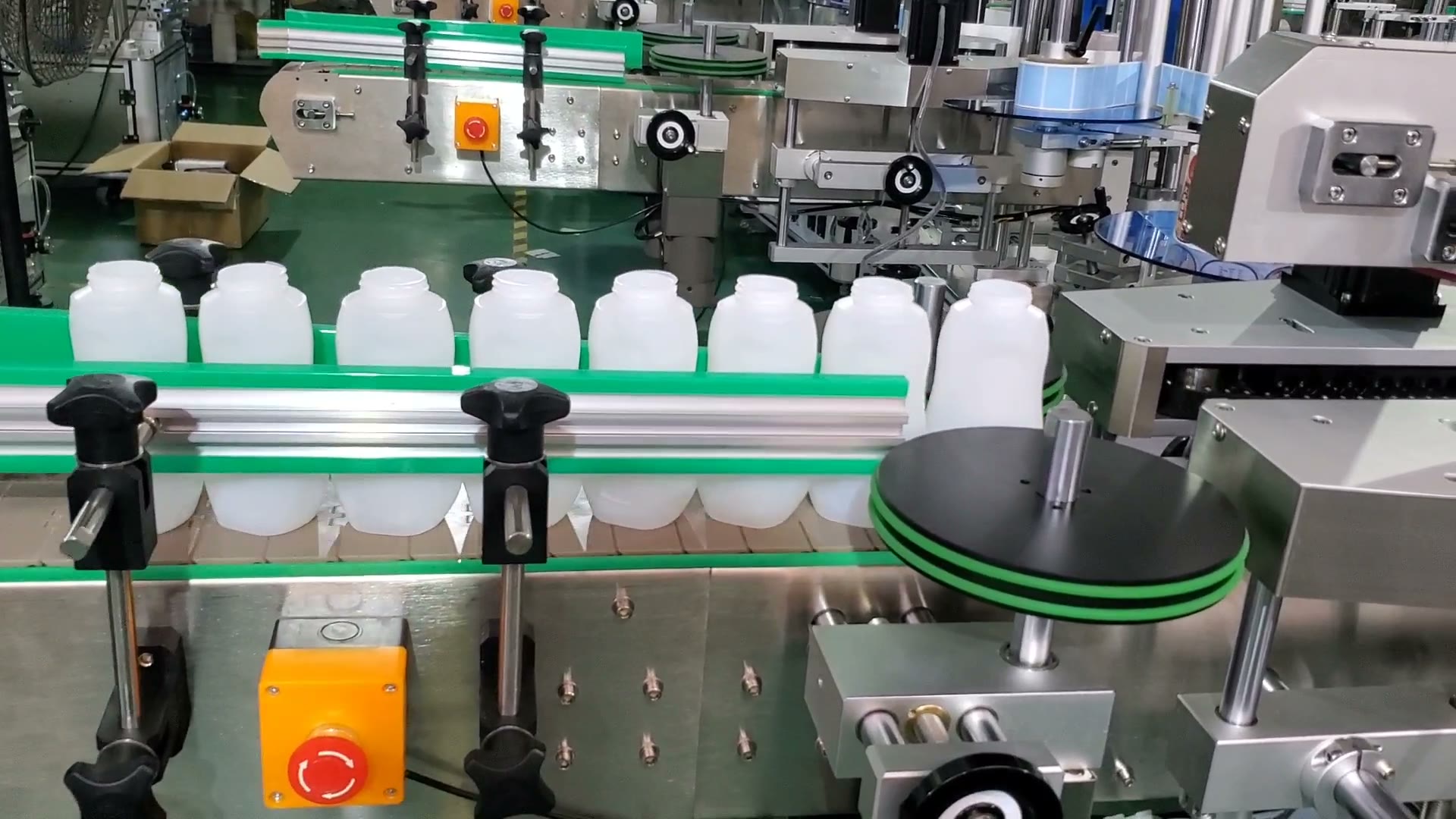
A neck label is applied to a shoulder radius, and the geometry is why the neck station cannot copy the body head’s settings. The body head presses a label onto a cylinder already held square by the conveyor and the pads. The neck head presses onto a curved, unsupported surface, so body clamping alone leaves the bottle free to roll under the wipe.
First, the bottle needs a neck or shoulder support while the wipe acts, because an overhead wipe pressing down loads the bottle rather than the label. Second, the wipe path follows a radius, so leading edge and trailing edge see different contact angles on one label. Third, orientation must be retained rather than re-found, since a downstream product sensor confirms a bottle is present, not that the bottle still faces the datum.
The failure signature is specific: a neck label passing at its own station and failing against the front label at inspection.
Three Applications per Bottle: Where Does the Rate Go?
The rate a buyer accepts is labelled output with three labels on the bottle, not a head rate multiplied by three. Each application consumes time inside the same cycle, and the slowest station sets the ceiling.
First, the limiting station is a duty cycle question. A neck head needing a longer dwell than the body heads lowers the achievable rate, and the reduction belongs to the configuration rather than to one head. Second, rejects and label roll changes sit inside the accepted output, so a rate quoted before those are subtracted describes a machine running empty shelves. Third, adding a third application to a front-and-back machine changes the index, and the quote must state the rate with three labels applied.
HiPaks publishes class ranges rather than one headline figure: 15 to 30 pcs/min for semi-automatic machines and 40 to 300 pcs/min for fully automatic machines. Which figure applies to a three-label configuration is confirmed item by item in the quote, beside the pitch and beside the first-bottle sheet. Label roll direction and core are the other input, covered in label roll specification.
What Belongs on the First-Bottle Sheet?
A first-bottle sheet is a record of each label measured against a named parent at a stated speed, and the sheet replaces one judgement with one row per label. HiPaks runs trial labelling on the buyer’s own bottles with the video returned, and the sheet is first filled in there. Send the bottle drawing, the three labels and the contracted speeds through the quote request, and the sequence is confirmed against those items.
What Does One Sheet Row Record?
One row carries seven fields: label identity, parent, height from the parent, centring, skew, angular relationship to the parent, and edge adhesion. The parent is the field that makes the row auditable, because a height without a parent is a distance from nowhere.
First, presence and identity, because a missing label, a wrong label and a wrong print orientation are pass or fail at sight. Second, height and centring taken from the parent named in the quote rather than from the machine base. Third, the angular relationship between neck label and front label, because a pair can sit inside its own figures and still look misaligned from above. Fourth, edge adhesion recorded with the time after application, since a lifting edge at one minute differs from a lifting edge at one shift.
What Fails the Bottle and What Fails the Machine?
A failed row is a bottle outside the quoted figure, and a failed machine is a row nobody can measure. The distinction decides who investigates, and the distinction belongs on the sheet rather than in a meeting afterwards.
A bottle fails when one of the seven fields sits outside the figure quoted for the parent, the speed and the sample. A machine fails when the same row cannot be produced at all: no gauge has been agreed, no parent was named, or the sample identity cannot be traced to a bottle lot and label roll. The first failure is an adjustment at the machine. The second is a paragraph missing from the contract, and the fix costs a renegotiation.
For example, a neck-to-front row outside the figure with the front label inside its own figure points at the neck station, while both rows moving together points at orientation.
Frequently Asked Questions
Can one machine apply a front, a back and a neck label?
That depends on the configuration, and the sequence is confirmed item by item in the quote. Which heads, which supports and which speed apply to a specific bottle is settled against the bottle drawing and the label set.
Should the neck head sit before, between or after the body heads?
After both body heads, because the neck head needs a bottle whose orientation is already established and still holds. A neck-to-front figure is derived from the front label, so the front label must exist before the neck figure can be measured.
What registration tolerance should the quote state for front to back?
The quote states the parent, the gauge, the speed and the sample beside the figure, because a number without those cannot be checked on the buyer’s line. A pair can sit inside its own figures and still look misaligned from above.
How is the first bottle checked when three labels are applied?
One row per label, each against a named parent, at crawl speed and again at the contracted rate. Crawl speed proves the dispense edge while the rate proves the indexing and the handling between stations.
