
Label placement drift is the slow, one-directional change in where a label lands and how far the label rotates across a shift. The 2 mm you see at hour eight is almost always the sum of three contributions, not one broken part. Catalogue claims in 2026 spread across a 200% range, from about plus or minus 0.5 mm on servo heads to plus or minus 1.5 mm on entry-level machines. This guide supplies what those pages leave out: a three-stage isolation test, an attribution table with a named owner on every row, and a purchase order clause written in millimetres and degrees.
Why Does Label Position Drift by the End of a Shift?
A shift-long drift is a systematic error, which means the average placement walks away from its starting value instead of scattering around a fixed one. Random scatter means imprecision, a walk means accumulation. Four things accumulate on a labeling line. The head, the guides and the frame warm up and grow a few tenths of a millimetre before hour two. The roll unwinds, so web tension at the peel plate changes as roll diameter falls. Guides creep and rollers wear, which opens clearance. Bottle lots change, and a new pallet or cavity brings a different diameter. According to the NIST/SEMATECH e-Handbook of Statistical Methods, short-term and long-term variability need separate studies. In 2026 a 2 mm walk still consumes 100% of a 2.0 mm allowance by hour eight.
Which Two Measurements Does Your QA Reject Rule Actually Use?
Label placement is a pair of independent measurements. Position is the distance from a named datum on the container to a named edge of the label, in millimetres. Skew is the rotation of the label axis away from the container axis, in degrees. Buyers quote position, QA rejects skew, and a clause in millimetres alone loses at acceptance. According to 21 CFR 101.3, a regulation defines which panel carries a claim, not how far off centre a label may sit. A label 80 mm tall that sits 2 mm further from the seam at the bottom than at the top is rotated about 1.4 degrees, which uses 70% of a 2 degree allowance. In 2026 this third item still needs its own line, because wrinkles, bubbles and flagging are appearance, not placement.
Step 1: How Do You Fix a Bottle Datum Before Any Label Runs?
The datum is the repeatable physical feature that every later measurement starts from. Use the bottle base, a panel edge, a mould seam or a cap feature. Do not use a printed design element, because print position moves between suppliers. Take 30 bottles from three pallets or cavities and measure diameter at label height with a calliper, then record the datum offset from a flat reference plate. On a 60 mm bottle, a 1% diameter change moves a half-wrap label edge about 0.9 mm, nearly half of the 2 mm you chase. According to ISO 5725-1, repeatability is the agreement between results obtained under identical conditions, so in 2026 measure one bottle 3 times before trusting any number.
Step 2: How Do You Isolate Transport Drift Without Applying Labels?
An unlabelled run is the control experiment that separates the conveyor from the label head, and the cost is a few hours of production time. Run bottles at the real speed, 200 per minute in your case, with the head disabled. Mark each bottle at the infeed, photograph the outfeed with a fixed camera, and compare the angular change on five consecutive containers at hours one, four and eight. Guides set too tight rotate the bottle, loose guides let it wander. If the unlabelled run reproduces 1.0 mm of the 2.0 mm, then 50% of the drift belongs to transport. According to the NIST/SEMATECH e-Handbook, a control chart separates special causes from routine variation. A guide that creeps 1 mm per hour adds 8 mm by hour eight.
Step 3: How Do You Separate Web Tension From Head Wear?
Web tension drift is an offset that resets with a new roll, and head wear is an offset that survives the roll change. Run labelled production with the step 1 bottle lot, and measure placement at the start and end of every roll on five consecutive containers at production speed. At each roll change, measure within the first five bottles of the new roll. An offset that resets with the new roll points to web tension, because tension demand climbs as roll diameter shrinks. An offset that survives the roll change points to thermal growth, guide creep, or wear at the peel plate. According to the AIAG Measurement Systems Analysis reference manual, repeatability and reproducibility are separate variances. If steps 1 and 2 account for half of the 2 mm, the head carries the other 50% in 2026.
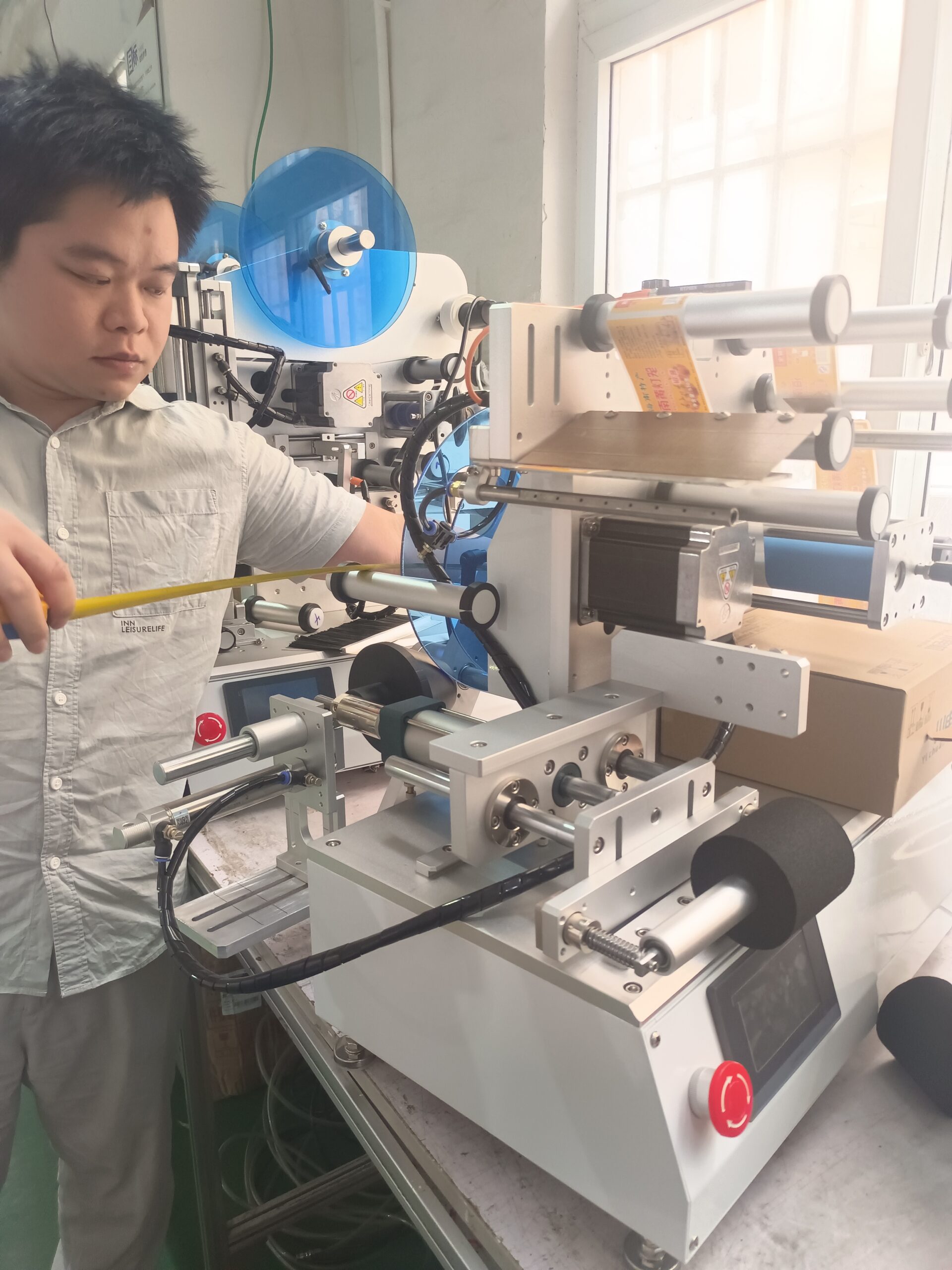
How Do You Split the 2 mm Between Bottle, Guide and Applicator?
What Does the Attribution Table Record?
| Test | Isolates | Reading on record | Owner of the fix |
|---|---|---|---|
| 1 Datum survey | Bottle and datum variation | Diameter and datum offset, 30 bottles from 3 cavities | Container supplier |
| 2 Unlabelled run | Transport and guide drift | Angular change, 5 bottles, hourly | Line builder |
| 3 Labelled run | Head residual after steps 1 and 2 | Position and skew, start and end of each roll | Machine builder |
| 4 Roll swap | Tension versus thermal wear | Offset reset within 5 bottles of a new roll | Builder with label supplier |
How Do You Back-Calculate the Number From the Reject Rule?
The purchase order number is derived, not copied, and the start is where QA rejects a bottle. If the reject threshold is 2.0 mm, a clause at 2.0 mm accepts a machine whose mean sits on the reject line, and about 50% of output then falls outside. Write the mechanical tolerance at roughly two thirds of the reject threshold, so a 2.0 mm rule argues for a 1.3 mm clause, and leave the remaining third for bottle and label variation. Then check the measurement system, because a gauge study consuming 30% of the tolerance adds more variation than the machine. According to ISO 2859-1, acceptance sampling by attributes needs a stated inspection level, so the sample size and the frequency belong in the same paragraph as the tolerance.
Worked Example: 200 Bottles per Minute Over One Shift
The arithmetic of a single shift explains why a slow walk is expensive. At 200 bottles per minute across eight hours, one shift carries 96,000 bottles, and a 2 mm drift over that shift averages 0.25 mm per hour. If QA starts rejecting in the last two hours, 24,000 bottles sit behind the reject line, which is 25% of the shift. A 1.3 mm clause leaves 0.7 mm of the reject band as margin, and 0.7 mm at 0.25 mm per hour buys under 3 hours before the margin is gone. According to ISO 7870-2, a control chart separates routine variation from a trend.
How Should the Position Clause Be Written?
A position clause is a sentence that names the datum, the measurement, the sample, the speed and the time, and most purchase orders omit time. The template runs like this: placement shall be within plus or minus X mm of the datum shown on the approved artwork, measured at the leading and trailing edge of the label, on at least five consecutive containers at production speed, after 60 minutes of running and again at the end of an eight hour shift, with the change between the two checks not exceeding Y mm. That final figure is the drift allowance, which a brochure number never states. Set Y at no more than 50% of X, so half the margin covers start-up error and half the walk. According to ISO 9001:2015 clause 7.1.5, the equipment that measures it must be fit for purpose.
Why Does the Skew Clause Need Degrees?
A skew clause is a limit written in degrees, because rotation is an angle, and a clause written in millimetres alone will be argued and lost at acceptance. Skew shall not exceed Z degrees, measured as the angle between the label vertical centreline and the container vertical axis, on the same sample and speed as the position check, with the change between hour one and hour eight not exceeding 0.5 degrees, which is 25% of a 2 degree allowance. A bottle can pass the position check and fail the angle check, which is the failure your QA team reports. In 2026 set Z from the reject rule, and confirm the reading method, since a photograph taken square reads differently from an angled projection. According to ISO/IEC Guide 98-3, a measured angle is reported with its uncertainty.
What Must the FAT Prove About End-of-Shift Drift?
A factory acceptance test proves drift only when the run is long enough for the walk to appear, and a 30 minute demonstration cannot show it. Three additions turn a standard test into a drift test. First, run at production speed for at least four continuous hours, or a full eight hour shift when the schedule allows, with readings at the start, at every roll change and at the end. Second, measure five consecutive containers at every checkpoint with the same instrument and datum. Third, keep the signed data sheet and a video of the final checkpoint, so the reading can be repeated on arrival. According to ISO 2859-1, the sample size and the acceptance number belong in the record rather than in memory.
What Does HiPaks Put Into the Trial?
The split needs real bottles, and demo stock answers a different question. Every order runs the buyer’s own bottles and labels before shipment, and the video of that run comes back with the readings, so the drift check starts before the machine reaches the dock. Full automatic machines are rated at plus or minus 1 mm excluding product and label error, while the MT-807 high precision labeling machine reaches up to plus or minus 0.2 mm, which is 20% of the automatic rating, and that gap is the budget to allocate. Controls use SICK sensors from Germany or Panasonic from Japan, with Mean Well power supplies and Leadshine stepper drives. Our shipment records cover 50+ countries and 500+ factories, and the factory acceptance test page lists what the witness run covers in 2026.
Straight Answers on Drift and Tolerance
Is Plus or Minus 1 mm Enough at 200 Bottles per Minute?
A plus or minus 1 mm machine rating is a capability figure measured on controlled samples, not a promise about your bottles. The rating excludes product and label variation, so a 1 mm machine running bottles with a 1% diameter spread adds the bottle contribution on top. Two of the three contributions sit outside the machine rating, which is why a 2 mm observation on a 1 mm machine is normal rather than a fault. Use the machine rating as a single line in the budget, add your bottle and label variation, then compare the total against the reject rule. According to ISO 5725-2, repeatability and reproducibility are determined under different conditions.
Can You Run the Drift Test Without Stopping Production?
The test can share time with production, and three of the four measurements cost nothing extra. Bottle checks run offline from a sample of 30 bottles, the unlabelled run needs the head disabled for a few hours, and the labelled run is ordinary production with readings added. That covers 75% of the evidence with no extra machine time. The real cost is discipline: the same instrument, the same datum, the same five consecutive containers and a written time stamp at every checkpoint. According to the AIAG Measurement Systems Analysis reference manual, a study is only as good as its recorded conditions, so log speed, roll diameter and guide position beside every reading.
Who Pays When the Drift Turns Out to Be the Bottles?
Responsibility follows the split, which is why every row of the table carries an owner. Bottle variation belongs to the container supplier, transport drift belongs to the line builder or to whoever set the guides, and the residual belongs to the machine builder. Two of those three parties sit outside the labeling machine order, which is 67% of the usual argument. With the runs, the argument moves to numbers and the clause applies to the party that owns the affected row. According to ISO 2859-1, an acceptance decision rests on a defined sample and a defined rule.
What Should You Send Before We Quote a Tolerance?
A tolerance quotation is a calculation built on four inputs rather than an opinion. Send your QA reject rule in millimetres and degrees, the bottle diameter and the datum you want to use, the label size and material, and the line speed in bottles per minute. Add a photograph of a rejected bottle and a note on whether the complaint is position, angle or appearance. With those inputs we quote a position figure, a skew figure and a drift figure separately, and the acceptance test is written against the same three numbers. The bottle labeling machine range shows the platforms they apply to, and our contact page reaches an engineer directly.
