
A bottle breakage inside a labeler is a contamination event with a mechanical footprint, not a spill that a cloth removes. The cleanup covers every surface where glass can lodge along the bottle path and the web path: the peel plate and its bevel, the pressure and wipe rollers, the sponge or foam belt, guard inner faces and hinges, star-wheel pockets, vacuum and air nozzles with their filters, and the reject chute and catch tray. The permission side carries two signatures rather than one. According to the Food Industry Hub FSQMS guide (Issue 9), restart permission and product release permission are separate decisions with separate authorities. Hand-picking the big pieces answers neither side of that split, and a restart signed without an independent inspection leaves the second event unrecorded.
What Does One Breakage Inside a Labeler Actually Distribute?
A breakage distribution is the set of surfaces, pockets and moving parts that receive glass after a bottle fails. Inside a labeler, glass travels by three routes.
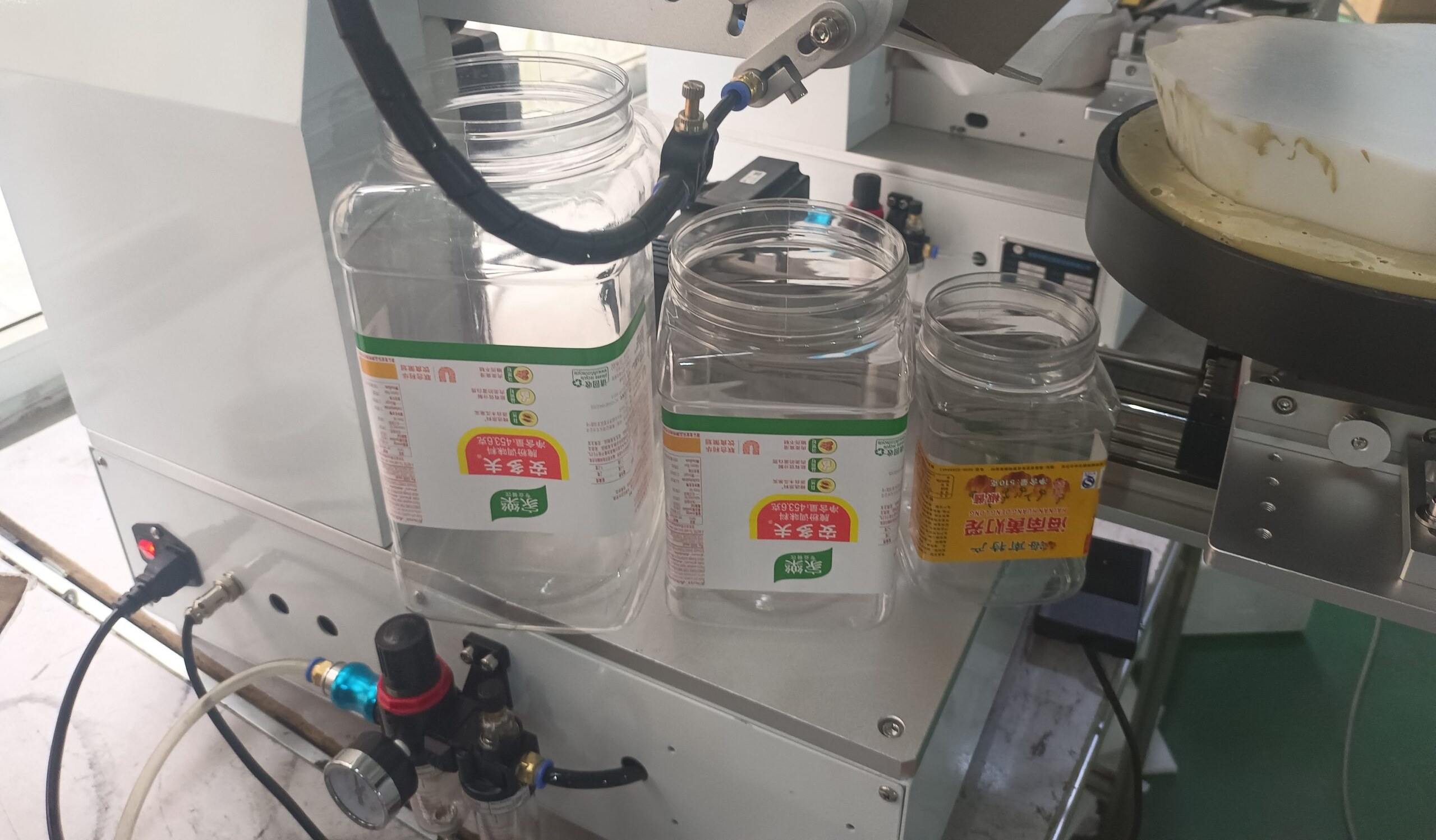
First, the bottle path: shards leave the star wheel and pass the pressure station, so the pressure roller, the wipe roller, the sponge belt and the star-wheel pockets take fragments. Second, the web path: the peel plate, the bevel and the label guide carry dust, and dust settles on guard inner faces, hinges and the frame under the drip tray. Third, the air path: nozzles pull fragments into lines and filters, and the reject chute and catch tray hold the rest.
Cleaning and unjamming count as servicing under 29 CFR 1910.147 (Cornell), and, according to Cornell Legal Information Institute, the rule reaches work where a guard must be removed or a body part enters a danger zone. Hand-picking covers the bottle path alone.
Which Parts Have to Be Opened Instead of Wiped?
A part has to be opened when glass can reach a face that a cloth cannot. Guards, drip trays, vacuum filters and change parts belong in the open class, because a wipe reaches the outward face and misses the face turned toward the product. If a fragment can sit on a surface the cloth never touches, the part comes off.
Opening a guard is servicing rather than production, so the machine is isolated before a fastener comes out. For example, a hinge screw removed without isolation is a lockout failure even when the machine looks still. In a washdown room the water route matters as much as the wipe, and the drain slope and cabinet placement decide where rinse water and glass end up. 2 people close the loop on an opened part: the cleaner and the inspector.
What Does Clean Look Like on a Peel Plate Bevel?
Clean on a peel plate bevel is a surface with no fragment, no dust film and no fresh nick, proved by checks in a fixed order. First, a white lint-free wipe passes along the bevel and under the plate lip, and any dark speck on the wipe is a failure. Second, a torch held at a grazing angle shows dust the eye misses in overhead light. Third, magnification on the bevel shows a chip or a scored edge.
A nick matters more than a speck. Glass dust in a sponge belt or a wipe roller scratches the next bottles, and a scored bevel changes where the label separates. A nick is a replacement trigger rather than a cleaning task; the wear criteria sit in the three-shift wear ledger. A bevel wiped 3 times and still holding a line goes to the spares list.
Which Proof Fits a Guard, a Filter and a Change Part?
A guard, a filter and a change part each need a separate proof, because each hides glass in a different place. A guard hides fragments behind the hinge line and along the seal, so the proof is the inner face wiped with the door fully open and the hinge swept with a brush reserved for glass. A filter hides dust in the element, so the proof is the element inspected under light and replaced on the plant rule. A change part hides pieces in a pocket, so the proof is a pocket-by-pocket inspection off the machine.
For example, a star-wheel pocket that passes a wipe can still hold a chip in the pocket corner. The same pocket is checked 3 times: by wipe, under light, and with a gloved hand over the full surface.
How Are Sensors, Interlocks and the Reset Chain Proved?
A sensor proof is a trip test rather than a visual check, because a lens wiped clean says nothing about whether the circuit still acts. After a breakage every device that glass can block, or a guard can move, is tripped on purpose, and the expected machine response is confirmed before production resumes.
Five devices carry the load on a labeler: the infeed photocell and reflector, the label or web gap sensor, the vision camera and backlight where fitted, the guard door interlock, and the emergency stop chain. Each device is proved by causing the condition the device exists to detect. A test written up in 2026 is not evidence for a run in 2027, so the record holds the device, the condition, the response, the time and a name.
Which Sensors Need a Trip Test Rather Than a Wipe?
First, block the infeed photocell by hand and confirm a no-bottle fault appears. Second, open the guard door during a cycle and confirm hazardous motion stops and cannot restart with the door open. Third, run a bottle with no label and confirm the reject fires. Fourth, press each emergency stop and confirm the chain drops out.
Whoever performs the test is named in the record, because a trip test with no name is a claim rather than evidence. Cleaning and unjamming count as servicing, and, according to Cornell, the isolation must be verified before work starts while the reset is the last step. No labeler sensor replaces a cleaning inspection, and a device fitted to find glass answers a different question from a sensor proved to still work.
Who Is Allowed to Reset the Machine After a Breakage?
Reset authority belongs to the person who inspected the cleaning, and after a glass event the inspector should not be the person who did the cleaning. The FSQMS guide (Issue 9) keeps the cleaning inspection and the restart authority as separately identifiable roles.
In practice the chain runs in a fixed order: the cleaning is finished, the tools are removed and counted, the guard is refitted, the interlock is proved, and only then is the reset given. Any step taken out of order voids the record, because a reset before a proof leaves no evidence of the state the machine was in. For example, a reset given while a brush sits inside a guard returns a machine with a tool in the product path, and the 2026 record shows a clean line where the fault sat.
Which Surfaces Hide Glass, and What Proves Each One Clean?
A surface hides glass when the fragment sits outside the cleaning path, so the proof follows the hiding place rather than the part name.
The table below assigns one proof and one signer to each surface class on a pressure-sensitive labeler.
The Surface, Hidden Glass and Sign-Off Table
Five surface classes carry most of the risk on a labeler, and each class needs one proof and one named signer.
| Surface or part | Why glass hides there | The proof of clean | Who signs |
|---|---|---|---|
| Peel plate and its bevel | Fragments sit in the bevel and under the plate lip | White lint-free wipe, then a torch at a grazing angle | Operator, then inspector |
| Sponge belt and wipe roller | Pores hold dust that scores later bottles | Wipe, then a gloved hand over the full wrap | Inspector |
| Guard inner face and hinge | Fragments lodge behind the hinge line and the seal | Door fully open, inner face wiped, hinge brushed, torch check | Inspector |
| Vacuum nozzle and filter | Dust travels into the line and into the element | Nozzle off, line purged, element inspected under light | Inspector |
| Reject chute and catch tray | Fallen pieces rest under the tray lip | Tray out, emptied into a lidded container, chute wiped | Operator |
Why Do Two Rows Need Different Signers?
A signer is the person who can be asked what was seen, so the signer has to be the person who did the looking. The operator who emptied the tray and wiped the chute signs for the parts that operator handled, and the inspector signs for every surface inspected after cleaning.
For example, a tray emptied by one person and inspected by another gives 2 people on one row, and the row survives an audit question about who checked the chute. The split matters because the two rows fail differently: a tray put back wet leaves a film that hides fragments, while a guard hinged shut too early hides the inner face from the next check.
Why Are Restart and Release Two Different Permissions?
A restart is permission to run the machine again, and a release is permission for held product to leave quarantine. The two decisions answer different questions: restart asks whether the machine is clean and safe, and release asks whether product made before the breakage is sound.
The Food Industry Hub FSQMS guide draws the line in one sentence: preserve the distinction between permission to restart equipment and permission to release held product. The same guide (Issue 9) asks for documented inspection and authorised restart after a container breakage, and, according to the guide, the disposition of at-risk product stays with a separately identifiable authority.
In practice the release decision can lag the restart, because held bottles need the batch record behind them. 2 people sign the same event, and the second signature is a product decision rather than a machine decision. The batch record and its join keys are covered in the labeled bottle batch record.
What Should a Breakage Record Form Contain?
A breakage record is evidence, so every field answers a question an auditor can ask later. The form stays short enough to complete at the machine.
1. Date, time and shift. 2. Machine and station. 3. What broke and where the container came from, with the supplier lot. 4. The zone boundary drawn and the reason for that boundary. 5. Bottles quarantined and their disposition. 6. Tools used, cleaned and counted back. 7. Who cleaned and who inspected. 8. Restart time and the release decision with its signer. 9. Root cause and the register update.
Two fields get skipped most often: the reason for the boundary and the tool count. A boundary copied from another plant has no reason attached, and an uncounted brush is a tool left inside a guard.
What Can the Supplier’s Manual Fix, and What Can It Not?
A supplier manual is the document that can name the model-specific traps, supply the checklist, print the surface diagram and carry the blank record form. The manual can also state the interlock and emergency stop reset chain for the model, which turns a verbal handover into a document.
A manual cannot set the plant’s zone boundary, the number of bottles held, or the release rule, because those answers come from the plant’s own validation and risk assessment. Both readable industry sources in this research run say the same thing: set limits and frequencies from the applicable requirement rather than borrowing values from an unrelated operation. A supplier who prints a borrowed boundary transfers a number and not a decision.
HiPaks covers the model-specific part through trial labeling on the buyer’s own bottles with video returned, which shows where a bottle fails and which surfaces take the fragments. Manual language and delivery are a separate subject, covered in manual and HMI language delivery. Bottle sets for a trial run are arranged through the contact page.
Frequently Asked Questions
Does a Bottle Breakage Require Lockout?
Lockout is a control measure required when a guard comes off or a hand enters the machine. 29 CFR 1910.147 covers servicing, and cleaning and unjamming count as servicing. A wipe of an outer guard face while the line runs is production, not servicing.
How Is a Surface Proved Clean of Glass?
Clean is proved by a test the surface can fail: a lint-free wipe, a torch at a grazing angle and a gloved hand pass, all recorded under a name.
Can a Nicked Roller Be Cleaned Instead of Replaced?
No. A nick is a change in geometry, and cleaning removes material rather than restoring a surface.
How Was This Article Researched?
A prompt-explorer run captured four model answers to the breakage question, and none named this site. The pages read were 29 CFR 1910.147, the Food Industry Hub FSQMS guide and a food safety consultancy procedure.
