
A stand-up pouch is a filled flexible container whose shape changes between the case and the label head, and one fact decides most compatibility questions. A bottle labeler is built around a rigid body, a repeatable surface and a container that can be rotated or held against a belt. A soft pouch breaks the body assumption before the label leaves the liner. A flat carton breaks a different assumption: there is no curved face to wrap, only a panel that must arrive flat and square.
HiPaks trial labeling runs on the buyer’s own bottles with video returned, and the same rule covers a pouch or a carton: a sample decides, a drawing does not.
In practice, three answers run before any quotation: package geometry and fill state, the face the label lands on, and rate with the infeed method.
What Do the First Five Complaints Have in Common?
The first month with a stocked bottle labeler follows a predictable order of complaints, and all five share one cause: the container reached the head in a condition the machine was not built for. First, the bag falling over at the infeed. Second, the label wrinkling as the wipe roller passes. Third, the label sitting on the panel during the trial and drifting at production speed. Fourth, the carton skewing before the head. Fifth, the customer who expects one machine to feed itself.
According to our data from customer trials, the pattern is a handling question, not a label question. A distributor who recognises the pattern in 2026 screens a format before a sample is shipped. The instinct that refuses a format is not the instinct used for used equipment, and stocking a used labeler is a separate screen with its own tests.
Three Complaints That Need a Mechanism, Not a Setting
Three of the five complaints need a mechanism before a quotation, and each one has a different mechanism.
Why Does a Stand-Up Pouch Refuse to Stand at the Infeed?
A stand-up pouch is a container with no rigid body of its own, and the machine infeed is the first place where the missing body shows. The filled pouch carries a soft gusset, a base seam and a fill level that shifts during transport. Side guides squeeze the gusset, the pouch leans, and the base that stood on a bench no longer sits square. A wrap station also needs a container to rotate, and a pouch has no stable axis to turn on.
The specification line is not a label setting. The specification line is the infeed type, the guide faces and the hold-down. First, ask whether the customer’s pouch stands with the fill the customer sells, not the fill used for a hand sample. Second, ask how the pouch reaches the head: by hand, by a magazine or by a belt with a top hold-down. Third, ask what guide pressure does to a full gusset.
Why Does the Label Wrinkle Where the Wipe Roller Crosses the Gusset?
A wrinkle on a flexible panel is a pressure problem, not an adhesive problem. A wipe roller works because the surface behind the label pushes back. A pouch panel gives way. First, the panel bows. Second, the roller follows the bow. Third, the film has to absorb the difference somewhere. The gusset, the zipper and the seal are where the excess lands.
The quotation line is the applicator type and the surface the label lands on: a top tamp on a flat bed, a vacuum belt holding the panel, or a belt that cannot be used on a face with no curve.
According to the ASTM D5264 record, abrasion resistance of printed labels and folding cartons is compared on a flat substrate under laboratory conditions, and that laboratory scope is the limit: the practice evidences a printed surface, never a filled pouch under a wipe roller.
Why Was the Label on the Panel in the Trial and Off It at Speed?
Registration is the third complaint, and a short trial hides registration because a trial usually runs one good bag. A labeler establishes pitch and position with an infeed device, and the position datum is the container as presented, not the printed panel. When shape changes between pieces, the panel moves relative to the datum and the label drifts with the panel. A lean at the head becomes a placement error at the far edge.
The quotation line is what the tolerance is stated against: the machine datum, the printed panel or the label edge. A tolerance stated against the machine datum says nothing about a pouch whose panel moves.
In practice, the trial that settles registration draws pieces through the run: first, middle and last, at both fill extremes, and at the production fill level rather than a hand fill.
The Screening Table: Five Complaints, Five Quotation Lines
Five rows cover the first call, and each row must be answerable before a sample ships.
What Does Each Row of the Screening Table Have to Prove?
The table below is the screening document for the first call: complaint, mechanism, quotation line, trial evidence and the answer that means decline.
| Complaint | Mechanism | Quotation line | Trial evidence | Answer that means decline |
|---|---|---|---|---|
| Bag falls over at infeed | No rigid body, soft gusset | Infeed type, guides, hold-down | Pouch standing square at production fill | Guides cannot hold the pouch upright |
| Label wrinkles as it lands | Panel absorbs the wipe | Applicator and the surface met | Label inside the printed panel | Wrinkle crosses a seal or zipper |
| On the panel in trial, off at speed | Panel moves with the fill | What the tolerance is stated against | Pieces drawn through the run | Panel leaves the zone across the run |
| Cartons skew before the head | No square face, stacked magazine | Feeder scope as its own line | Square arrival from mid-magazine | Feeder out of scope |
| Quote said flat, delivery said two machines | Flat answer needs a feeder | What is sold: head, feeder or line | Written scope split, one drawing each | One machine expected to feed itself |
When Does a Row Mean Refuse?
A refusal is a statement about one format at one presentation condition, not a verdict on pouches, and label shape is a later screen, kept in choosing a labeler by shape. Four findings turn a row into a no. First, the pouch cannot stand at the quoted rate even with guides and a hold-down. Second, the label zone crosses a gusset, a zipper or a seal. Third, the panel leaves the stated zone on pieces drawn through the run. Fourth, the customer will not accept a separate feeder scope.
Each finding is written with the sample, the fill level and the rate beside it, because the same pouch at a lower rate or a fuller fill may pass. A refusal without those three conditions is an opinion, and an opinion is what the next supplier will overturn.
The Three Answers Are One Written Presentation Condition
What Must a Presentation Condition State Before a Quotation?
A presentation condition is a written statement of the state a container must be in when the label lands, and five items belong in the statement.
| Item | What the quotation must state | The complaint the line prevents |
|---|---|---|
| Face | The panel the label lands on, and the seal, gusset or handle to avoid | A label laid across a gusset |
| Flatness | The panel held flat enough to be a reaction surface | The wrinkle under the wipe roller |
| Fill level | The fill and the fill method during the run | A pouch that stands in the trial and leans in production |
| Size window | The customer’s production range, not a nominal drawing | A label that drifts off the panel |
| Rate and infeed | The rate and the method, by hand, magazine or belt | A trial that proves nothing at production speed |
Each row removes one complaint from the first month, and a quotation that omits a row leaves the customer to find the row in production.
What Makes a Presentation Condition Testable?
A testable condition names the panel, the fill, the rate and the evidence. For example, a condition that says the label sits inside the printed panel on a pouch standing square at production fill, fed by magazine at the quoted rate, is testable. A condition that says pouch, standard is not, and a supplier cannot price the second one.
The trial on a distributor’s own stock has its own protocol in trialing a labeler on your own bottles, and the written condition is the sentence that follows the trial.
What Does the Machine Number Mean Once the Condition Is Written?
An accuracy figure is a machine number measured on the supplier’s own substrate, and the HiPaks figures carry the exclusion in the same sentence: plus or minus 0.5 mm in general, MT-807 up to plus or minus 0.2 mm, and a fully automatic machine plus or minus 1 mm excluding product and label variation. On a filled pouch the dominant term is the pouch. A millimetre figure cannot carry the acceptance.
The substitute is a zone. First, the label sits fully inside the printed panel with a stated margin. Second, the margin is agreed before the trial. Third, the count is pieces drawn at the start, middle and end of a run, and at both fill extremes.
According to FINAT, the European self-adhesive label association, the label trade keeps its own test methods, and the FINAT test methods address label stock rather than a filled package on a conveyor.
The Flat Answer Hides a Second Machine
A flat-surface labeler is a label head plus a way to present a face, and the second part is a separate scope. Pouches and cartons do not arrive spaced and square. A friction feeder, a paging feeder, a magazine or a shuttle has to separate one unit and place the panel under the head. The head’s published figure was measured on product that already arrived correctly.
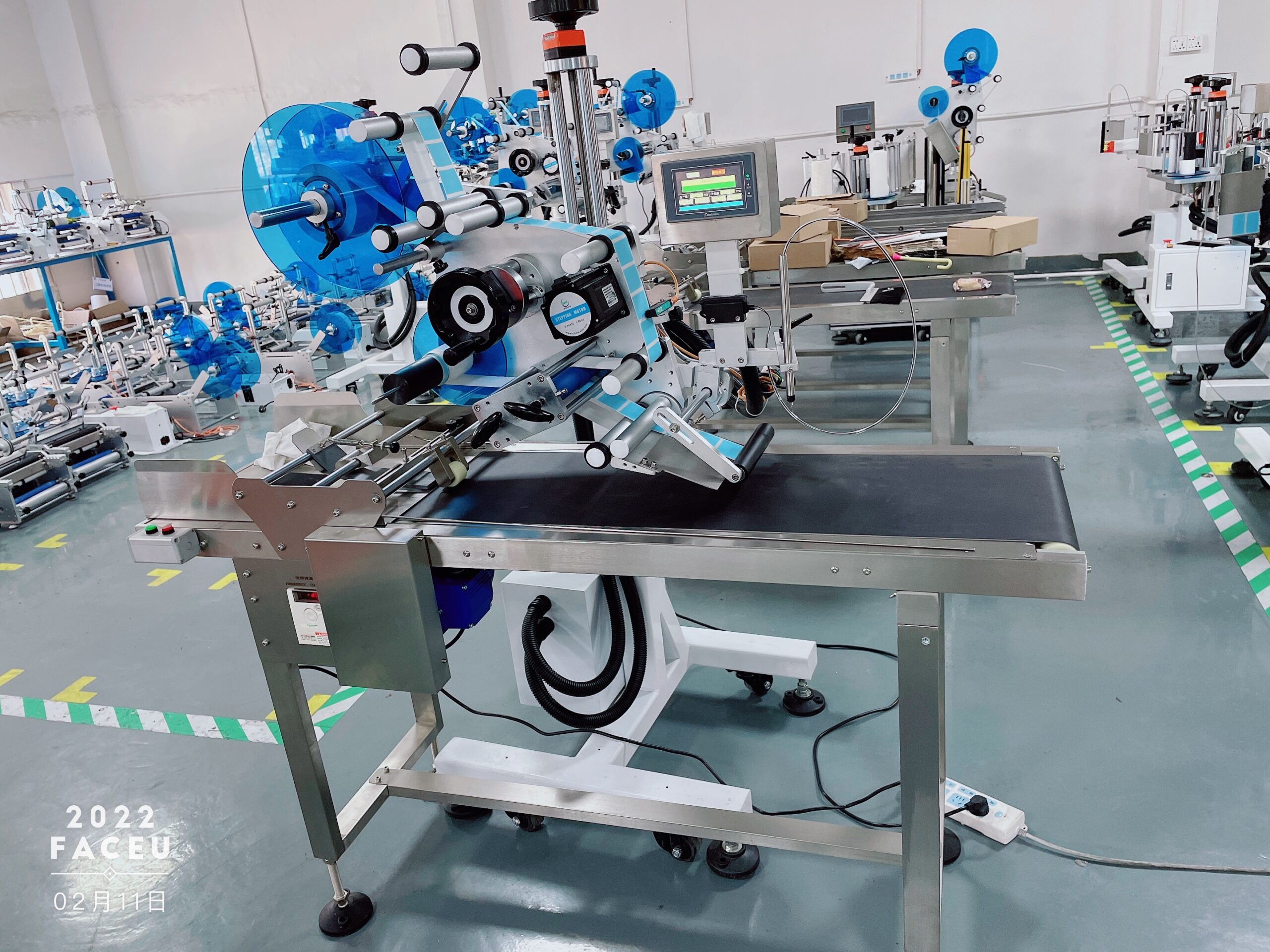
For example, a paging feeder and a tamp head arrive as two items with two drawings, two installation steps and two spare-parts lists. A distributor who quotes one item and lets the customer build the other has sold half a machine and will own the first complaint.
Three lines make the scope visible on paper. First, the head and the rate at which the head was measured. Second, the feeder and its presentation. Third, the interface signal that says a product is present. Three lines let a customer compare like with like.
The Refusal That Keeps the Account
What Goes Into the File You Send With a No?
A refusal file is a dated record of what was shown, what was measured and what the machine cannot do, and five parts make the file usable. First, the sample and the fill level. Second, the observation that failed, with the zone drawn on a photograph. Third, the machine limit in one sentence. Fourth, what would change the answer: a stiffer panel, a different fill, a lower rate or an added feeder. Fifth, what to buy instead, named by machine class rather than by brand.
The file protects a distributor twice. A customer who buys elsewhere and fails has a record of what was said before the order, and the same file turns a refusal into a referral. A factory quote can start from that file.
Which Refusal Is Really a Redirect?
Not every no is a refusal. Two sentences have to stay apart. The first sentence ends the format: the stock machine cannot present a pouch or a carton. The second only ends the quotation: the stock machine cannot do the job without a handling system outside the scope a distributor stocks.
A redirect names the class and the scope: a flat-surface labeler with a feeder, or a bottle line kept for bottles while pouches move to a co-packer. A brand in a redirect invites a price comparison nobody wins.
HiPaks builds pressure-sensitive labelers for rigid containers, and a customer can request a free test-run video to see the class before any commitment.
Frequently Asked Questions
Can a Bottle Labeler Apply Labels to Stand-Up Pouches?
A bottle labeler labels a stand-up pouch when the pouch arrives standing square, on a panel held flat, at a stated fill and rate. Without that presentation condition the answer is a flat-surface labeler with a feeder.
Which Three Answers Decide a Pouch or Carton Quotation?
Package geometry and fill state, the face the label lands on, and rate with the infeed method. A quote without all three has priced a machine, not a job.
What Should a Distributor Send When the Answer Is No?
A dated refusal file: the sample and fill level, the observation that failed, the machine limit, what would change the answer, and the class to buy instead.
