
A pre-stocking trial is a factory run on the distributor’s own bottles and labels, arranged before a purchase order and paid for in samples rather than in stock. Most buying guides answer the question with a yes and stop there, which leaves the useful part unsaid. A new distributor needs three events kept apart: a showroom demonstration on factory bottles, a trial on the distributor’s sample box before the order, and the factory acceptance test after the order. Each event answers a different question and carries different commercial terms. The sections below give the sample box specification, the run conditions, a camera protocol which turns the returned video into sales evidence, a per-SKU result sheet, the terms which sit beside the trial, and the limits of what one SKU can prove. A trial which returns a video, a result sheet and a deviation list can be quoted to a customer, and a trial which returns a video alone cannot.
What Are the Three Events Behind the Word Trial?
A trial is an umbrella word for three events, and the commercial weight differs at each one. First, a showroom demonstration runs a stock machine on factory bottles, costs the distributor nothing and proves only that the machine moves, counts and stops. Second, a pre-stocking trial runs the distributor’s own bottles and labels before a purchase order, and the factory keeps the settings for the order which may follow. Third, a factory acceptance test runs after the order, once the 30% TT deposit is paid, and the buyer signs a record against the specification. According to HiPaks shipment records, the company has supplied 500+ factories in 50+ countries, and in 2026 the pre-shipment run on customer bottles is standard practice in our production line. In practice the three events share one machine and leave three documents: 1) a demo note, 2) a trial result sheet, 3) a FAT record.
What Goes Into the Sample Box?
Which Bottles Belong in the Sample Box?
A sample box is a shipment of the distributor’s own containers and closures, sent so the factory runs the real article rather than a demo bottle. Twelve bottles per SKU is a workable set: six filled to the fill height sold, two empty, two wet from rinsing, and two carrying the defects the line will meet, such as a dented shoulder or an oval neck. Every cap must be the production cap in the production neck finish, because a demo cap with a different liner changes the height and the grip. Send PET, HDPE and glass as separate SKUs rather than as one mixed set. For example, a 500 ml PET bottle and a 500 ml glass bottle reach the same label length at different wrap forces, so one video cannot cover both. Mark the SKU code on every bottle.
Which Label Roll and Core Size Belong in the Box?
A label roll is a matched system of face stock, adhesive, liner and core, and the trial must use the roll the distributor will sell beside the machine. Send one production lot, never a mix of lots, because lot-to-lot adhesive variation shows up as a placement drift no setting can fix. The core diameter must be the figure on the quotation, commonly 76 mm (3 in) on automatic applicators and whichever core the semi-automatic model specifies. Check the wind direction, outside wound on most applicators, and the die-cut gap against the quotation. Write the core size and the wind direction on the box label. In practice a factory demo roll with a heavier glassine liner peels at a different force, and the returned video then proves the wrong machine.
Which Run Conditions Must the Trial Cover?
A run condition is one combination of bottle state, speed and label stock, and the trial is incomplete until each condition has run for a recorded stretch. First, run filled bottles at the speed band being sold: 15-30 pcs/min on a semi-automatic machine and 40-300 pcs/min on an automatic machine. Second, run empty bottles, because an empty bottle is lighter and the wrap belt slips. Third, run wet bottles, because condensation on a cold-filled bottle changes peel and adhesion. Fourth, run the defective bottles from the box, and record every jam rather than clearing the jam silently. Finally, measure the label edge against the placement figure: ±0.5 mm semi-automatic, ±1 mm automatic, and up to ±0.2 mm on the MT-807, with product and label variation excluded. In practice the wet run is the one most often skipped.
What Camera Protocol Makes the Video Usable?
Which Six Shots Must Be in Frame?
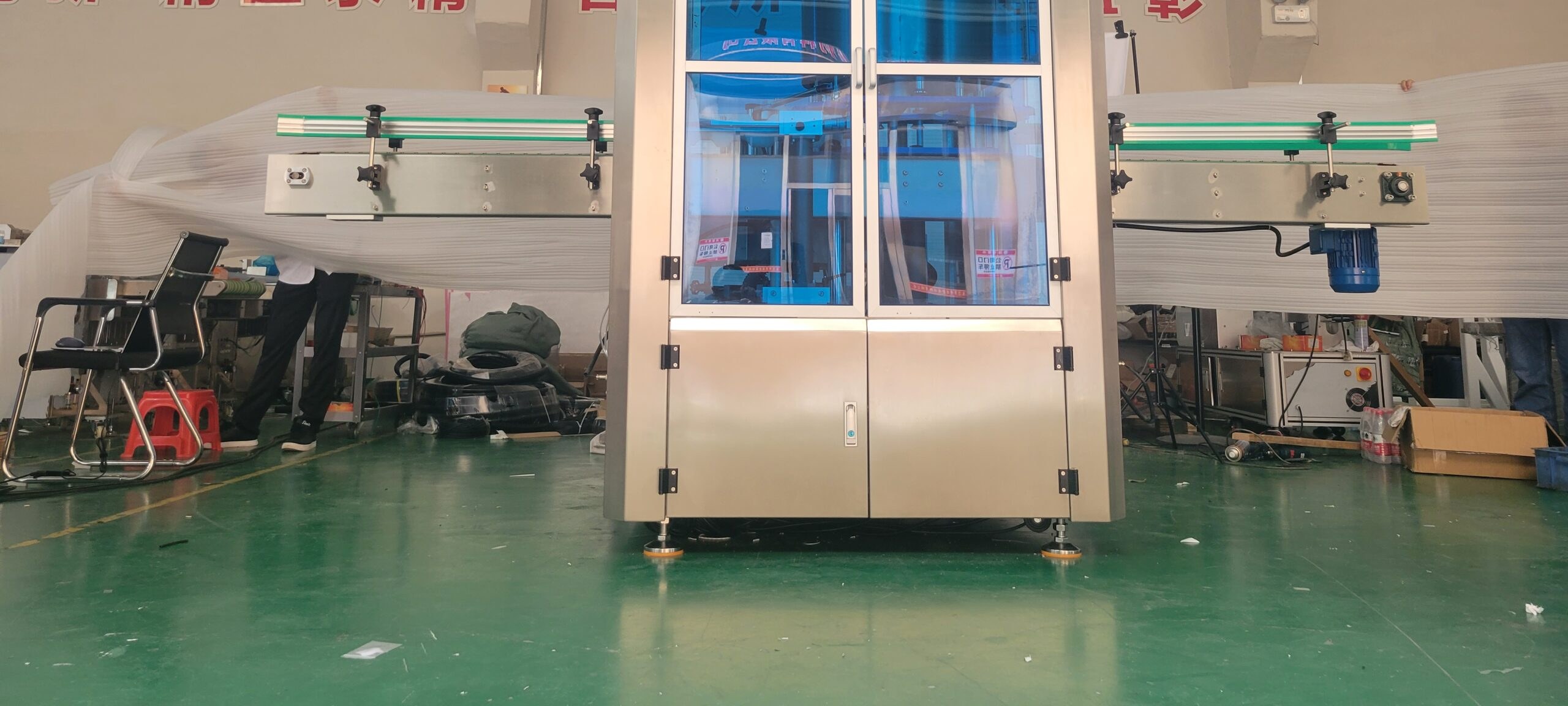
A usable trial video is a record with six fixed shots, not a showreel with music. First, the machine serial plate, square on and readable, because a claim later needs the number. Second, the counter or totaliser at the start and at the end of the run, so the bottle count is auditable. Third, a stopwatch or the machine timer, so the run time is auditable beside the count. Fourth, a tape measure held at the label edge on three bottles, so the placement spread is visible rather than described. Fifth, one deliberate reject, filmed from the reject lane. Sixth, one changeover to the next SKU, filmed without a cut. According to our production records, the plate and the counter are the two shots most often missing from a customer video. In practice a clip with the six shots replaces a site visit for the distributor’s own customer.
Why Do the Reject and the Changeover Belong in the Same Video?
A reject event is a bottle deliberately diverted by the machine, and the event proves the reject signal, the sensor and the lane work together. A changeover is the swap of format parts between two SKUs, and one uncut changeover proves the parts list matches the box. The two events belong in one video because the reject and the changeover are the moments a distributor’s customer will ask about. Film the reject with the bottle visible in the lane and the counter frozen on screen. Film the changeover from the first screw loosened to the first good label on the next bottle. Send the clip with the settings used, and the test-run video page shows the format HiPaks returns with every order. In practice a silent changeover looks staged.
How Is a Pre-PO Trial Different From the FAT?
A factory acceptance test is the post-order acceptance event at which the buyer signs the machine off against the order, and the FAT sits on the other side of the purchase order from the trial. The trial is a selection event: no order exists, sample freight is agreed, and the output is a result sheet which may end in a decision not to buy. The FAT is an acceptance event: the 30% TT deposit is paid, the buyer or a representative witnesses the run, and the record closes deviations before shipment. HiPaks runs the buyer’s bottles before shipment and returns the film with the order, and the factory acceptance test page sets out the FAT record. In practice the FAT inherits the trial settings, so a trial without a written settings sheet costs a second setup.
What Terms Sit Beside the Trial?
Trial terms are the commercial lines written next to the sample run, so the result leads to an order rather than to a conversation. Five lines matter. First, minimum order: HiPaks quotes MOQ 1 unit, so a first stock order can start at one machine. Second, payment: 30% TT deposit with 70% before shipment. Third, delivery term: FOB Shenzhen. Fourth, warranty: one year on the whole machine plus lifetime technical support, with wear parts excluded. Fifth, lead time: 7-10 days on a semi-automatic machine and 7-25 days on an automatic machine by configuration, counted from the order rather than from the trial. Write down who pays sample freight and who owns the video, in the quotation annex rather than in an email. In practice the lead time line decides whether the trial happens before the season or during it.
What Can One SKU Trial Not Prove?
A single-SKU trial is a selection test, not a performance guarantee, and the honest output is a deviation list rather than a promise. What the trial does prove is placement on one bottle, one cap and one label lot at the tested speed. Three limits matter. First, drift: an eight-hour run at production speed is the smallest useful drift test, and a fifteen-minute clip cannot show thermal drift in the applicator or wear in the peel plate. Second, customer promises: a distributor quoting a second bottle format runs a format the trial never covered, on one cap and one label lot. Third, compliance: according to the European Commission CE marking page, distributors must ensure that only compliant products bearing CE marking are placed on the EEA market and must know the legal requirements. A trial video does not build the manufacturer’s technical file. Used units follow a different test set, covered on the used machine test page.
What Does the Per-SKU Result Sheet Contain?
Which Columns Belong in the Pass or Fail Sheet?
A pass or fail sheet is one row per SKU, signed by the factory and countersigned by the distributor, and the sheet is the document the trial exists to produce. Eight columns carry the decision.
| Column | What goes in the cell | Who signs |
|---|---|---|
| SKU and bottle | Bottle code, material and fill height | Distributor |
| Cap and neck finish | Production cap, liner and thread callout | Distributor |
| Speed run | Pieces per minute held for the recorded stretch | Factory |
| Placement spread | Millimetres across the bottles measured | Both |
| Defect count | Count and type, with the bottle state | Factory |
| Settings used | Parameter set and recipe name, backed up | Factory |
| Change parts | Format parts fitted for the SKU | Both |
| Verdict | Pass or fail, dated | Both |
What Goes on the Deviation List?
A deviation is any result the quotation did not promise, written in the same units as the promise, and the list is the most useful page the trial returns. Four deviation types cover most runs. First, placement outside the band, recorded as a spread in millimetres over the bottles measured. Second, a format part which needs a new tool, recorded with the bottle dimension which caused the need. Third, a cap or a liner which jams, recorded with the batch and the supplier. Fourth, a speed below the band, recorded with the condition which caused the shortfall. For example, a 2 mm spread on an oval bottle is a deviation on an automatic machine quoted at ±1 mm, and the distributor needs that number before quoting a customer. Send the sample box list with the enquiry and HiPaks confirms the run slot before the box ships.
Questions Distributors Ask
Can the Distributor Attend the Trial in Person?
Yes. A distributor can attend in person at the factory, and a live video call is the workable substitute when travel is not possible. Attend the first run rather than the last, because the first run shows the setup work and the last run shows a settled machine. Bring the result sheet, the sample box list and the quotation, and sign the settings page before leaving the factory.
How Long Does a Pre-Stocking Trial Take?
The run itself is a factory slot measured in hours, not weeks. The calendar is set by sample freight to the factory and by the factory queue, so send the box early and book the slot in writing. Machine lead time starts after the order, at 7-10 days on a semi-automatic machine and 7-25 days on an automatic machine by configuration.
Does a Trial Video Replace a Factory Acceptance Test?
No. A trial video supports a selection decision before the purchase order, and a factory acceptance test is the post-order acceptance event where the buyer signs the machine off. The FAT uses the trial settings and adds the paid order, the witness and the deviation closure. A distributor who treats the trial as acceptance has no signed record when the machine ships.
