
A relabelling job is a routing decision reached before any quotation, not a demonstration of what a machine can do. Four thousand filled bottles carrying last season’s label can go three ways: over-label the old print, delabel and relabel, or scrap the bottle.
Three facts decide the way. First, the bottle and the label stock. Second, the adhesive class chosen when the label was bought. Third, whether the bottles are still filled.
In practice a labeling machine applies a label, and removal is a separate process or a separate machine, which is why the first honest reply to the customer is a list of questions instead of a yes.
Nothing in the citation set behind this 2026 guide was written for the distributor routing a filled, already-labelled consignment, and the gap is what the chain below closes: five questions, one branch, a paid trial, a route and a register.
Which Five Questions Come Before Any Answer to the Customer?
A pre-quote screen is a five-question check costing one telephone call, and the answers decide whether funding a trial makes sense. First, the bottle: material, coating, decoration and finish, because bare glass, coated glass, printed glass and PET respond differently to one removal method.
Second, the label construction: facestock, laminate, and whether the stock was ordered as destructible or as tamper evident. Third, the adhesive class, since a wash-off adhesive was designed to leave a surface and a permanent acrylic was designed to stay. Fourth, age, heat and storage history, because a bottle that spent the warm season in a warehouse presents harder residue than a bottle straight from the filler.
Fifth, filled or empty. According to Avery Dennison, testing at the end user is required to define the best methodology, so four of the five answers sit with the customer. Step 1 of the follow-up call is a request for the label specification and the storage history.
Why Is the Filled-or-Empty Answer the First Branch?
A filled bottle is a different substrate from an empty one, and the difference is not cosmetic. An empty return can be soaked, tipped, stacked and wetted by any method a trial proves safe. A filled bottle cannot: the container holds saleable product, and the product sets the limit on immersion, on handling angle and on how much heat a closure will tolerate.
The label material maker acknowledges the split. The Avery Dennison bulletin allows hotter water for empty bottles than for filled ones, and the same document opens by placing the testing at the end user. Thermal shock is the second risk, because a sudden change in temperature can crack glass already carrying the weight of the contents.
For example, when the customer’s bottles are filled and cannot be wetted, the soak route closes before any chemistry is discussed, and the job moves to over-label or to scrap.
What Does Strip and Reapply Actually Mean?
Strip and reapply names two processes quoted as one line, and the wording hides half the work. A labeling machine applies a label: the applicator draws stock from the roll, presents the adhesive face and presses the label onto the container. Removal is a different operation, run on different equipment or by hand.
A cited industrial example shows the difference. US 5,317,794, a delabelling method, bottles run on a turret to delabelling stations, where a differential cutter cuts the relatively soft plastic of a plastic label from top to bottom while not cutting or marring the bottle, the label’s own elasticity widens the cut, and a water flush lifts the cut film away.
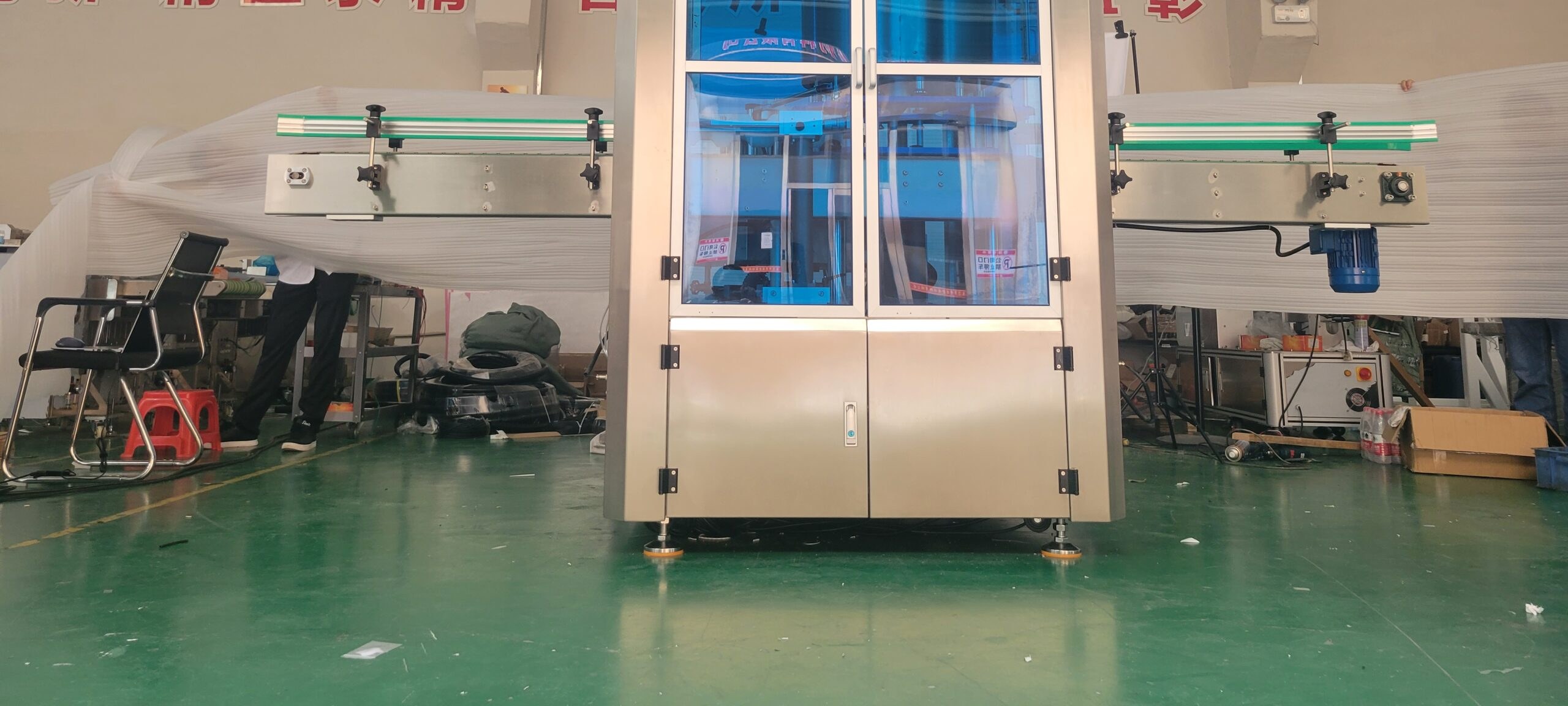
The mechanism is built around a plastic film label. First, a paper face, a destructible stock or a laminate presents a different edge. Second, the surface that fails may be the bottle coating rather than the adhesive, which is why the answer to the customer is a route plus a test and never a promise.
Who Fixed Removability, and When?
Removability is a property of the adhesive system chosen at the label order, and no later process adds it. A wash-off adhesive is designed to release from a purchased product, and a permanent acrylic is designed to hold. The label material maker sells the first because brand owners rework packages, and the S-100R wash-off bulletin exists for the wine and spirit market for exactly that reason.
First, end users and converters are responsible for testing and determining the fitness of use for a specific application. Second, an embossed surface or an over-laminate can change wash-off behaviour. The first question to the customer is therefore about the label that was bought, not the bottle being photographed, and the answer usually sits with the co-packer or the label converter.
For example, a request for the specification and a retained sample costs less than a failed trial. Where the stock was chosen for recycled PET and its adhesive class, the same purchase record settles the question before a bottle is touched.
Step 1: How Do You Draw the Sample?
A trial sample is a set of bottles drawn from the customer’s stock by rule, not by convenience, and the rule is what makes the result usable in a quotation. A handful of photographs and the best bottle in the pallet say nothing about the consignment.
First, draw from every pallet, every lot code and every storage position, including the bottom and the back. Second, keep the group that looks worst: the faded label, the bottle that sat in sun, the one with a lifted corner. Third, photograph each group with the lot code visible. Fourth, write down what the customer says about storage, because a description of a warm warehouse cannot be rebuilt later.
For example, a draw covering three pallets with one bottle from every lot code is agreed in writing before the first bottle is touched. Trial labeling before a machine purchase answers a different question; the rule here belongs to a rework job.
Step 2 and Step 3: Remove the Label, Then Re-label and Judge
What Does Removal Have to Show on the Bottle?
A removal test is a pass or fail judged on the bottle surface after the label is off and the area is dry. The method begins with a slow, low-angle peel by hand, because a peel shows whether the adhesive releases cleanly or transfers to the glass.
1. Heat goes on only when the bottle tolerates it, and only after a check on one bottle. 2. Plastic tooling replaces metal. 3. Any chemical remover is spot-tested on an inconspicuous area of the same bottle first, because a remover that lifts print or dulls a coating has converted a relabel job into scrap.
According to Avery Dennison, razor blades are not recommended, as they can scratch away the bottle coatings. Judgement after removal covers residue, scuff, haze, ghosting and coating lift, and each item is recorded per bottle rather than summarised.
What Must a Re-labelled Bottle Pass?
A re-bond test is the second half of the route, and a bottle that passes removal and fails re-bond is still a scrap decision. The surface is cleaned and dried to the label specification, the new label is applied, and the result is judged for bond, edge lift, wrinkles and show-through.
First, bond: a label lifting at the leading edge has failed whatever the appearance. Second, appearance: a ghost of the old print under a translucent face is a complaint waiting to happen. Third, position, judged against the accuracy class in the order, general ±0.5 mm or up to ±0.2 mm on the MT-807, excluding product and label variation.
For example, an over-label that covers the old print completely removes the ghosting question and leaves only the bond question. Step 3 of the trial is therefore the re-bond check, and a re-labelled bottle then has to survive a second pass on the line.
Which Three Routes Exist, and What Does Each Demand of the Line?
A route register is a three-way split with a condition attached to each way, and the split is what the customer buys. First, over-label: the old label stays and new stock covers the old print. Second, delabel and relabel: the old label is removed, the surface is judged, and new stock goes on.
Third, scrap: the bottle is rejected and the customer is told why before a purchase order is raised. For the first two routes the line has to accept a bottle already handled once, because guide rails scuff a handled bottle and the reject logic has to treat a second pass as a different product.
The commercial frame around a 2026 order is ordinary: MOQ one unit, 30% deposit with 70% before shipment, FOB Shenzhen, one year of warranty with lifetime support. The trial result decides which route that frame attaches to, and the tests run on a used machine before stocking follow the same logic.
How Do You Write the Route Into the Quote?
What Does a Conditional Quote Have to Name?
A conditional quote is a quotation that names the route, the condition the route depends on, and the evidence that closes the condition. The sentence is short and protects both sides, because a route named in writing can be accepted or rejected before work starts.
First, name the route the trial supports. Second, state the condition in the customer’s own terms, whether the label specification, the storage history or the fill level. Third, name what the customer supplies, because a trial on the customer’s bottles and new stock is a different job from one run on sample stock.
Step 4 is the price line: attach the price to the route rather than to the bottle count. In our own product line, trial labeling runs on the buyer’s own bottles with the video returned, and the same evidence standard is what a 2026 rework quotation should rest on. To start that exchange, request a factory quote with the bottle and label details.
The Route Register
| Route | What has to be true | What the trial must show | The sentence in the quote |
|---|---|---|---|
| Over-label | The old print stays hidden under new stock, with no window and no cut-out, and the new label covers the old outline | Bond on an old surface, no read-through, no bubble at the old edge | Route over-label, condition new stock covering the old print completely |
| Delabel and relabel | Label construction and adhesive class allow release, and the bottle coating survives the workable method | Clean surface, no haze, no coating lift, re-bond at the ordered accuracy class | Route delabel and relabel, condition trial rows passing on the supplied lots |
| Scrap | A filled bottle that cannot be wetted, a destructible face tearing into adhesive, or coating lifting under every workable method | Nothing is released, and the trial documents the refusal | Route scrap, reason recorded on the trial sheet and signed by the customer |
Frequently Asked Questions
Can a Labeling Machine Strip Labels?
A labeling machine applies labels. Removal is a separate process or a separate machine, so the honest answer to the customer is a route and a test rather than a capability claim.
When Is Scrap the Honest Answer?
Scrap is honest when the bottle is filled and cannot be wetted, when a destructible or tamper evident face tears into the adhesive, when coating or print lifts under the only workable method, or when the customer will not fund the trial.
What Makes a Relabel Quote Different From a Machine Quote?
A relabel quote covers two processes and one decision. The trial comes first, the route is named in writing, and the price follows the route rather than the bottle count.
How Was This Article Researched?
The research run behind this batch returned answers from four models and none of those answers named this site. The cited pages were two consumer label-removal guides, two patent records and one label-material bulletin, so the article rests on the Avery Dennison wash-off bulletin and US 5,317,794.
