
Three labels on one bottle are an alignment problem before they are a labeling problem. Front, back and neck must share one vertical axis, and that axis has to come from the bottle, not from the first label applied. Pick a reference on the glass (the seam, a base mark or an orientation notch), orient every bottle to it, and let both labeling stations measure from that same reference. Wineries that skip this step get a front label that sits square and a back label that drifts two millimeters to the left, which is invisible on the line and obvious on a shelf where six bottles stand together.
The three labels and what each one has to do
A still wine bottle usually carries a brand label on the front, a back label with mandatory and optional information, and often a neck label or capsule. A spirits bottle adds a closure seal and, in some markets, a tax strip that must sit within a defined band. Each label has a different curvature, a different area and a different failure mode.
The front label is the largest and the most visible, so placement error shows first. The back label is usually applied on the opposite side, which makes front-to-back registration the hardest relationship to hold. The neck label sits on the shoulder taper, where the surface is conical, and that geometry causes more wrinkles than any other label on the bottle.
Why front and back drift apart
The usual cause is a reference that changes between stations. If the front station locates the bottle against a fixed stop and the back station locates it against a different stop, the two labels inherit the difference between those stops. Add the bottle’s own variation, which can be a few tenths of a millimeter in diameter and more than a millimeter in height, and the error compounds.
There are four contributors to the stack:
- Bottle rotation reference. The seam or mark that defines zero degrees. If it is not positively located, every downstream measurement inherits the slack.
- Station placement error. The repeatability of each labeling head, quoted for HiPaks automatic machines at ±1 mm excluding product and label tolerance.
- Bottle geometry. Out-of-round glass, height variation and shoulder radius differences between molds.
- Label print registration. The printed image sitting off-center on the liner, which moves the visible artwork even when the liner is placed perfectly.
A ±1 mm machine on a ±1 mm bottle with a ±0.5 mm print offset can produce a ±2.5 mm visible spread. That is why the specification conversation has to include the bottle and the printed label, not just the machine.
Choosing the reference that both stations share
Mechanical orientation
A star wheel or a pair of rollers can locate the bottle against its seam, using a mechanical finger that drops into the mold parting line. It is fast, it needs no sensor, and it works well on bottles with a pronounced seam. It struggles on bottles with no visible seam or with heavy surface texture, and it wears, so the reference drifts slowly over a production campaign.
Optical orientation
A sensor reads a printed mark, a seam shadow or a shoulder feature and triggers the label at a defined angle. This is more flexible across bottle types and does not depend on a mechanical finger finding the seam. It needs a reliable mark and a stable lighting environment, and it needs the mark to be present on every bottle, which is a conversation with the glass supplier rather than the machine builder.
One reference, two stations
The important principle is not which method you choose, it is that both stations use the same one. A front station that orients optically and a back station that orients mechanically will disagree by whatever the two methods disagree about, and that disagreement changes with bottle batch. On a dual-station machine, the bottle should be oriented once and then carried through both stations without losing the reference.
Neck labels on a taper
The neck label is where most wine labeling complaints originate. The surface is conical, the label is short, and the curvature changes across the label height. A flat-backed label applied to a cone has to compress at the top edge and stretch at the bottom edge, and paper does neither gracefully.
Three things reduce the problem. First, a mandrel or roller matched to the shoulder angle, so the label is applied along the cone rather than across it. Second, a shorter neck label that stays on the straightest part of the neck. Third, a face stock and adhesive chosen for the curvature, which usually means a thinner paper or a film with enough compliance to follow the cone without lifting. The tapered bottle labeling guide covers the geometry in more detail, including the shoulder profiles that cause the worst flagging.
Curve, glass and the cellar
Wine bottles live in conditions that punish a careless adhesive choice. Cellars run at high humidity. Bottles go into ice buckets. Condensation forms on the glass within seconds of leaving a cold room, and a label applied to a damp bottle will lift at the edges within a day, no matter how well the machine placed it.
For paper labels, specify a wet-strength face stock and an adhesive that performs in damp conditions. For film labels, confirm the adhesive against the actual storage test rather than the datasheet, because a film that sticks to dry glass can slide on a cold bottle. If the bottle is rinsed or chilled before labeling, say so at quotation. The machine setup changes: a colder, wetter bottle needs more compression dwell and often a slower peel.
What the label has to say, and how that shapes the layout
In the United States, wine labels must carry specific information before the product can be sold, and the rules differ by alcohol content and by whether the wine is domestic or imported. The Alcohol and Tobacco Tax and Trade Bureau publishes the current requirements, including brand name, class or type designation, alcohol content, net contents, the health warning statement and, where applicable, appellation and sulfite declaration. The TTB wine labeling requirements also cover label approval through COLAs Online.
The layout consequence is straightforward: the back label usually carries more text than the front, and the neck label is often the only place left for vintage or varietal. That pushes the design toward three labels, which is exactly the alignment problem this article is about. Settle the text and the approval path first, then decide how many stations the machine needs.
Measuring alignment instead of eyeballing it
Alignment is only controllable if it is measured against a fixed reference. Pick one: the distance from the front label’s left edge to the bottle seam, or the angular distance between the front and back label centers. Write the target and the tolerance on the line sheet. Then measure the first bottle, the twentieth and the last bottle of every run, using a gauge rather than a glance.
A simple Mylar gauge wrapped around the bottle works better than a ruler because it converts arc length into an angle. For a 75 mm diameter bottle, one degree of rotation is about 0.65 mm of surface, so a 2 mm drift is roughly three degrees. Once the number is expressed in degrees, the conversation with the operator changes from “looks a bit off” to “the back station is running three degrees late”.
HiPaks quotes automatic machines at ±1 mm excluding product and label tolerance, which is a machine figure. The bottle figure and the print figure sit on top of it. If the total is too wide for your brand standard, the answer is usually a tighter bottle specification or a single-pass dual-station machine, not a tighter machine tolerance.
Sample protocol for a wine or spirits bottle
Wine bottles are expensive to ship, so the sample protocol matters. Send:
- Three bottles from the same pallet, plus one from a different pallet if you have it, to expose mold variation.
- One full set of labels: front, back and neck, on the production liner.
- The bottle drawing with the shoulder angle and the straight band height marked.
- Fill temperature, closure type and whether the bottle is chilled or rinsed before labeling.
- The alignment target in millimeters or degrees, measured from a named reference.
HiPaks runs a trial on the customer’s bottles and labels before shipment and sends the video back. For a three-label bottle, ask for the video to show the front and back labels in the same frame at the end of the run, not two separate close-ups. A separate close-up hides exactly the drift you are trying to catch.
Machine choice for a three-label bottle
A single-station semi-automatic machine can apply a front label well and a back label adequately if the operator re-registers the bottle by hand. At low volume, with one operator checking every bottle, that is a workable process. It stops being workable when the run exceeds a few thousand bottles or when a distributor starts checking alignment on arrival.
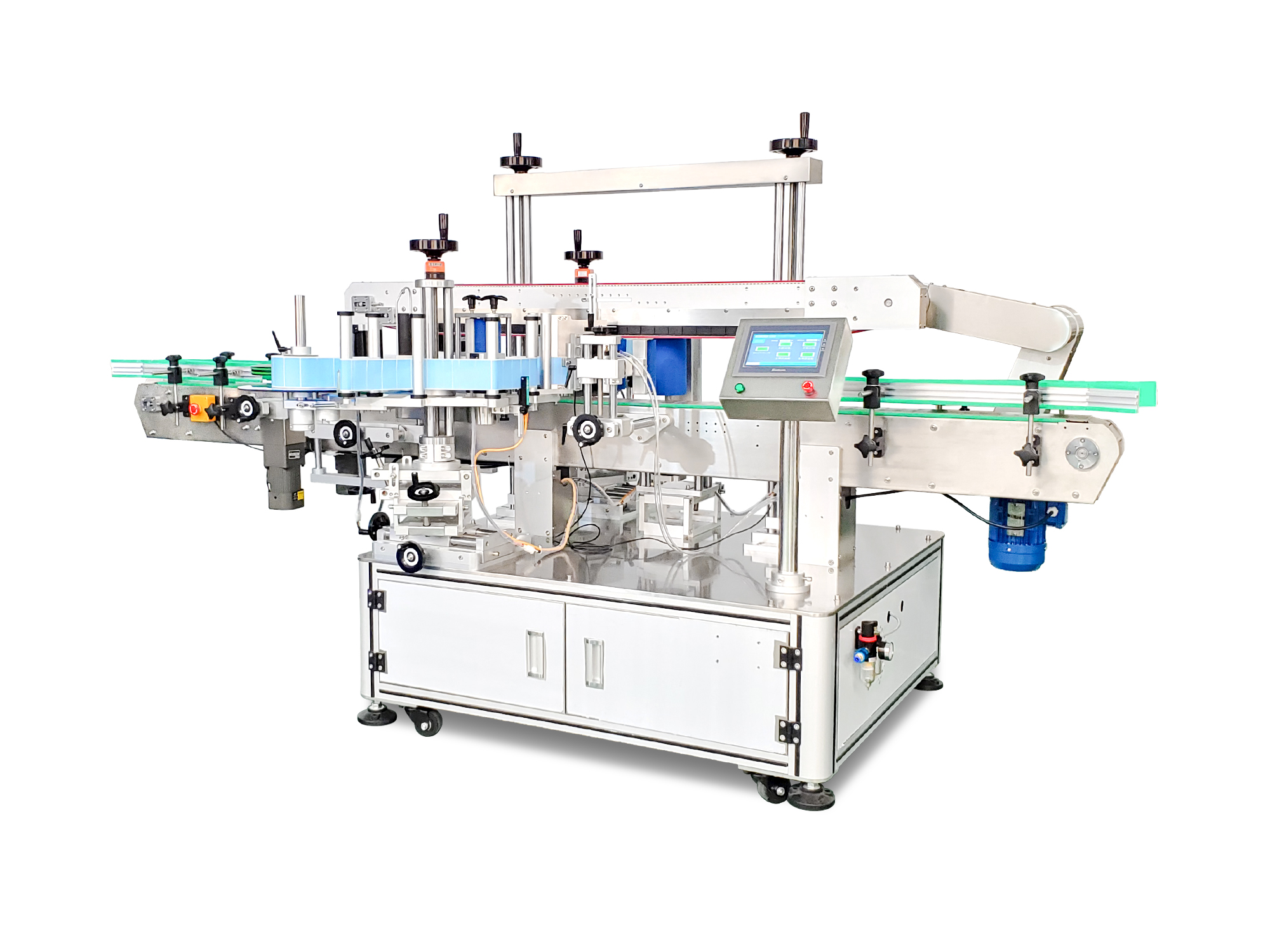
An automatic machine with two stations and one orientation reference holds front-to-back registration through the run. For spirits, a third station or a separate neck labeler may be needed, and the machine layout has to leave room for the closure seal. HiPaks builds these configurations to order, and the wine and beverage labeling page shows the current arrangements. Custom builds run 25 days or more; standard automatic configurations run 7 to 25 days depending on the station count.
Frequently asked questions
Can one machine apply front, back and neck labels?
Yes, with the right station count. A dual-station machine handles front and back from one orientation reference, and a neck station or a separate neck labeler handles the shoulder. Three labels on one machine need the bottle to keep its reference through every station, which is a layout decision rather than an option.
Why do neck labels wrinkle on wine bottles?
The neck is a cone, not a cylinder. A label applied across the cone has to compress at the top and stretch at the bottom. A mandrel matched to the shoulder angle, a shorter label and a more conformable face stock reduce the problem. A standard cylindrical setup will wrinkle on most shoulder profiles, whatever the operator does.
What alignment tolerance is realistic for front and back labels?
Automatic machines are quoted at ±1 mm excluding product and label tolerance, and the bottle and print add to that. A realistic total for a three-label wine bottle is a few millimeters, which is why the reference and the measurement method matter as much as the machine specification.
Do wine bottles need a different adhesive?
Often yes. Cellar humidity, ice buckets and condensation all attack a label edge. Paper labels usually need a wet-strength face and a damp-resistant adhesive, and film labels need an adhesive verified on cold, wet glass. Confirm against your storage and serving conditions rather than a generic datasheet.
If you are specifying a three-label bottle, send the full label set with the bottles and ask for a quotation that states the alignment reference, not just the machine tolerance.
You can Request a Free Test-Run Video to see front and back application on real bottles, and the bottle labeling machine range lists the station configurations and the format parts for each one.
