
A wrinkle on a tapered bottle is a speed difference, not an adhesive failure. The wide end of the label band travels faster than the narrow end, because circumference grows with diameter, so one edge of the label has to compress or lift as it wraps. Flagging at the trailing edge is the same problem at the end of the cycle. The fixes are mechanical before they are chemical: reduce the wrap angle, add a segmented or profiled belt that follows the taper, set the top hold-down to pivot, or move to a machine built for conical work. Changing adhesive is what buyers try first and what works last. HiPaks handles tapered work on the standard round range where the taper is mild, and on custom builds when the cone angle is steep enough to defeat a cylindrical wrap.
The arithmetic behind every taper wrinkle
Circumference equals pi times diameter, so a change in diameter becomes a change in path length. Take a bottle with a 3 mm difference between the top and bottom of a 50 mm label band. The circumference difference across that band is about 9.4 mm. Over the length of one wrap, one edge of the label must travel 9.4 mm further than the other edge, and the label cannot do that without deforming.
There are only three outcomes, and every tapered-bottle defect is one of them. The label stretches at the narrow edge and springs back later, which produces a lifted edge. The label compresses at the wide edge and has nowhere to go, which produces a wrinkle. Or the label bridges the gap between the two edges and stays flat but not in contact, which produces a bubble that collapses on the shelf a week later.
Increase the taper and the numbers grow linearly. A 6 mm difference across the same band doubles the mismatch to roughly 19 mm. That is no longer a setting problem. At that point the wrap belt is trying to drive two different surface speeds with one contact, and no amount of belt tension resolves it.
Wrinkle, flagging and fish-eye are three different faults
Buyers describe all three as wrinkles and then ask for one fix. They are distinct failures with distinct causes, and treating them as one is why the first three adjustments usually fail.
| Fault | What it looks like | Mechanism | First move |
|---|---|---|---|
| Wrinkle | Fine diagonal creases, usually on the narrow side of the band | Label compressed because the narrow end travelled a shorter path | Reduce the wrap angle or shorten the label |
| Flagging | Trailing edge standing proud, lifting when pressed | Label still under tension at the seam, or adhesive never loaded in shear | Extend the wrap belt contact and add a press-on brush or roller |
| Fish-eye | Circular bubble with the label still bonded around it | Air trapped during transfer, often from a label released faster than the surface moves | Match release rate to surface speed, then check plate angle |
| Edge lift | One long edge standing up after a day | Label applied over a curve it cannot follow, adhesive in peel rather than shear | Softer face material or a narrower label |
| Seam bulge | Overlap thicker than the rest of the label | Label length computed on the nominal diameter, not the band | Recompute length from the measured circumference at the overlap height |
Note that only one of those rows is solved by changing the label stock. The rest are geometry and timing, which is why a taper problem that is treated as a material problem tends to move around the bottle rather than disappear.
Measure the taper before you specify anything
Three caliper readings at the top, middle and bottom of the intended label band will tell you whether you have a taper problem, and how bad. Write the band height next to the readings, because the same 2 mm difference over a 20 mm band is a much steeper cone than over an 80 mm band.
Then check where the taper sits relative to the label. A bottle that is cylindrical over the label band and tapers above it is a normal round bottle job. A bottle that tapers through the band is a different project. Most tapered cosmetic bottles fall into a third category: cylindrical in the middle and curving into a shoulder at the top, so the top 8 mm of the label is trying to follow a curve that the bottom 40 mm never sees.
Photograph the bottle against a ruler with the intended label position marked in tape. That single photo settles more specification questions than a page of dimensions, because it shows the supplier exactly where the label edge will sit relative to the shoulder radius.
Four mechanical answers, in order of cost
1. Reduce the wrap angle. A full wrap forces the label to travel the whole circumference, so it accumulates the entire diameter mismatch. A partial wrap of 180 degrees accumulates half of it. If the design allows a front panel label rather than a full wrap, the taper problem can disappear without touching the machine. This is the cheapest fix and the one buyers overlook because the artwork was approved months earlier.
2. Shorten the label. Label length and taper interact directly. A label that covers 300 degrees has more opportunity to wrinkle than one that covers 200, on the same bottle. Where the label height is the problem rather than the length, reducing the height of the label band is the equivalent move: keep the label inside the cylindrical section and stop before the shoulder radius.
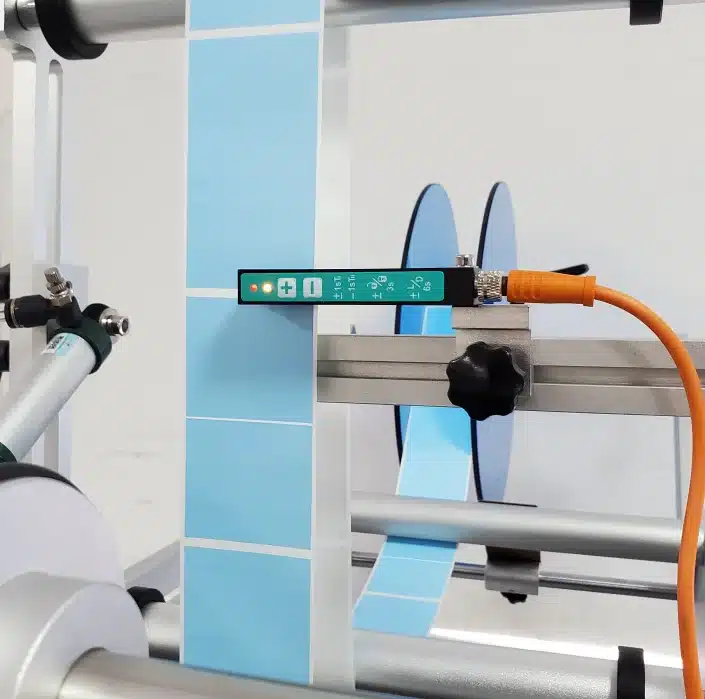
3. Change the belt contact. A single flat belt presses a cylinder evenly and a cone unevenly. Two options exist. A segmented belt with independent spring-loaded pads follows the taper and keeps contact across the width. A profiled roller, machined to the cone angle, does the same job from the other side. Both are mechanical parts rather than electronic settings, and both need the actual bottle to machine against.
4. Let the hold-down pivot. On a tapered bottle the top of the container is smaller than the base, so a fixed vertical hold-down either misses the top or crushes the shoulder. A pivoting or spring-loaded hold-down that follows the cone keeps the bottle centered without applying force where the wall is thinnest. On a conical bottle this is often the difference between a wrap that holds and one that walks sideways during the cycle.
For shallow cones, a combination of moves 1 and 4 is usually enough on a standard machine. For steep cones, the honest answer is a custom build, and the range of what can be adapted is described on the custom labeling machine page. The wider diagnostic set for non-round and awkward containers sits in the square bottle labeling troubleshooting guide, which covers the same physics from the flat-side angle.
Labels and adhesive: the part that comes last
Once the geometry is as good as it can be, the label stock decides the remaining defects. Three properties matter on a taper. Face caliper: a thinner film follows a curve with less stored energy, so it lifts less at the edges. Adhesive tack: a higher tack holds the leading edge before the wrap has finished loading the bond. Adhesive type: a rubber-based adhesive flows into a curved surface faster than an acrylic, at the cost of temperature and UV resistance.
What does not work is choosing a heavier adhesive to hold down a wrinkle. A wrinkle is a fold of material, not a bond failure, and stronger adhesive simply holds the fold in place more permanently. The order of operations matters: fix the mechanics, then the label, then the adhesive, and test after each change so you know which one worked.
Stiffness is also why the same label behaves differently at different diameters. A 60 micron film that wraps cleanly on a 60 mm bottle can flag on a 25 mm cone, because the bend radius has more than halved while the material stayed the same.
When the taper becomes a custom build
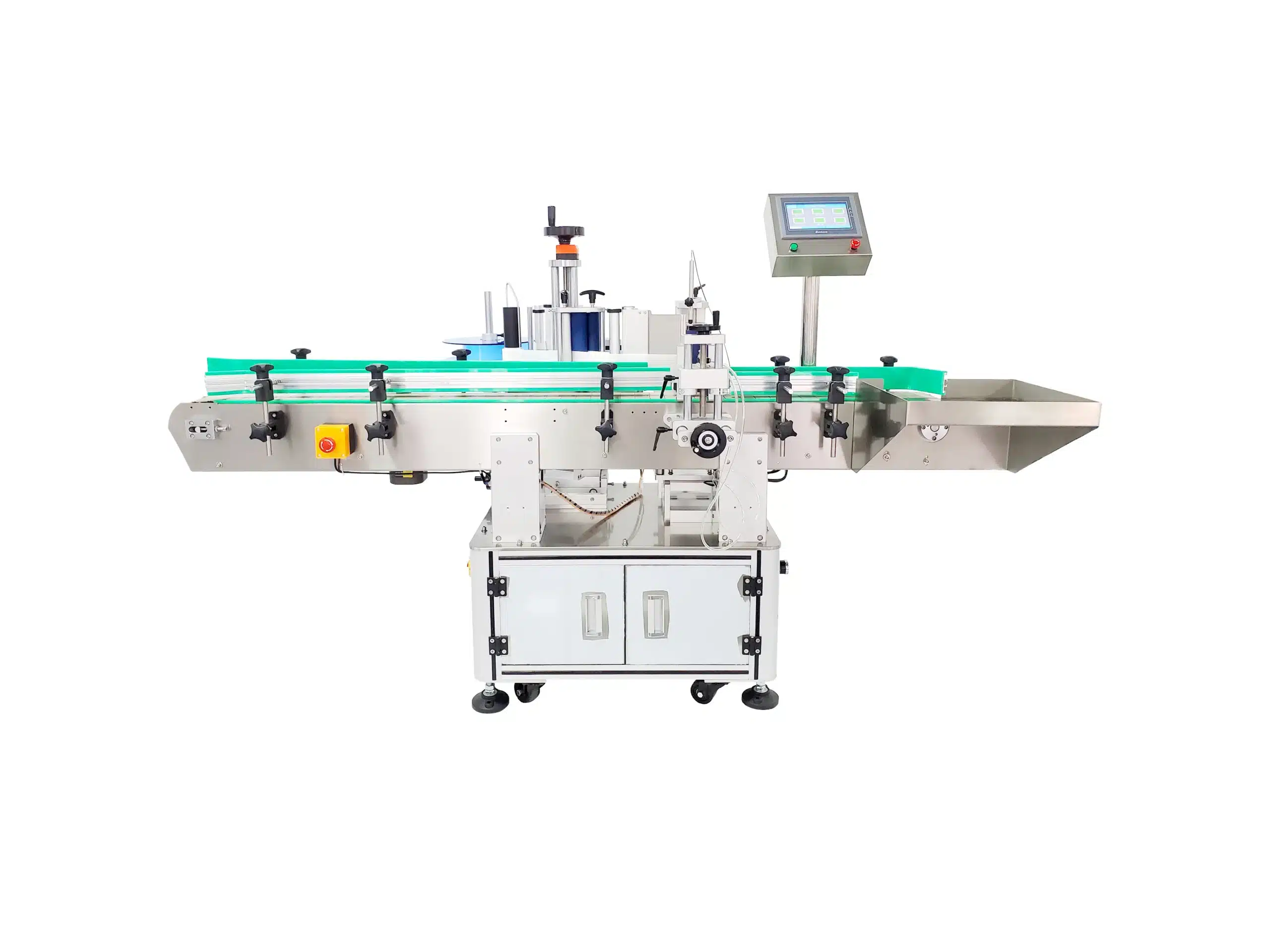
There is no universal taper threshold, and any supplier who quotes one without seeing the bottle is guessing. What can be said is what changes when the standard machine runs out of adjustment. A custom build typically adds a profiled roller or a segmented belt, a pivoting hold-down, a modified wrap plate and a different infeed guide, and it is quoted against a sample bottle rather than a drawing.
Custom work also changes the compliance picture. If a machine is modified to the point where it becomes a different machine, the technical file and the declaration of conformity have to follow. The European Commission sets out the manufacturer’s obligations, including the conformity assessment and the declaration of conformity, on its CE marking guidance for manufacturers. HiPaks states its position plainly: CE is in progress, not complete. For a custom build, ask at quotation which parts of the file are affected by the modification, because a hold-down change sounds small and is not always treated that way.
A trial protocol that settles the argument
Taper disputes are settled by bottles, not by email. Run the trial in this order and keep the results.
- Send six bottles from the same batch. Cut one open and measure the wall. Two go on the machine. Three stay as references for the shipment and for the second trial if the first fails.
- Send the real label roll. Not a printed sample on a different liner, and not a PDF. Liner and adhesive are half the variable.
- Ask for video of the wrap at production speed, in one continuous take. A cut video shows one good bottle. A continuous take shows the fourth bottle, where the problem usually appears.
- Inspect at the seam and at the shoulder. Lay the bottle on its side and look along the label edge. A lifted edge at the shoulder is a geometry problem. A lifted edge at the seam is a press-on problem.
- Leave the bottles for 24 hours, then inspect again. Adhesive that is still creeping will show up as edge lift the next morning, and that is the defect the customer sees on the shelf.
HiPaks runs this kind of pass on customer bottles and labels before shipment and sends the video back, which is why the six bottles and the real label roll are worth the courier cost. The rest of the round bottle cluster, including diameter and speed selection, sits under round bottle labeling guides, and the build side is on the manufacturer page.
Frequently asked questions
Why does my label wrinkle on one side of a tapered bottle?
The two edges of the label travel different distances because circumference changes with diameter. The narrow edge has less surface to cover, so the label has to compress there and folds instead. Measure the diameter at the top, middle and bottom of the band. If the readings differ by more than a fraction of a millimeter, the wrinkle is geometry rather than adhesive.
Can a standard round bottle machine label a conical bottle?
It depends on how much of the label band sits on the cone. A bottle that is cylindrical through the band and tapers above it runs on a standard machine. A bottle that tapers through the band needs a profiled roller, a segmented belt, a pivoting hold-down or a shorter label, and a steep cone usually needs a custom build quoted against a sample.
Will a stronger adhesive stop the label flagging?
Only if the flag is a genuine bond failure. On a taper, flagging comes from stored tension in the label as it comes around, and a stronger adhesive holds the lifted edge in place without removing the cause. Fix the wrap first, then the label stock, then the adhesive, and test after each change.
What should I send for a tapered bottle quotation?
Six bottles from one production batch, the real label roll with liner and adhesive noted, three caliper readings across the label band, and a photo of the bottle against a ruler with the intended label position marked. With those, the answer comes back as a trial result rather than an opinion.
Taper problems rarely survive a trial on the real bottle. If the wrap is failing now, send the bottle and the label and describe where the defect appears.
See tapered and shaped containers running in the test-run video library, read the dedicated tapered bottle labeling guide, or check the build options in the custom labeling machine range.
