

Tapered (Woozy) Bottle Labeling: Fixtures, Labels & Machines
The stronger version of the same geometry problem: three ways to win on conical faces.
Diagonal wrinkles, skewed front panels, corner bubbles: all three trace to geometry and pressure, not a broken machine.
Square and flat bottles fail in three repeating ways: diagonal wrinkles that climb toward a corner, front/back labels that sit at different heights, and bubbles trapped at the edges. The causes are mechanical, in order of likelihood: the applicator or pressure rollers are not square to the face; the label is taller than the bottle’s straight-wall zone; the two application heads are out of phase; or the label material is too stiff for the bottle’s curvature. Start with the diagnosis table below, run the seven on-machine checks, then escalate to fixtures or a dedicated double-side machine (~$9,000 class) only after the cheap fixes are exhausted.
Find your symptom in the left column. Work top to bottom within the row: fixes are ordered cheapest first.
| Symptom | Most likely cause | Fix |
|---|---|---|
| Diagonal wrinkles climbing toward one corner | Label spans a shoulder or taper: upper edge travels farther than lower edge | Shorten label to the straight-wall zone; add a centering fixture; see the deep-dive below |
| Front & back labels misaligned (different heights) | Dividing screw phase drift, or the two applicator heads are not set to the same datum height | Re-zero both heads against one master bottle; check the feed screw pitch against product pitch |
| Bubbles on one side only | Pressure roller uneven: one side presses harder than the other | Balance roller pressure left/right; check roller surface for wear or flat spots |
| Corner lifting / edge catch | Label wider than the flat face: corners wrap onto a radius | Reduce label width to the flat panel; or chamfer the label corners in the die-cut |
| Skewed label (rotated a few degrees) | Dispensing head not perpendicular to the face, or product guide rails loose | Square the head to the conveyor; re-set guides to just-touch the container |
| Transparent label misses / double-feeds | Photoelectric sensor cannot see clear film | Switch to an ultrasonic or special contrast sensor (e.g. SICK class); declare clear labels at inquiry |
| Label position shifts at higher speed | Conveyor belt speed out of sync with dispense rate | Re-sync belt speed to the label dispense timing; verify product pitch stability |
Diagonal wrinkles are the signature failure of shaped bottles, and they follow physics rather than bad luck. A pressure-sensitive label is a thin, nearly inextensible film. When it is pressed onto a surface where one edge must cover more distance than the other (a shoulder curve, a taper, a chamfer), the longer edge is asked to stretch. Film does not stretch; it buckles. The buckles appear as wrinkles running diagonally toward the corner where the excess length has nowhere to go.
This is why the problem gets worse as bottles get “sleeker”: more curve, less straight wall, more differential. It is also why turning a knob rarely fixes it. The excess length is a geometry problem, and geometry has three honest answers:
If your bottles are tapered rather than square, the same physics applies more strongly. The dedicated guide is tapered (woozy) bottle labeling.
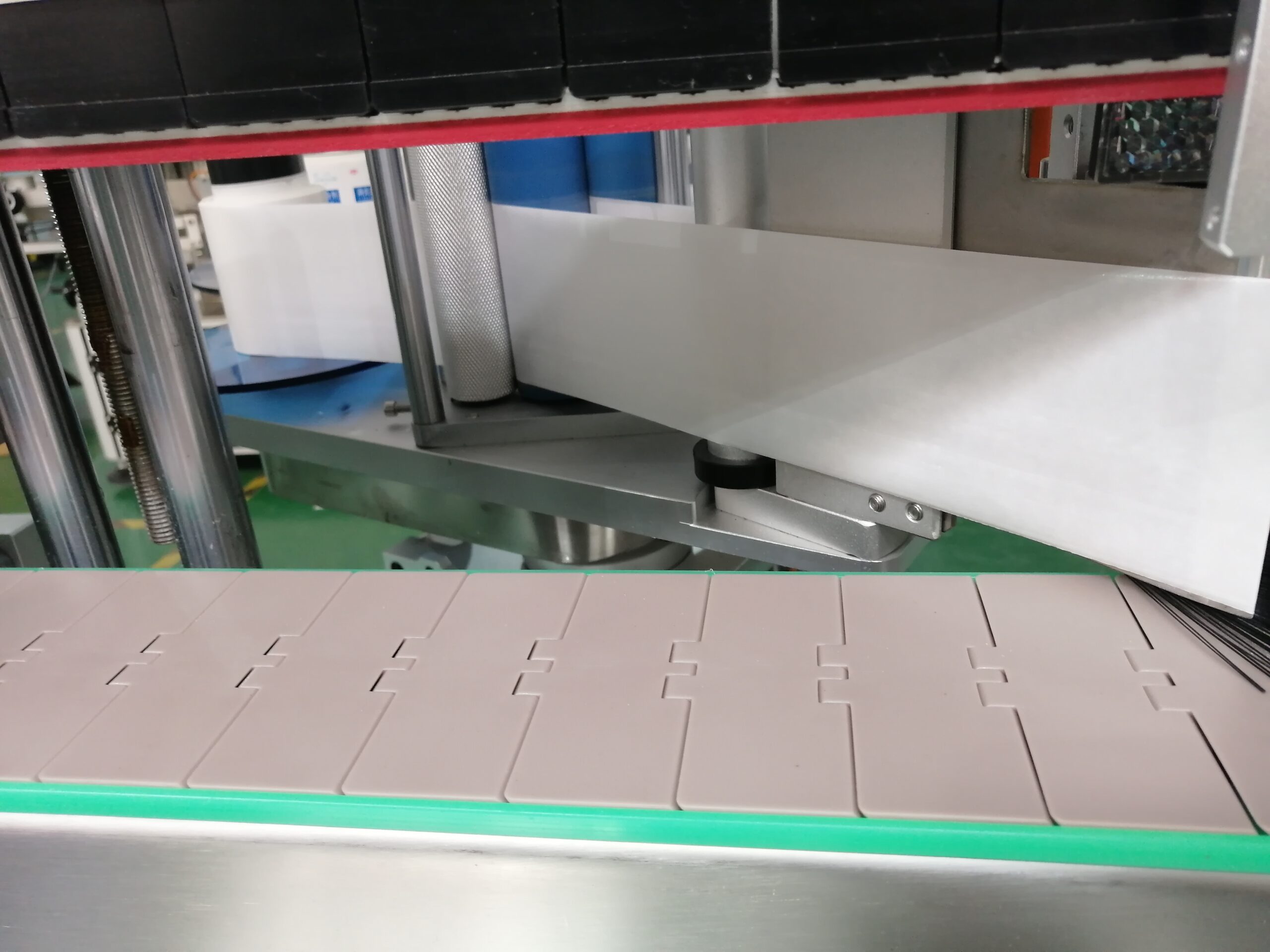
Run these in order; each takes minutes. Half of all “machine problems” end at check 3.
Place a bottle at the applicator and sight the dispensing head against the face. Even one or two degrees of yaw prints itself onto every label as skew. Loosen, square, retighten, and run ten bottles to confirm.
The feed screw must match the product pitch: the center-to-center spacing the rest of the line expects. A screw cut for a wider bottle feeds the next bottle early or late, and the misalignment shows up downstream as height offset between front and back labels.
The conveyor speed and the label dispense rate are a ratio, not two independent settings. If labels land correctly at low speed and drift at high speed, sync is the suspect, not the sensor.
Guides should just-touch the container. Too loose and bottles wobble into the applicator at random attitudes; too tight and they scrub, adding rotation. Check both sides, along the full length of the application zone.
The label sensor must see the gap between labels at the exact moment the dispense expects it. After any web or label change, re-teach the sensor. A drifted sensor produces early or late peels that look like machine skew.
Too loose and the web sags, laying labels down at an angle; too tight and the liner stretches, changing label spacing. Set tension so the web runs flat without humming, then lock the brake.
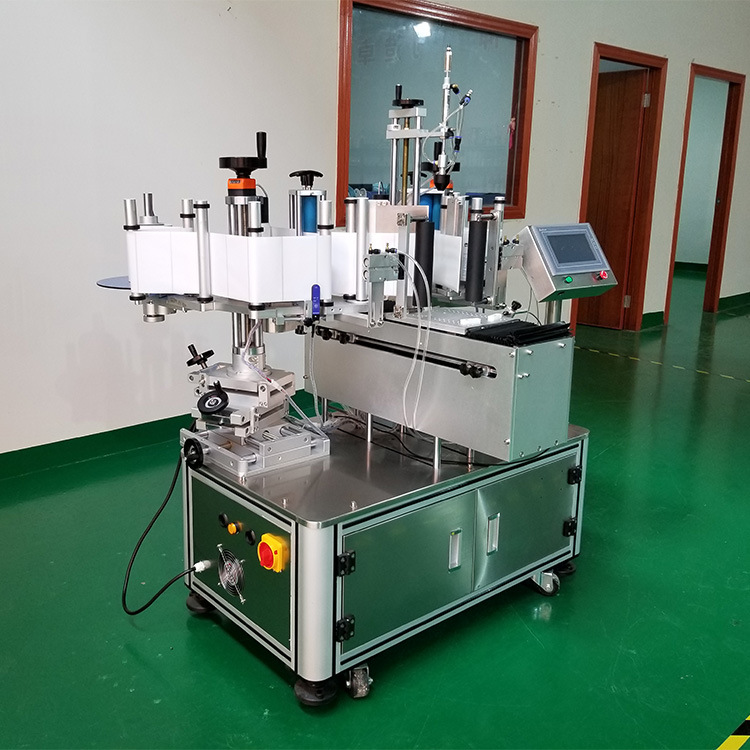
Press down evenly across the full label width. One-sided pressure is the classic cause of single-side bubbles. If the roller surface is glazed or cut, replace it. Pressure adjustments cannot compensate for a worn roller. The parts and their names are in the parts diagram.
Some failures arrive in the mail as a roll of labels. Three design rules prevent most of them:
Label suppliers can test-apply by hand; we test-apply on the actual machine and film it. That combination catches design issues before they become production issues.
If the checklist and the label redesign are exhausted and the defect persists, the container needs engineered help:
The same square bottle and label, run without a fixture and then with one: both clips filed with the machine’s FAT documentation. See the test-run video library and the FAT process.
Two clips: a square bottle labeled on all four faces, a flat bottle getting front and back in one pass.
Because the label extends beyond the flat panel onto a radius, or the application pressure is uneven. Corners are where excess film collects: shorten the label to the straight-wall zone, chamfer the die-cut corners, and balance the pressure rollers. If the bottle itself is tapered or curvy, a centering fixture is usually required (see the diagnosis table above).
Re-zero both applicator heads against one master bottle, check the dividing screw pitch against the product pitch, and confirm the sensor timing after any label change. If alignment still drifts at speed, the two heads are fighting each other. A paired-head double-side machine on a common datum is the structural fix. Compare machines on the double-side page.
Yes, a standard photoelectric sensor beams straight through transparent film and sees nothing. Ultrasonic or special contrast sensors detect the film-to-liner boundary reliably, but only if we know at inquiry stage. Declare clear labels when you request a quote and we prove the sensor on your material in the test video.
Start with adjustments: the seven checks above plus a label design review solve most cases. If defects persist across all bottles, the container needs a fixture, and if it needs front and back labels at line speed, a dedicated double-side platform (semi-automatic MT-860 from ~$2,200, automatic T962 class ~$9,000) is the right tool. Prices are market references: confirm before publish.
Keep the label inside the flat panel with a margin, match a flexible face stock to soft bottles, chamfer corners on full-panel labels, and confirm the liner width suits the machine. Then verify on the real machine: our free test-run video uses your exact label stock so any design issue surfaces before production, not after.
The stronger version of the same geometry problem: three ways to win on conical faces.

Buying a new machine to fix the problem? Check which certification your market needs before the purchase order.