
Below about 30 mm diameter, a round container stops behaving like a small bottle and starts behaving like a small cylinder with a stiff label attached. A 10 mm vial has a circumference near 31 mm, so a 20 mm label wraps more than 200 degrees and has almost no slack to absorb a positioning error. That changes the handling method, the label specification and the accuracy you can inspect. HiPaks quotes a 10 to 30 mm (Φ10-30) envelope for vials, ampoules, pen barrels and small droppers, and in most cases the reliable answer is horizontal handling: the container lies on its side, supported along its length, and rotates against a drive belt while the label is applied. Everything else follows from that decision.
Why 10 mm is not a scaled-down 40 mm
Geometry does the damage. Circumference scales with diameter, so a 10 mm vial has 31 mm of surface to carry a label, while a 40 mm bottle has 126 mm. A label that looks modest on the bottle, 25 mm long, covers 80 percent of the vial and about 20 percent of the bottle. On the vial it is a near full wrap; on the bottle it is a front panel. The same label, the same adhesive and two completely different application problems.
Curvature scales the other way. The label has to bend around a radius of 5 mm instead of 20 mm, which means the face material is being asked to do five times the bending for the same arc. Paper labels crack or lift at the edges. Film labels manage the bend but tend to curl before they touch the container, because there is so little label length to hold them straight off the peel plate.
Then there is the ratio between the label and the part. At 10 mm diameter, a 1 mm position error is 10 percent of the diameter, which is visible to anyone holding the vial. On a 70 mm bottle the same 1 mm error is under 1.5 percent and reads as normal production variation. This is why the accuracy conversation changes at small diameters even when the quoted tolerance does not.
The 10 to 30 mm envelope, container by container
The envelope is one range, but the containers inside it are not interchangeable. The table below describes how each family usually behaves. The diameters are typical for the container type rather than a machine limit, and every job is confirmed against a real sample.
| Container | Typical body diameter | What decides the handling | Main risk |
|---|---|---|---|
| Glass or plastic vial | 10 to 22 mm | Whether the body is cylindrical or has a shoulder and neck | Label riding onto the shoulder curve and lifting |
| Ampoule | Bottom of the envelope | Thin glass, tapered body, no flat base to stand on | Grip pressure cracking the body, or the part tipping |
| Pen barrel | 10 to 16 mm | Long length relative to diameter, plus a clip or window | Barrel flexing between supports and the label skewing |
| Dropper or roll-on | 16 to 26 mm | Short body, often with a cap that stays on | Label height colliding with the cap during wrap |
| Small cosmetic tube | 20 to 30 mm | Soft wall that deforms under a belt | Oval cross section after wrapping, label lifting at the seam |
Two of those rows are worth planning around. An ampoule has no flat base and cannot be stood on a conveyor without a carrier, so a vertical machine needs a puck or a nest for every part. A pen barrel is long and thin, and if it is supported only at two points it will flex in the middle, which shows up as a label that is square at the leading edge and low at the trailing edge.
Horizontal handling, and why it usually wins
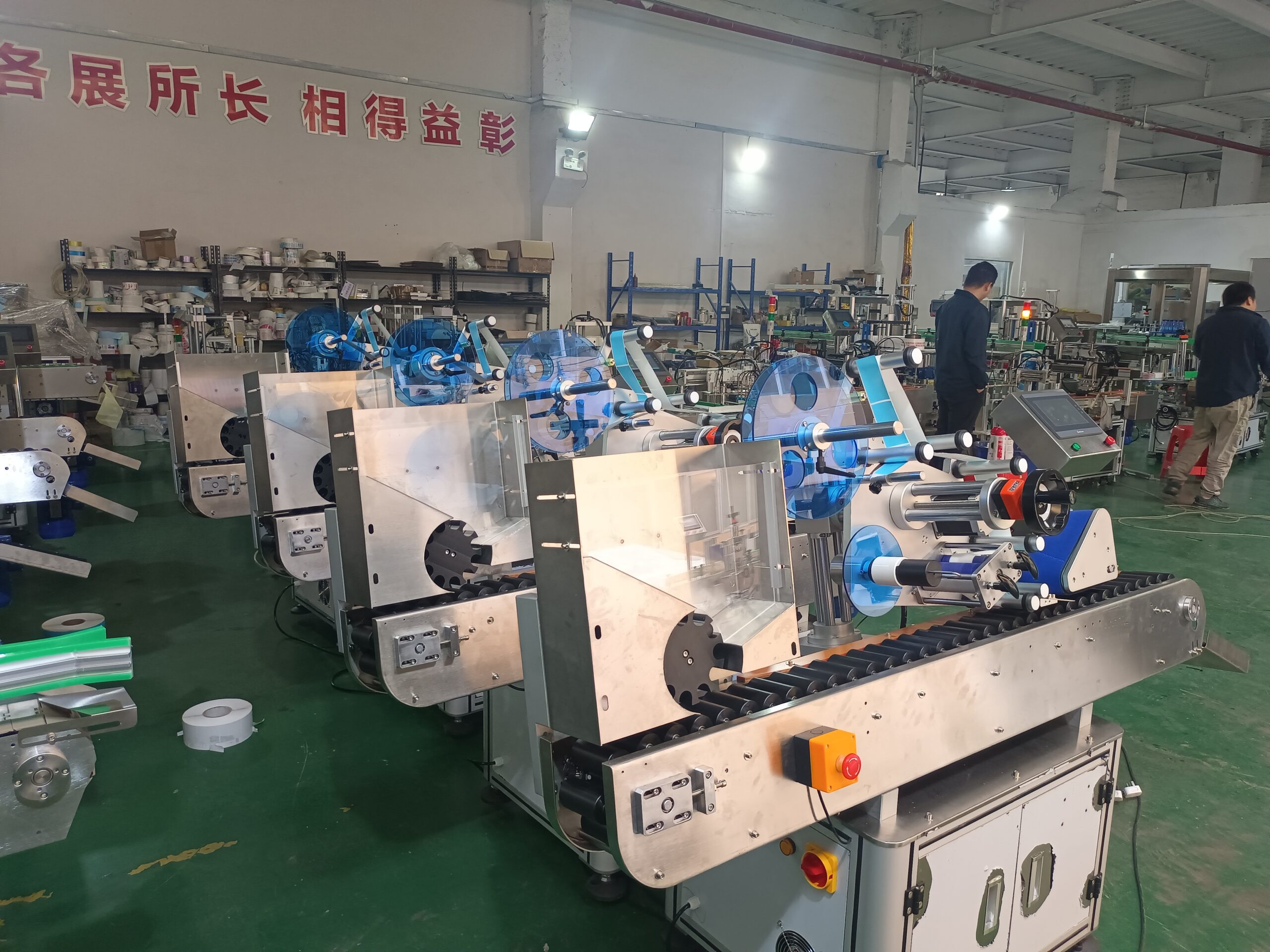
On a horizontal machine the container lies in a channel or on a pair of rollers, is driven along its axis, and rotates against a belt from above. The advantage is support: the whole length of the container is backed up, so a thin wall cannot collapse and a long barrel cannot flex. The label is applied to the top of a rotating cylinder, which is a stable geometry even at 10 mm.
The trade is that the container has to be fed in a defined orientation. Vials and pens arrive from a hopper or a unscrambler, not from a conveyor of standing bottles, and the feeder is part of the project rather than an accessory. That is why small-part labeling is usually quoted as a line section: feeder, orientation, wrap, and outfeed, with the labeling head as one component.
Vertical handling is still the right answer when the container stands reliably, when the cap is on and the body is stiff, and when the batch is small enough that an operator loads each part. The test is simple: stand ten containers on a table and push each one gently with a finger. If any of them tips or dents, a vertical wrap station will do the same at speed. HiPaks builds both configurations, and the choice is confirmed against your container rather than assumed from the diameter.
Labels and liners at small size
Small labels fail for reasons that large labels never show. The first is the liner. A thin liner that behaves on a 90 mm label can curl at the peel plate on a 20 mm label, because there is less label mass to hold the web flat. The second is the gap between labels. On a narrow web the gap is short, so the sensor sees less contrast per cycle and clear-on-clear stock becomes genuinely difficult.
The third is adhesive. A small label has a small bond area, and the same adhesive that holds a 60 by 40 mm label will let a 20 by 8 mm label lift at the seam on a curved surface. The usual answer is a higher tack adhesive or a thinner face material that follows the curve, and both are decided by testing rather than by reading a data sheet.
Ask for a trial with the actual label stock, not a generic sample. HiPaks runs a labeling pass on customer containers and labels before shipment and sends the video back, which is the only practical way to see whether a 20 mm label will sit flat on a 12 mm vial at production speed.
What accuracy means on a 10 mm part
Automatic machines are quoted at plus or minus 1 mm and semi-automatic machines at plus or minus 0.5 mm, both excluding deviation caused by the product and the label itself. On a 70 mm bottle that is a comfortable specification. On a 10 mm vial it is a tenth of the diameter, and the first question a quality manager asks is where the measurement is taken.
Answer that question before the order. A tolerance measured at the label edge on a stationary vial with a vision system is a different claim from a tolerance measured by eye at the end of a production run. If the label has to sit within a window printed on the container, the window becomes the datum and the machine has to be set up against it. If the label only has to look centered, the datum is the seam and the tolerance is looser in practice than on paper.
Only the MT-807 is quoted up to plus or minus 0.2 mm, and that figure belongs to flat high-precision work rather than to small round containers. Quoting a flat-machine tolerance on a curved 10 mm part is the kind of specification that reads well in a proposal and fails in validation.
Changeover, batch size and the economics of small parts
Small-part lines usually run many SKUs in short batches, because the fill volumes are small. That makes changeover the dominant cost rather than throughput. A machine that labels 300 parts a minute but needs forty minutes between SKUs is worse than one that labels 120 and changes over in five, if you run ten SKUs a week.
Ask for the changeover parts list with prices and the changeover time in minutes, then multiply by your real SKU count. On small containers the parts that change are usually the channel width, the drive belt height, the wrap plate and the label sensor position. Those are simple parts, and they should be priced as simple parts rather than discovered later as a custom kit.
For batching, the practical unit is the tray or the nest, not the individual part. A line that handles 50 vials per tray changes over per tray, and the labeling head sees a continuous stream. That framing also makes the output number meaningful: parts per hour including loading, rather than parts per minute on the head.
Documentation a pharmaceutical buyer will ask for
If the containers are pharmaceutical, the labeling step sits inside a quality system rather than beside it. The US requirements for methods, facilities and controls in drug manufacturing and packing are summarized in the FDA pages on current good manufacturing practice regulations, including 21 CFR Part 211 for finished pharmaceuticals. A labeling machine is equipment inside that system, so the questions that follow are about documentation rather than about speed.
Expect to be asked for the equipment manual, the parts list, the material certificates for product contact surfaces, the calibration record for any sensor used in a inspection step, and a change control procedure for software settings. HiPaks supplies a manual and a parts list with each machine, includes one year on the whole machine plus lifetime technical support with wear parts excluded, and states plainly that ISO 9001 and CE are in progress rather than complete. A supplier who says the certificate is issued when it is not has just failed the first audit question, and the rest of the documentation becomes suspect.
For the wider context on this segment, see the pharmaceutical labeling section and the automatic range under automatic labeling machines.

Frequently asked questions
Can a standard round bottle labeler handle 10 mm vials?
Usually not well. A standard machine is built around a 20 to 80 mm envelope, with belt gaps, wrap plates and hold-downs sized for that range. A 10 mm vial needs a smaller wrap radius, lower grip pressure and, in most cases, horizontal handling with the container supported along its length. HiPaks quotes a separate 10 to 30 mm envelope for this work.
Why is horizontal handling preferred for ampoules?
An ampoule has no flat base and a tapered body, so standing it on a conveyor requires a puck or nest for every part, and the thin glass is easy to crack with a hold-down. Lying on its side, the ampoule is supported along its length and rotated against a belt, so the grip force is spread over a larger area and the part cannot tip.
What label material works on very small containers?
A thin film face with a higher tack adhesive is the usual starting point, because the label has to follow a tight radius and has a small bond area. Paper labels tend to lift at the edges on a 10 mm body. The final choice is settled by a trial on the actual container and the actual label stock, not by a data sheet.
What tolerance should I expect on a 10 mm vial?
Automatic machines are quoted at plus or minus 1 mm and semi-automatic machines at plus or minus 0.5 mm, excluding product and label deviation. On a 10 mm part that is a large fraction of the diameter, so agree the measurement point at quotation. If the label must land inside a printed window, the window is the datum.
If the container is under 30 mm and the current machine is fighting it, send the container, the label roll and a photo of the failed label. The answer is usually a handling change rather than a new head.
Watch small containers run in the test-run video library, compare the vertical and horizontal builds in the bottle labeling machine range, or read the assembly detail on the round bottle labeling machine manufacturer page. Spare and wear parts for small-part lines are listed under labeling machine parts, and the rest of this cluster sits under round bottle labeling guides.
