
Clear labels on round cosmetic bottles fail for four reasons that have nothing to do with machine quality: a photoelectric sensor that cannot see transparent film, a label taller than the bottle’s straight wall, roller pressure that deforms a light container, and a fixture that lets the seam drift on a tapered face. Each has a mechanical answer. An ultrasonic sensor reads label thickness instead of light interruption, so clear-on-clear registers like paper. A label kept inside the straight zone wraps without bridging. Pressure set against the container weight rather than the maximum the roller allows keeps a 30 ml bottle round. A machined jig presents every bottle at the same angle. Get those four right and a machine at ±0.5mm produces retail-grade cosmetics; get any one wrong and the same machine produces wrinkles that look like a machine fault.
The four failures that get blamed on the machine
1. Clear film on a clear bottle: the sensor never sees the label
A standard photoelectric sensor detects a label by the interruption it creates as the web passes the beam. Clear film on a clear liner creates no interruption, because light passes through both. The sensor therefore either feeds blind, spacing labels by time rather than by detection, or double-feeds when the gap is misread. Both faults look random, and both are blamed on the applicator.
Ultrasonic sensing changes the measurement: the sensor reads the physical thickness of label against liner instead of the optical difference. Clear film then registers exactly like paper, cycle after cycle. On this platform, transparent-label detection is a build-time decision rather than a setting, and the roller platform fitted with special SICK sensors is the configuration specified for it. Declare clear-on-clear at inquiry. Discovering it after delivery means a retrofit.
2. A label taller than the straight wall
Cosmetic glass often has a short cylindrical section and then a shoulder that curves toward the neck. A label that crosses into that curve has to stretch to stay flat, and film does not stretch. It wrinkles at the top edge, lifts at the seam, or climbs. The fix is not more roller pressure; it is honest measurement of the straight zone before the artwork is approved. If the design needs the height, the label belongs on a different part of the bottle, or the bottle belongs on a different project.
This is the same geometry that makes wine bottles difficult, and the decision tree for straight-zone labels, angled application and full-wrap jigs is set out in the tapered bottle labeling guide. Cosmetic dropper bottles are the small-format version of the problem: the shoulder starts higher up the bottle than most designers assume.
3. Roller pressure against a light bottle
A 30 ml serum bottle weighs very little, and glossy PET or glass gives a roller nothing to grip. The instinct is to increase pressure until the label stops slipping. That deforms the container instead of smoothing the label, and a bottle that is slightly oval by the time it leaves the roller shows a seam that wanders by a millimeter or two across a run. The correct setup is pressure matched to container weight and wall stiffness, grip surfaces that bite without marking, and a speed ramp that accelerates the bottle into the wrap instead of shocking it. All three are calibrated during the test run, on your bottle, and filmed.
4. Seam drift on tapered and oval faces
Curved and tapered faces change circumference under the label. Without a fixture, each bottle presents to the applicator at a slightly different angle, and the seam moves. Operators compensate by hand, which works for a photoshoot and fails at case level. An engineered jig presents every bottle at the same angle, and for a private-label range the jig is worth more than a faster machine because it removes the operator variable from the quality report.
What the label must carry before you size it
Cosmetic labels are dense documents. In the European Union, Regulation (EC) No 1223/2009 sets out what a cosmetic product label must show, including the nominal content, a date of minimum durability or a period after opening, the batch number, and the ingredient list in INCI nomenclature, alongside the responsible person’s details. The full requirements are in the Cosmetic Products Regulation.
Two consequences follow for labeling. First, a small bottle with a long ingredient list needs a label area that can hold it at a legible type size, and legibility is a design constraint, not a print preference. Second, the batch code has to be applied somewhere, either printed on the label or stamped on the bottle, and if it is printed on the label the artwork grows again. Measure the final label, including the batch field, before choosing a platform. A 30 mm label that has to become 40 mm changes which machine is appropriate.
Matching the platform to the cosmetic format
Round cosmetic containers span an awkward range: 10 mm nail polish caps at one end and 100 mm shampoo bottles at the other. The platform follows the diameter and the volume, not the product category.
| Format | Typical container | Platform fit | Placement |
|---|---|---|---|
| Nail polish, small glass | 10 to 30 mm diameter, short | Benchtop high-precision head, or horizontal small-bottle platform at higher volume | Up to ±0.2mm on the precision tier |
| Serum, dropper, essential oil | 20 to 40 mm, slim with a shoulder | Benchtop wrap with a dedicated jig | ±0.5mm |
| Shampoo, lotion, 100 to 400 ml | 40 to 80 mm, often oval or tapered | Semi-automatic wrap, or inline automatic above 20,000 units a month | ±0.5mm semi, ±1mm automatic |
| Airless pump, clear on clear | 30 to 50 mm, transparent | Any round platform with ultrasonic label sensing | ±0.5mm, sensor class declared at order |
The precision tier matters more in cosmetics than in beverage because the label is a small fraction of the container. On a 25 mm bottle the whole circumference is about 78 mm, so a 1 mm placement error is a visible line in a product photograph, not a tolerance. The MT-807 high-precision platform is specified up to ±0.2mm and exists for exactly this geometry, at a price above the standard benchtop class because the fixture and the sensor are the cost, not the frame.
Semi-automatic or automatic for cosmetics
The honest split is volume and SKU count. A brand running four SKUs in batches of 2,000 to 5,000 units a few times a year does not need an automatic machine, and an automatic machine would slow it down, because changeover between four formats costs more time than the labeling itself. A brand shipping one serum in continuous production above 20,000 units a month is the opposite case: the operator becomes the constraint and an inline system at 40 to 120 pcs/min earns its floor space.
There is a middle case that gets overlooked. A semi-automatic floor unit with a short conveyor lets one operator label without turning around for every bottle, and it costs a fraction of automation. For a brand with three SKUs and steady weekly output, that configuration usually beats both ends of the range.
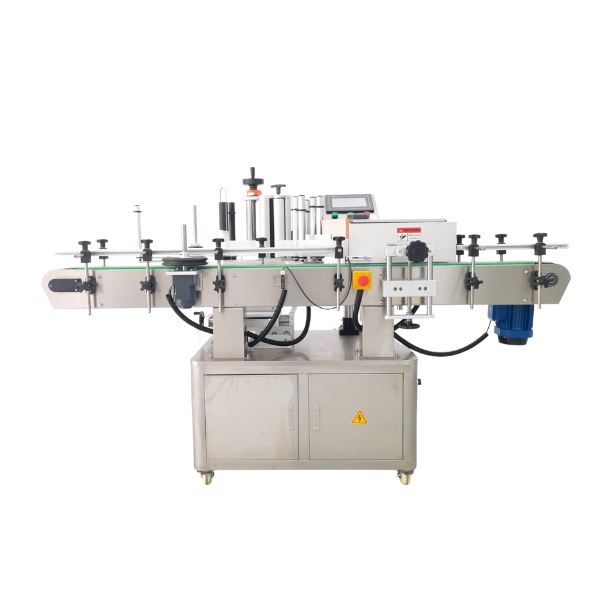
The round bottle labeling machine manufacturer page sets out the full speed ladder from 15 pcs/min on a desktop unit to 10,000 to 15,000 bph on rotary systems, and the round bottle labeling guides cover diameter, height and speed selection in more detail.
A test protocol you can run in one afternoon
Most cosmetic labeling disputes would disappear if the trial used production bottles instead of empty samples. Empty glass and filled glass behave differently under a roller, and a bottle that is warm from the filling room behaves differently again. Run the trial this way:
- Send bottles from the production batch, filled to the normal level, with the cap fitted, packed the way they will travel.
- Send the actual label roll, not a printed sheet, because liner stiffness and die-cut quality change how the label releases.
- Label twenty bottles and keep the first, the tenth and the twentieth. The drift across twenty bottles is the number that predicts a production run.
- Check three things on each bottle: seam position relative to a reference point, wrinkle at the top edge, and label height from the base.
- Repeat with the clear stock if the design uses transparent film, because a paper trial proves nothing about sensing.
HiPaks films this trial on the customer’s own containers and sends the video for approval before shipment, and the footage is archived with the machine record. For a cosmetics brand, that recording is also the evidence a retailer or a contract manufacturer asks for when they audit placement consistency. Existing examples are in the labeling test video library.
What to send with a quotation request
Five items shorten a cosmetic quotation from a week of email to a single reply: bottle diameter and height at the label band, bottle weight, the label dimensions and material, the required output per shift, and a photograph of the bottle with the intended label position marked. Add the market you sell into, because the mandatory content differs between the EU, the US and the Gulf, and the label area follows the content.
The cosmetic and personal care labeling page collects the formats this platform is tested on, from lip balm tubes to airless pumps, and it is the fastest way to see whether your bottle has a precedent. If it does not, the answer is a jig, and a jig is a normal part of the order rather than a special project.
Frequently asked questions
Can a standard labeler apply clear labels to clear bottles?
Only with the right sensor. A photoelectric sensor cannot detect transparent film on a transparent liner, so the machine feeds without confirmation. An ultrasonic sensor reads label thickness and detects clear film reliably. Specify clear-on-clear at the quotation stage, because the sensor is fitted during build.
Why does the label wrinkle at the top on a round cosmetic bottle?
Usually because the label crosses into the shoulder curve, where the circumference shrinks. Film cannot compress, so it wrinkles or lifts. Measure the straight wall and keep the label inside it, or move the label to a position where the surface is cylindrical.
Is a semi-automatic machine accurate enough for premium cosmetics?
Yes. Semi-automatic platforms hold ±0.5mm, and the precision tier reaches up to ±0.2mm, which is tighter than most cosmetic artwork requires. The variable that matters more is fixture quality: a good jig on a ±0.5mm machine beats a poor fixture on a more expensive one.
How do I stop a light bottle from deforming under the roller?
Set roller pressure against the container weight and wall stiffness rather than at the maximum, use grip surfaces that do not mark glossy PET, and ramp the speed instead of starting the wrap abruptly. These are calibrated on your bottle during the test run and recorded for repeat orders.
