
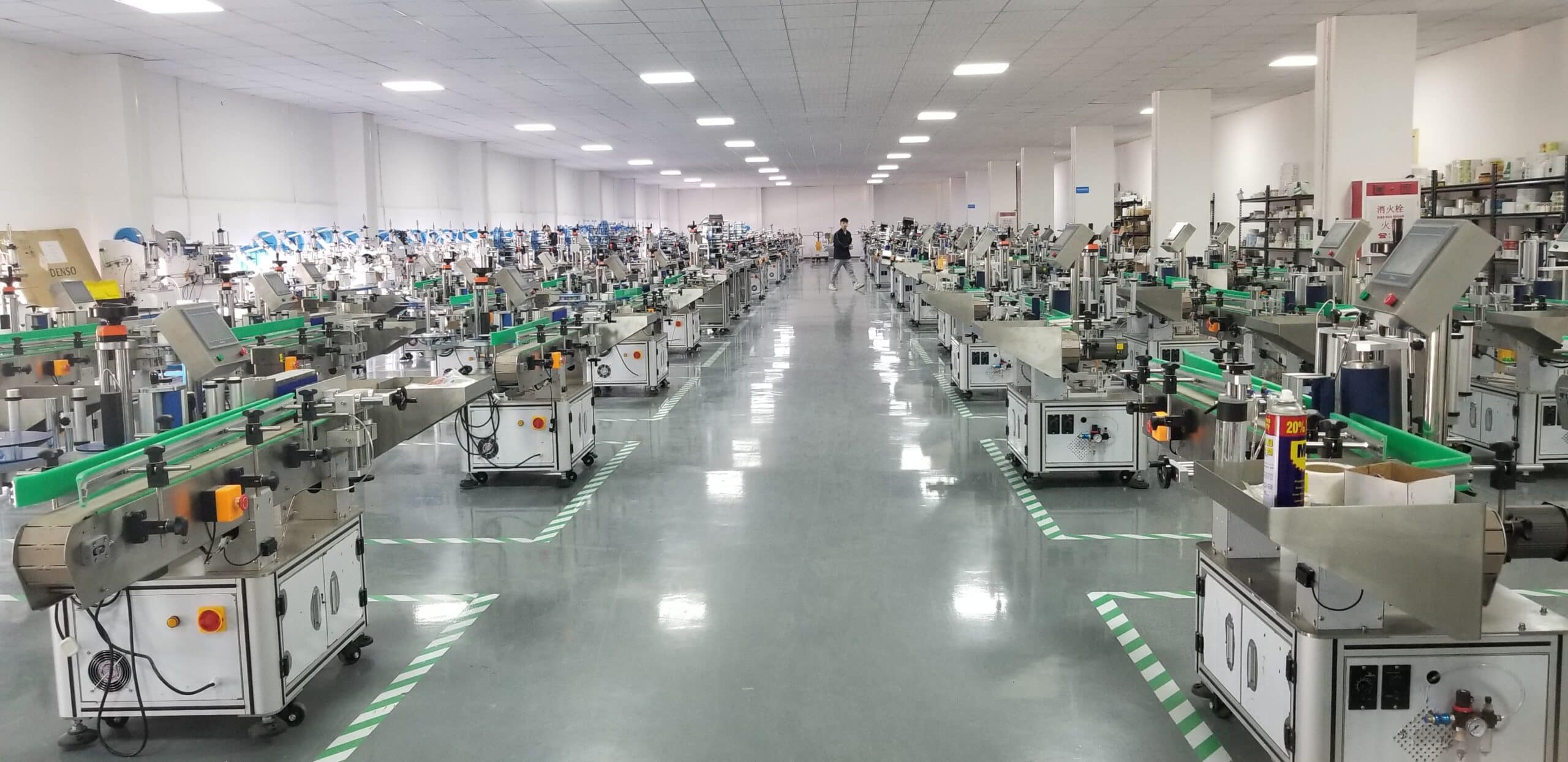
A 2026 sourcing round in China will bring you ten kinds of supplier, and they are not interchangeable. The profiles below are sorted by how much of the machine the supplier actually controls: its own machining, its own assembly, its own acceptance test station, and its own engineers on the phone after the crate is opened. A factory that machines its own jigs and runs your bottles before shipping is a different risk from an office that forwards your drawing to a subcontractor. The list is written by a manufacturer, HiPaks in Kunshan, and our own plant appears openly at number ten so you can test the criteria against a known case.
How this shortlist was built
No public registry counts Chinese labeling machine factories, and any list that claims to rank them by revenue is guessing. So this shortlist uses five filters that a buyer can verify in a single afternoon, whatever the supplier claims on its homepage.
| Filter | What you ask for | Passing answer | Failing answer |
|---|---|---|---|
| Ownership of assembly | Photos or video of your model being assembled, with the serial plate visible | Bench, wiring, and frame visible in one continuous clip | Stock renders and catalog PDFs only |
| Machining capability | Who cuts the jig that holds your bottle | In-house workshop, drawings archived for repeat orders | “We cooperate with a partner factory” |
| Spec discipline | A spec sheet with speed, accuracy, and container range in numbers | Numbers that match the quotation and the nameplate | Adjectives, no figures, or figures that move between emails |
| Pre-shipment test | Your bottles and your labels run on the machine before crating | Video of the run, defects shown as well as good output | “Every machine is tested” with no evidence |
| Component provenance | Brand and origin of sensor, PLC, power supply, and stepper | Named brands you can buy spares for locally | “International brand” with no name |
A supplier can pass four of these five and still fail the fifth, which is why the profiles below are separated by what they build rather than by size. The same five filters are the backbone of our 10-point factory acceptance test, and they work just as well when you apply them to a competitor.
The ten manufacturer profiles
1. The desktop semi-automatic specialist
Builds tabletop and floor-standing units for round bottles and flat surfaces, typically 15 to 30 pcs/min at plus or minus 0.5mm, priced from $600 to $4,500. This is where most first machines come from and where most disappointment starts, because “semi-automatic” covers everything from a hand-fed roller to a motorized wrap-around unit with a PLC. Ask for the cycle time with your bottle diameter, not the catalog number.
2. The flat and carton applicator house
Focuses on top, side, and corner labeling of cartons, pouches, and flat cartons. The tell is whether the applicator head is a catalog module bolted to a bought-in conveyor, or a head designed around your product height and line speed. Heads in this class are often sold separately, which is useful if you already own the conveyor.
3. The print and apply integrator
Assembles thermal transfer print engines into an applicator so the label carries a batch number, date code, or barcode printed at line rate. The machine is only as good as the engine and the data link, so ask which print engine, which protocol, and what happens when the database goes down. Pricing lands in the same $6,000 to $15,000 band as a standard automatic, and the print engine is the variable.
4. The double-side and square bottle builder
Specializes in front and back labels on square, flat, and oval containers, with paired press plates that hold the bottle steady while two labels land. Expect roughly $9,000 and 60 to 120 pcs/min. The engineering difficulty is not the label head, it is keeping a square bottle from rotating between the two heads, which is why tooling quality decides the outcome.
5. The rotary hot melt house
Builds carousel machines with 12 or 16 stations, cutting and gluing OPP labels at 10,000 to 15,000 BPH on the 12-station frame and 10,000 to 12,000 BPH on the 16-station frame, from $25,000. Very few Chinese plants machine a rotary carousel in-house, so this profile is short and the factory visit matters more here than anywhere else on the list.
6. The wet glue traditionalist
Still builds cold glue labelers for cut-and-stack paper labels, mostly for beer and beverage lines that were specified around paper. Cheap labels, slower changeover, and a skill set that is disappearing. If your line already runs wet glue and your label supply is stable, this profile is rational. If you are starting fresh, compare total label cost before you commit.
7. The pharmaceutical micro-container specialist
Labels vials, ampoules, and pens from about 10mm to 30mm in diameter, usually horizontally so the container cannot tip. Accuracy of plus or minus 1mm is normal for automatic machines and is measured without container or label error. The differentiator is the fixture and the vision option, not the frame.
8. The custom jig engineer
Takes the containers that catalogs refuse: tapered, conical, soft, handle-bearing, or wire and cable. The machine is often a standard frame plus a one-off fixture, quoted as a separate line item and archived so a repeat order skips the tooling. Ask whether the drawing is yours to keep. At HiPaks it is archived under your project, and that is a policy worth demanding from anyone.
9. The OEM and private label builder
Builds to your brand for resale, with your manual, your nameplate, and sometimes your carton. Useful for distributors who need a consistent product without owning a plant. The risk is that the same builder supplies three of your competitors with an identical machine, so ask about exclusivity in writing before you invest in a brand.
10. The full-range mid-volume builder: HiPaks
Our plant in Kunshan, Suzhou builds 36 models across eight product lines plus custom engineering, from desktop labelers at 15 bottles/min to rotary hot melt at 15,000 bottles/hour. Machines ship to 50+ countries, and 500+ factories have bought from us. Core parts are SICK sensors from Germany, Panasonic PLCs from Japan, Mean Well power supplies, and LeadShine steppers, named on the spec sheet so you can price a spare locally. MOQ is one machine, terms are 30% deposit with 70% before shipment on most models and 50/50 on some, FOB Shenzhen, with 7 to 10 days dispatch on semi-automatic and 7 to 25 days on automatic depending on configuration. Every machine runs your bottles before crating, and you get the video. The full range is on the product catalog.
What separates a factory you can audit from one you cannot
Every profile above can quote a price. What separates the strongest from the rest is documentation that survives scrutiny. The table below is the difference between a supplier you can audit and a supplier you have to trust.
| Capability | What it proves | How to test it in one call |
|---|---|---|
| In-house jig machining | The machine will fit your container, not a catalog container | Ask for a photo of the jig drawing with your bottle profile on it |
| Named component brands | Spares arrive in days, not months | Ask for the sensor and PLC part numbers, then search them locally |
| Full-speed acceptance test | Claimed output is real output | Ask for an uncut video at production speed with defect counts |
| Written warranty boundary | You know which failures are yours to pay for | Ask which parts are excluded as wear parts, in writing |
Six questions that remove a name from your list
These are cheap to ask and expensive to skip. Each one has an answer that ends the conversation, and a buyer who asks all six will usually drop three suppliers before the second call.
- Can you send the business license, and does its scope include machinery manufacturing rather than trading?
- Which exact model will you build for my bottle, and what is its cycle time at that diameter?
- Who signs the declaration of conformity, and under which legal entity?
- What is the total price at FOB Shenzhen, including the jig, and what is excluded?
- What happens if the machine does not hit the agreed speed during the acceptance test?
- Who answers technical questions in year two, and in which time zone?
Question three is the one most buyers skip. A declaration of conformity is a legal document, and the entity that signs it is taking responsibility for the machine. If your supplier cannot name that entity, you are buying an unregulated certificate, which has no standing with customs or market surveillance. The same logic applies when you compare a factory with a reseller, which is covered in detail in our guide to labeling machine manufacturers.
Certificates deserve the same treatment. ISO 9001 is voluntary, it is certifiable, and the certificate names the body that issued it, so the ISO 9001 standard page is enough to establish what the claim actually covers. A supplier who cannot name its certification body is describing an intention rather than a certificate. HiPaks states its own position plainly: the ISO 9001 and CE processes are in progress at the time of writing, and the quotation says so rather than implying otherwise.
How to run the shortlist in 14 days
Days 1 to 3: send the same brief to all ten profiles: container drawing, label size and material, target output, line height, voltage, and destination country. Identical briefs produce comparable quotations; a brief sent by voice message produces a price you cannot compare.
Days 4 to 6: score the replies against the five filters above. Drop any supplier who answers a technical question with a brochure.
Days 7 to 10: request a test run on your own bottles from the two or three survivors. This is the step that reveals the real machine, because a bottle that is slightly oval or a label that is slightly stiff will expose a setup that was tuned for a catalog sample.
Days 11 to 14: negotiate tooling, spares, and the acceptance test clause, then place the deposit. Anything you intend to rely on in year two should be in the contract by day 14, not in a chat thread.
If you would rather compress the whole exercise into one call, read the step-by-step selection method first, then send your bottle details and we will quote against the same five filters.
FAQ
How many labeling machine manufacturers are there in China?
There is no reliable public count. Trade directories list several hundred storefronts under labeling machinery, and a large share of those are trading offices rather than factories. The practical list is much shorter: the plants that can machine a jig, assemble a full machine, and run an acceptance test on your container.
Which Chinese region is best for labeling machines?
Each cluster has a specialty rather than an overall ranking. Kunshan and Suzhou are strong on precision machining and export documentation, Wenzhou on packaging machinery volume, and the Guangzhou and Dongguan belt on general packaging and print and apply integration. Visit the cluster that matches your machine type.
Is a Chinese labeling machine as accurate as a European one?
For semi-automatic machines the usual figure is plus or minus 0.5mm, and our MT-807 reaches up to plus or minus 0.2mm on flat surfaces. Automatic machines are typically plus or minus 1mm, measured without container or label error. The remaining gap is usually in servo label feed and validation paperwork, not in the frame.
How much does a labeling machine from China cost in 2026?
Indicative factory-direct bands are $600 to $4,500 for semi-automatic, $1,500 to $4,000 for desktop automatic, $6,000 to $15,000 for fully automatic, around $9,000 for double-side, and from $25,000 for rotary hot melt. Every figure is confirmed against your bottle and label at quotation.
Can I visit a Chinese labeling machine factory before ordering?
Yes, and you should. A visit lets you see the machining area, the assembly benches, and the acceptance test station, and it lets you watch your own bottle run. If travel is not possible, ask for an uncut video of the same three areas plus the test run, and compare it with the address on the business license.
Next step: send your container and label details through the factory quote form and you will get a model recommendation, an indicative price, and a dispatch window. If you want to see how we test before you talk to anyone, request a free test-run video on your own bottle.
