
The short answer: a bottle labeling machine order fails on geometry long before it fails on speed. Confirm 11 specs in this order: bottle diameter and taper, bottle height and center of gravity, label length and wrap angle, label material and liner, required output, accuracy plus the point where it is measured, changeover and format parts, conveyor interface, sensor and drive brands, utilities and floor space, then lead time and payment terms. Every one of them is cheap to change on paper and expensive to change after the frame is welded. Buyers who send a bottle sample, a label roll and a line layout with the inquiry usually settle all 11 in one exchange. Buyers who send a photo of a bottle settle four and discover the rest on installation day.
Why the bottle decides the machine, not the brochure
Two 500 ml bottles can need two different labelers. A straight-sided cosmetic bottle with a 2 mm taper wraps cleanly on a standard roller machine. A sauce bottle with a 12 mm shoulder radius and a recessed panel fights the same machine: the label bridges the recess, the leading edge lifts, and the operator slows the line to keep the reject bin empty. The machine did not change. The bottle did.
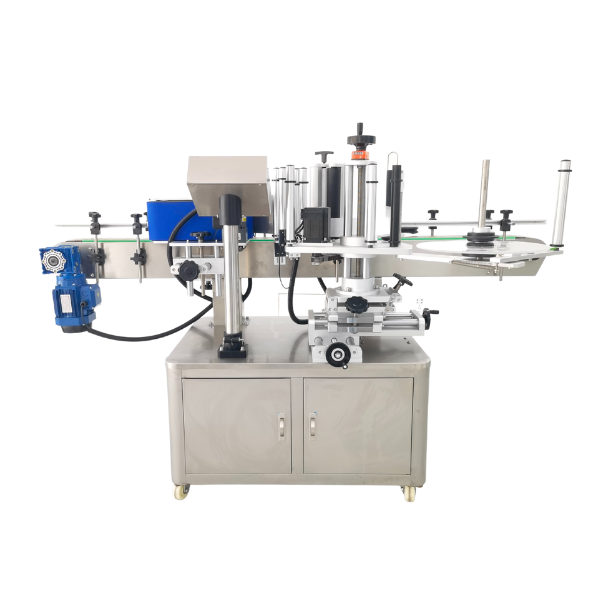
That is why a checklist matters more than a catalog. HiPaks builds bottle labelers from the MT-801 bench unit up to the T921 inline machine, and the specification sheet for each model is a starting point, not an answer. The details that decide whether a machine runs at 25 pcs/min or stops every forty bottles live on the bottle, the label roll and the conveyor, and none of them appear in a PDF.
The 11 specs, in the order to confirm them
Work down this table before you discuss price. The right-hand column is the reason the spec changes the quote, not a restatement of the spec.
| # | Spec to confirm | What to send | Why it changes the quote |
|---|---|---|---|
| 1 | Bottle diameter at the label band | Caliper readings at top, middle and bottom of the band | Sets roller gap and belt pressure. A taper above roughly 2 mm pushes the job toward a custom hold-down or a different wrap principle. |
| 2 | Bottle height and center of gravity | One physical sample bottle | Sets conveyor height, top hold-down clearance and head stroke. Tall light bottles need a different stabilizer than short heavy jars. |
| 3 | Label length and wrap angle | Label roll plus flat artwork dimensions | Decides full wrap, partial wrap or two-panel application, and whether a second station is needed. |
| 4 | Label material, liner and adhesive | Roll with liner and adhesive grade noted | Clear film on clear film, textured paper and thin liners all change sensor choice and peeling plate setup. |
| 5 | Required output | Units per shift, plus the busiest hour | Semi-automatic machines run 15 to 30 pcs/min, automatic machines 40 to 300 pcs/min. Sizing on the average hour buys a machine that queues at the peak. |
| 6 | Accuracy and measurement point | Target tolerance and where it is checked | Semi-automatic is quoted at ±0.5 mm, automatic at ±1 mm, both excluding product and label tolerance. The MT-807 reaches up to ±0.2 mm. A tolerance without a measurement point cannot be inspected. |
| 7 | Changeover and format parts | SKU list with typical run length | Changeover parts are priced separately. Ten SKUs at 800 bottles each need a different answer than one SKU at 40,000. |
| 8 | Conveyor interface | Line layout with infeed height and accumulation space | Decides standalone machine, inline machine, or a labeling head bolted onto your existing conveyor. |
| 9 | Sensor and drive brands | Your site standard, or ask what is fitted | HiPaks fits SICK sensors from Germany, Panasonic sensors and controls from Japan, MEAN WELL power supplies and Leadshine steppers. Brand matters when your maintenance team already stocks spares. |
| 10 | Utilities and floor space | Supply voltage, air pressure, room dimensions | Power and air are confirmed against your site before shipping. A machine that needs 6 bar and a dedicated circuit is a different installation than a bench unit on a 13 A plug. |
| 11 | Lead time, MOQ and payment | Target start date and order size | Semi-automatic machines ship in 7 to 10 days, automatic machines in 7 to 25 days by configuration, custom builds in 25 days or more. MOQ is 1 unit, payment is normally 30% TT deposit with 70% before shipment, 50/50 on some models, FOB Shenzhen. |
Specs 1 to 4: geometry you can measure with a caliper
Bottle diameter is never one number
Measure at the top, middle and bottom of the label band, and write down all three. A bottle that reads 74.0 mm at the waist and 72.8 mm at the shoulder is a tapered bottle whether the drawing says so or not. On a wrap-around machine the bottle rotates against a belt, and a taper makes the label walk sideways as it wraps. The result is a label that sits square at the seam and rides high at the trailing edge. Suppliers who ask only for the nominal diameter are planning to solve the taper during commissioning.
Height sets the frame, not the label
Height decides conveyor height, head stroke and how much top hold-down force the bottle can take before it deforms. A 240 mm wine bottle needs a taller column than a 90 mm cosmetic jar. A thin-wall PET bottle needs a pressure-limited hold-down or the shoulder dents. Neither detail is expensive, but both have to be decided before the frame is cut.
Label length decides wrap or panel
A label that covers 330 degrees of a 70 mm bottle needs a wrap station. A 60 by 40 mm front label needs a positioning station and a reference edge. Two labels on opposite sides need two stations or one station and a rotated second pass. Send the flat artwork size, not a photo of a printed label, so the supplier can compute the wrap length against the real circumference.
Material and liner decide the sensor
Paper labels on a standard glassine liner are the easy case. Clear film on clear film is the hard case: a standard optical sensor may not see the gap, and the fix is a different sensing principle rather than more operator attention. Thin liners curl at the peeling plate. Textured or partial-adhesive stocks need a slower peel and a different plate angle. All of this is settled by sending one roll, not by describing it.
Specs 5 to 8: output, accuracy, changeover and the line
Quote output at the peak hour
Fill in three numbers: bottles per shift, bottles in the busiest hour, and bottles in the busiest fifteen minutes. Size the machine against the second number and check that the first still works after changeovers. A semi-automatic machine at 15 to 30 pcs/min is often enough for a single shift with one operator. An automatic machine at 40 to 300 pcs/min earns its price when the filling line upstream already runs faster than a person can feed a bench unit.
Accuracy without a measurement point is marketing
Ask two questions: what is the tolerance, and where is it measured? A ±1 mm figure measured at the label edge on a stationary bottle is a different claim from ±1 mm measured on a running line at full speed. HiPaks quotes ±0.5 mm for semi-automatic machines and ±1 mm for automatic machines, excluding deviation caused by the product and the label itself, because a bottle that is not round cannot be labeled round. Only the MT-807 is quoted up to ±0.2 mm, and that figure belongs to flat, high-precision work rather than to every bottle job.
Changeover is where small runs lose money
List every SKU with its typical run length. A machine that changes over in four minutes is worth more than a faster machine that takes twenty-five, if you run eight SKUs a week. Ask for the changeover parts list with prices at quotation stage, because format parts are the line item buyers forget and suppliers are happy to quote later.
The conveyor interface decides the layout
Send the line drawing with infeed height, conveyor width, accumulation length and the position of the next machine. A standalone labeler needs floor space at both ends. An inline machine needs a timing screw or a star wheel matched to your bottle pitch. A labeling head mounted over an existing conveyor needs only the head and a bracket, which is often the cheapest retrofit when the conveyor already runs well. Draw the bottle path before you choose the machine type.
Specs 9 to 11: hardware, utilities and terms
Control hardware is a maintenance decision
The brands in spec 9 are a maintenance question rather than a performance question. If your plant already stocks SICK, Panasonic, MEAN WELL or Leadshine parts, the machine fits your spare parts cabinet on day one. If your site standard is different, say so at quotation. Retrofitting a sensor brand after delivery usually costs more than specifying it before the build, and it always costs more downtime.
Utilities and floor space
Confirm voltage, frequency, air pressure and air quality before the proforma invoice. A machine configured for 380 V three-phase will not run on 220 V single-phase without a change. Pneumatic units need dry air at a stable pressure, and a compressor that cycles hard at shift start shows up as label placement drift. Measure the doorway too: a floor-standing machine that fits the line but not the door is a story that happens more often than suppliers admit.
Lead time, MOQ and payment
HiPaks quotes 7 to 10 days for semi-automatic machines, 7 to 25 days for automatic machines depending on configuration, and 25 days or more for custom builds. MOQ is one unit. Payment is normally 30% TT deposit and 70% before shipment, with 50/50 terms on some models, FOB Shenzhen. If a supplier cannot put a date and an Incoterm in the quotation, the 11 specs are not yet confirmed, whatever the email says.
What to put in the inquiry email
One email with five attachments settles more than a week of messages:
- A photo of the bottle next to a ruler, plus caliper readings at the label band.
- One label roll, or the artwork with flat dimensions, material, liner and adhesive grade.
- The line layout, even a hand sketch, with infeed height and available floor space.
- Target output per shift and the busiest hour, not just the annual volume.
- Your site voltage, air pressure and any preferred control brands.
HiPaks runs a trial labeling pass on customer bottles and labels before shipment and sends the video back. That test is only meaningful if the sample is the real bottle and the real label, which is why the five attachments above are also the shortest path to a useful test.
How to verify all 11 before the deposit
Ask for a video of your bottle running on the quoted model, filmed in one continuous take, with the reject bin visible. A cut video proves that the machine can label one bottle. A continuous take proves that it can label forty in a row.
Then book a factory acceptance test if the order value justifies the trip. At the test, bring a stopwatch and count bottles for ten minutes rather than accepting a number from the HMI. Check the label position on the first, twentieth and fortieth bottle at the same setting. Ask the technician to change over to your second SKU while you watch, and time it. If changeover takes longer at the factory than in the quotation, it will take longer in your plant too.
Finally, ask what happens after the warranty year. HiPaks includes one year on the whole machine plus lifetime technical support, with wear parts excluded, and the parts list should name the wear parts before you sign.
Quotation red flags
- A speed figure with no bottle size, no label size and no operator count behind it.
- An accuracy figure with no measurement point and no statement about product tolerance.
- Format parts listed as “available” instead of priced.
- No mention of a trial run, or a trial run offered only after the deposit.
- A certification claim that reads as finished when the paperwork is still in progress.
HiPaks states its position plainly: ISO 9001 and CE are in progress, not complete. ISO 9001 is a quality management standard, as the ISO 9000 family overview sets out, and it governs process control rather than the accuracy of any single machine. A supplier who describes an in-progress certificate as issued is telling you something about how the rest of the quotation was written.
Frequently asked questions
How many bottle samples should I send for a quotation?
Send three bottles from the same production batch. One is cut open for measurement, one runs on the test machine, and one stays with the supplier as a reference for the shipment. Three bottles also expose batch variation that a single sample hides.
Can one machine handle several bottle sizes?
Yes, with format parts. A changeover set typically covers the bottle diameter range, the label height and the wrap length. The honest limit is the taper: strongly tapered or non-round bottles usually need a dedicated hold-down rather than a generic changeover kit.
Is a semi-automatic machine accurate enough for retail bottles?
For most retail work, yes. Semi-automatic machines are quoted at ±0.5 mm, which is tighter than the print registration on many labels. The constraint is output, not accuracy: 15 to 30 pcs/min suits small batches and sample runs, while a retail launch at volume usually needs an automatic machine.
What is the lead time for a bottle labeling machine?
7 to 10 days for semi-automatic machines, 7 to 25 days for automatic machines depending on configuration, and 25 days or more for custom builds. Add transit time and customs clearance for your destination. MOQ is one unit.
If the 11 specs above are still open, send the five attachments with the gaps marked. You will get a specification back with the assumptions written down, which is the part most quotations leave out.
Want to see the machine on a bottle like yours before you commit? Request a Free Test-Run Video, or browse the bottle labeling machine range and the manufacturer page for build details. More buying questions are answered in the labeling machine FAQ, and the rest of this cluster sits under bottle labeling guides.
