
A labeling machine is the piece of packaging equipment that takes a printed label and attaches it to a container at a controlled position, at a controlled speed, without human hands touching the label. It does one job: it presents a label, separates it from its backing or glue, and presses it onto a bottle, jar, carton, vial, or cable at the point the container passes. It does not fill, cap, seal, or inspect the product. Every labeling machine, from a $600 semi-automatic unit to a 15,000 BPH rotary carousel, is built from the same five subsystems and uses one of eight labeling methods. The sections below define the parts, compare the methods, and show how to read a specification sheet without a sales call.
The definition, and what sits outside it
The working definition used by packaging engineers is narrower than the words suggest. A labeling machine positions a container, presents a label, and applies it with a defined pressure and alignment, then releases the container to the next station. Everything else in a packaging line is a different machine with a different job.
This matters at the quotation stage, because buyers often ask a labeler to solve a filling problem. If labels are landing crooked because bottles arrive at inconsistent spacing, the fix is a metering screw or a timing wheel upstream, not a more expensive label head. If labels wrinkle on a square bottle, the fix is a press plate or a jig, not more speed.
| Machine | What it does | Often confused with a labeler because |
|---|---|---|
| Filling machine | Doses product into the container | It also handles bottles at speed |
| Capping machine | Applies and torques the closure | It sits next to the labeler on the same conveyor |
| Induction sealer | Seals the foil under the cap | It is sometimes mounted over the same conveyor |
| Labeling machine | Applies the printed label | It is the machine this article is about |
| Print and apply unit | Prints and applies in one step | It is a labeling machine with a printer attached |
The five subsystems every labeling machine shares
Prices differ enormously, but the architecture does not. Once you can name these five blocks, a specification sheet stops being a wall of numbers and becomes a list of trade-offs.
- Label feed. A roll unwinds, a dancer arm keeps tension, and a stepper or servo motor pulls the web. Servo feed costs more and holds placement as the roll diameter changes; it is also what makes 100 m/min possible on hot melt lines.
- Applicator. The label is separated from its backing at a peel plate and transferred by a roller, a tamp pad, an air jet, or a wipe-on belt. The choice depends on the container surface, not on the price.
- Container handling. A conveyor, a wrap-around belt, a star wheel, or a rotary carousel holds the container in the right place for the fraction of a second the label lands. This block decides whether the machine runs one bottle shape well or six shapes adequately.
- Sensing and control. A label sensor detects the gap between labels, a product sensor triggers the cycle, and a PLC sequences the motion. Sensor class matters most with transparent labels, where a standard photoelectric sensor will miss the gap.
- Drive and frame. Motors move the web and the conveyor; the frame holds everything still. Frame material looks cosmetic until the machine goes into a washdown area.
The eight labeling methods
| Method | How the label attaches | Typical output | Best fit |
|---|---|---|---|
| Wrap-around (pressure sensitive) | Bottle rotates against a belt while the label wraps | 40 to 120 pcs/min automatic, 15 to 30 semi-automatic | Round bottles, jars, cans |
| Flat and top | Tamp or roller applies to a flat upper surface | 40 to 300 pcs/min depending on the frame | Cartons, pouches, lids, boxes |
| Front and back (double side) | Two heads apply to opposite faces, press plates hold the container | 60 to 120 pcs/min | Square, flat, oval bottles |
| Corner and seal | Label folds around an edge or bridges a seam | Set by the host line speed | Tamper evidence, medical device boxes |
| Print and apply | Thermal printer produces the label, applicator places it | Line rate, variable data | Batch codes, barcodes, waybills |
| Hot melt glue | Molten glue is applied to a cut label edge, then rolled onto the bottle | 10,000 to 15,000 BPH on 12 stations | High-speed beverage and water lines |
| Wet glue (cold glue) | Starch or resin glue on a paper label from a stack | Below a rotary hot melt line, set by the label stack | Beer, cut-and-stack paper labels |
| Shrink sleeve | A printed sleeve shrinks around the container in a tunnel | Line rate, high volume | Full-body decoration, tamper evidence |
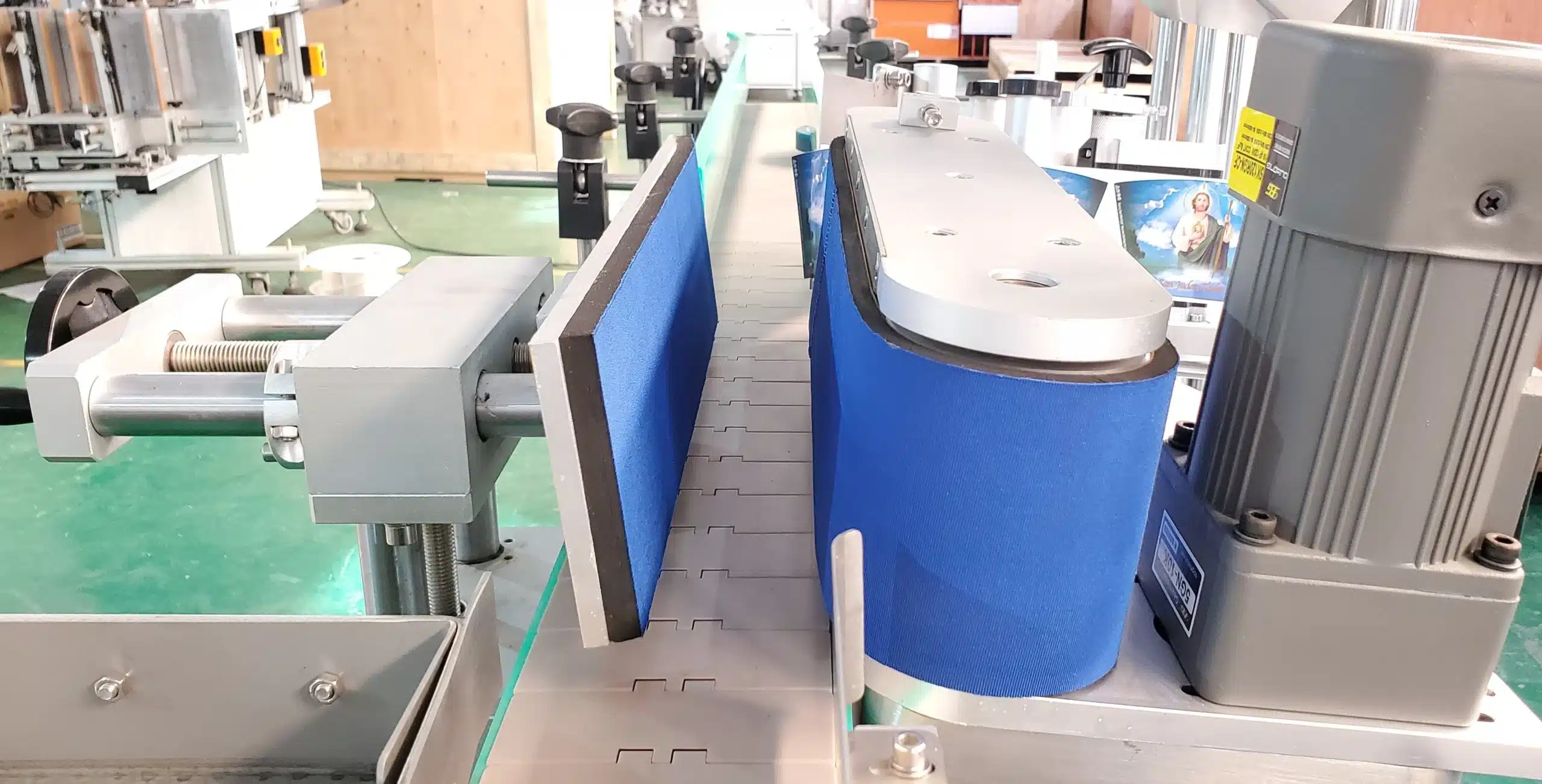
The four pressure-sensitive methods (wrap-around, flat and top, front and back, corner and seal) share a supply chain and a set of failure modes, and print and apply adds a printer to the same base. Hot melt and wet glue use glue instead of adhesive, so the label cost and the changeover time behave differently. Shrink sleeve is not really labeling at all, it is full-body decoration, and it needs a tunnel rather than an applicator.
Semi-automatic, automatic, and everything between
The automation level is the second axis, and it is the one that decides labour cost. A semi-automatic machine needs an operator to place each container, which limits realistic output to 15 to 30 pcs/min regardless of what the motor can do. A fully automatic machine takes containers from a conveyor and runs 40 to 300 pcs/min depending on the method and the container.
Accuracy moves on the same axis but less than buyers expect. Semi-automatic machines are typically plus or minus 0.5mm, our MT-807 reaches up to plus or minus 0.2mm on flat surfaces, and automatic machines are usually around plus or minus 1mm, measured without container or label error. Above that, the limit is the container, not the machine: a moulded bottle that varies by a few tenths of a millimetre cannot hold a 0.2mm label position no matter what the spec sheet says.
Between the two ends sit desktop automatic units at 20 to 40 pcs/min, which feed themselves but occupy a table rather than a line, and applicator heads, which are labeling machines stripped of their conveyor so they can be bolted onto equipment you already own.
What a labeling machine does not do
It does not fill, cap, seal, code the carton, or check that the bottle contains the right volume. It does not make labels, and it does not decide label content. It also does not fix an unstable container: a soft pouch or an oval bottle will move under the applicator unless a fixture holds it, and no amount of servo control compensates for a container that shifts.
Two adjacent capabilities are worth separating because they change the price. Coding is either pre-printed on the label or added by a print and apply unit, and the second option brings a print engine, a data feed, and a new set of failure modes. Inspection is a camera added after the label head, and it is priced and specified separately.
How to read a spec sheet in five minutes
| Row | What it tells you | Question to ask |
|---|---|---|
| Speed | Ceiling output, usually at a favourable container | What is the rate at my diameter and label length? |
| Accuracy | Placement tolerance, excluding container error | Measured on what, with which gauge? |
| Container range | Diameter and height limits | Does my container sit near an edge of the range? |
| Label size | Width and length limits of the web | Does my label fit without changing the peel plate? |
| Power | Voltage, phase, and current draw | Does it match my site, and is a transformer included? |
| Air | Pressure and consumption if pneumatic | Do I have a compressor that can hold it? |
| Weight and footprint | Shipping and floor space | Will it fit through the door and under the ceiling? |
If a spec sheet omits the container range or the label size, the machine is probably a standard frame waiting for a jig, and the missing numbers will be settled in the quotation. That is normal for custom work, but the numbers should appear before you pay, not after.
Where the label content comes from
A labeling machine applies what it is given. In most factories that means pre-printed rolls bought from a label printer, and the machine’s job is placement. When the label carries variable data such as a batch number, an expiry date, or a serial number, the machine needs a print and apply unit, and the printer becomes part of the specification.
Regulated products push this further. Pharmaceutical packs in the EU must carry a unique identifier and an anti-tampering device on the outer packaging, which is why serialization lines pair a print and apply head with a verification camera. The requirement is described in the European Commission’s falsified medicines safety features pages. For a buyer, the practical consequence is that the labeler is specified together with the data source, not after it.
Choosing a type without overbuying
Three questions settle most of the decision. What is the container: round, square, flat, tapered, or flexible? What is the label: pressure sensitive, paper with glue, sleeve, or printed at line rate? What is the realistic output, not the peak output? A factory that fills 2,000 bottles a day does not need a 300 pcs/min line, and a factory that fills 40,000 does not need four semi-automatic machines and four operators.
Start with the container and the label, then let speed and budget follow. That order is the same one used in the selection guide, and the products overview maps the eight methods onto the machine families that build them.
HiPaks builds 36 models, from desktop labelers at 15 bottles/min to rotary hot melt at 15,000 bottles/hour, covering pressure-sensitive, hot melt, wet glue, print and apply, and shrink sleeve work. Machines ship to 50+ countries, and every unit runs the customer’s own bottles before crating, with the video sent back including any rejects. The complete model list, with speed, accuracy, and container range for each family, is on the product catalog.
FAQ
What is the difference between a labeling machine and a label applicator?
A labeling machine includes the container handling, so it can run a bottle from a conveyor. A label applicator is the head alone, without the conveyor or the frame, and it is mounted onto equipment you already own, such as a carton sealer or an existing line.
How fast does a labeling machine run?
Semi-automatic machines usually run 15 to 30 pcs/min because an operator feeds each container. Automatic machines run 40 to 300 pcs/min depending on the method and container, and rotary hot melt lines reach 10,000 to 15,000 BPH. Always ask for the rate at your own container size.
What is the most accurate labeling method?
Pressure-sensitive labeling on a flat surface is the most accurate, with semi-automatic units typically at plus or minus 0.5mm and high-precision models reaching up to plus or minus 0.2mm. Automatic wrap-around systems are usually around plus or minus 1mm, excluding container and label variation.
Can one labeling machine handle several bottle sizes?
Yes, within the container range, but changeover time is the real limit. Ask how many adjustments are needed, whether they are tool-free, and whether a second format needs a new jig. A machine that changes size in five minutes is a different asset from one that takes forty.
Do I need a print and apply machine?
Only if the label content changes per unit, such as a batch code, expiry date, serial number, or shipping address. If every label is identical, a standard pressure-sensitive machine with pre-printed rolls is cheaper to buy and cheaper to run.
Next step: if you are not sure which of the eight methods fits your container, send a photo and the label size through the quote form and we will name the method and the model, or request a free test-run video on your own bottle to see the method in motion.
