
Yes, the first bottles after a planned stop usually do lose registration, and the loss is a state problem rather than a broken part. Power stays on during a planned stop, so the recipe, the IO map and the drive settings are untouched. What drains away is position and supply: web tension at the peel plate, the label already sitting over the plate, the glue temperature on a hot-melt machine, and the reference the registration sensor was taught against.
Three faults hide behind the same complaint. First, every bottle is off by the same fixed amount. Second, the first bottle arrives unlabelled, double-labelled or rejected. Third, registration walks and no number repeats.
Each fault has its own reading, owner and signature.
What Does a Labeler Forget During a Planned Stop?
What Changes in the Web and the Glue While the Line Sits?
A web is a spring under tension, and tension releases at the peel plate the moment the drive stops. Three changes follow. First, the dancer parks at the end of travel, so the first start pulls against a shorter free loop than the run condition used. Second, the label already bent across the plate edge takes a set against steel, and a pressure-sensitive face held in that shape lifts at the leading edge. Third, on a hot-melt machine the pot and the roller cool toward ambient, so the first bottles meet glue at a temperature the run never used.
The web path is re-threaded and the plate gap is checked at every format change and not only after a fault, according to HiPaks commissioning practice. In practice a long stop and a format change land on the same bottle.
What Does the Controller Keep, and What Does It Not Keep?
The controller keeps everything written to memory and nothing measured on the line. The recipe number, the offset value, the pitch table and the IO map survive a planned stop, because power never left the cabinet. The position reference does not survive: the servo is disabled, the encoder index drops while the axis is off, and the taught window of the registration sensor still exists as a number while the glass behind the number has been cleaned, moved or fogged.
Two consequences follow. A recipe can reload cleanly and still be wrong, because the last recipe loaded is not always the last recipe proven on this bottle. A registration value can read back correctly and still be false.
Do the First Bottles Come Off by a Fixed Offset?
A fixed offset means the label lands in the same wrong place on every bottle, in the same direction and by roughly the same amount. A fixed offset is the cheap fault: the machine is still registering, and the whole pattern has shifted. Bottle one and bottle ten carry the same error, so one gauge reading describes the fault and a re-teach can be proven on 3 consecutive bottles.
The cause sits in web path length and the pitch queue, not the sensor. A labeler tracks a queue of labels between the unwind and the head, and a stop empties the queue. On the first start the head fires against a queue being rebuilt, then settles as the queue fills.
On a wrap-around station the shift shows at the leading edge and again at the lap, because the bottle carries the label round to the seam. Measure both before calling the offset fixed, then re-teach on a proven bottle.
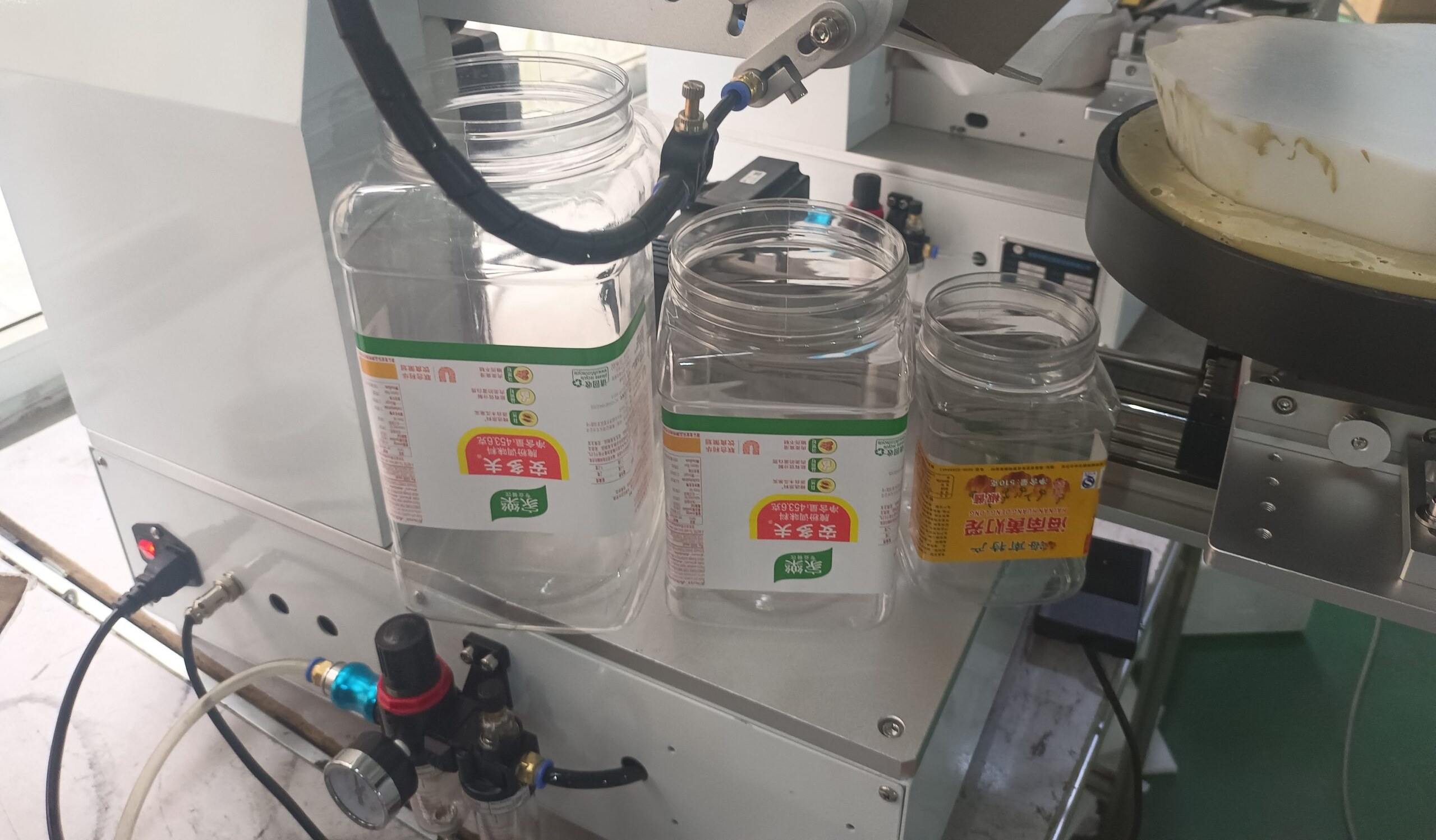
Why Would the First Bottle Be Missing, Double, or Flagged?
A missing, doubled or flagged first bottle is a supply and peel fault, and the label count separates the three cases. A label already presented at the peel plate during the stop has left the liner. The label drops onto the plate, curls back against the liner, or waits for the first bottle and travels with a second label behind it.
Three mechanisms cover most cases. First, liner creep: sustained pressure between the roll and the plate advances the liner, so the gap meant to hold the next label fails. Second, a lifted edge: face stock held over a steel lip takes a set and leaves the plate early. Third, a reject fired before the stop and left latched in the lane, so a good bottle is flagged by a counter nobody reset.
Why Would Registration Stay Lost Until the Machine Is Re-Homed?
Lost registration is a sensor and encoder fault, and the tell is that no number repeats. The leading edge walks forward and back between bottles, the seam gap changes on every bottle, and a second measurement disagrees with the first.
Three causes dominate after a planned stop. First, the registration sensor window is fogged, dusted or nudged, often by a clean-in-place wash or a wipe that reached past the guarding. Second, the encoder index or the servo reference drops when the axis is disabled, so the machine counts from a new zero. Third, the product sensor is masked by a bottle left standing in the beam, so the trigger arrives late and every later decision sits one position out.
Registration returns by re-referencing the axis, cleaning the window and teaching the sensor on a real label, then proving the result on 3 consecutive bottles with a gauge.
Which Reading Separates the Three Faults?
What Does the Symptom, Cause, Reading and Owner Table Show?
A reading is a number taken before the line is released, not an opinion about how a bottle looks. The rows below hold on any automatic labeling machine class rated 40 to 300 pcs/min.
| Symptom on the first bottles | What the machine shows | Reading that proves the cause | Who resets | Who signs |
|---|---|---|---|---|
| Same offset every bottle | Pattern shifted, seam gap uniform | Label start against a datum, 3 bottles, same direction | Technician sets the offset | Technician and quality |
| Unlabelled or flagged | Label on plate or a liner gap | Labels dispensed against bottles presented | Operator stops, technician frees the plate | Operator |
| Two labels on one bottle | Label count ahead of bottle count | Label count on the first article sample | Operator | Operator and quality |
| Leading edge walks, no repeat | Registration value drifts | Stored teach against fresh teach on a real label | Technician re-references the axis | Technician |
| Runs, seam gap varies | Spread bottle to bottle | 3 gauge readings one minute apart | Quality holds the line | Quality |
How Is Each Reading Taken Before the Line Runs Again?
Three readings carry the three faults. First, the offset reading: stand the first bottle on a flat surface, measure the label start against a datum line, then repeat on 3 consecutive bottles and compare direction as well as amount. Second, the count reading: count labels dispensed against bottles presented over the first article sample, because two labels on one bottle is a supply fault and zero labels on one bottle is a peel fault. Third, the sensor reading: read the stored teach value on the HMI, clean the window, run a fresh teach on the same label stock and compare the numbers.
Who Writes and Signs the Three Parts of the Restart?
Part 1, the Operator Confirms State and Signs the First Bottles
The operator’s part is state confirmation, and the operator signs the first bottles rather than the machine. First, confirm the safe state: guards closed, emergency stop reset, air at the drop, reject lane empty. Second, read the recipe number on the HMI against the bottle standing on the conveyor, because a correct recipe for the previous format is a wrong recipe for the current format. Third, confirm the label roll lot and the web path against the threading diagram. Fourth, start at jog speed, present the first bottles, place the sample on the gauge and write the number on the card. A supervisor countersigns when the recipe changed during the stop.
Part 2, the Technician Resets Mechanics and Sensors
The technician’s part is the mechanical and sensor reset, and the technician signs settings rather than bottles. First, set the peel plate gap and the web tension for this label stock and record both as numbers. Second, clean the registration sensor window, run a fresh teach on a production label and compare the new value with the stored value. Third, re-reference the axis: home the servo, confirm the encoder index and watch the first index pass instead of assuming the boot routine finished the job. Fourth, on a hot-melt machine, hold the pot until the roller surface reaches temperature, because a display reading ready is not a roller at temperature. HiPaks fits SICK sensors, Panasonic drives, Mean Well power supplies and Leadshine steppers, and technical support backs the one year whole-machine warranty.
Part 3, Quality Signs the First Article and Releases the Line
The quality part is the first article, and quality signs the release. The first article is the record of the first bottles labelled after the restart, measured against the band quoted for the machine class. HiPaks quotes plus or minus 0.5 mm on semi-automatic machines, plus or minus 1 mm on automatic machines and up to plus or minus 0.2 mm on the MT-807, with product and label variation excluded. The record carries the bottle, the label lot, the serial, the measured spread and the seam gap on a wrap-around. Quality releases the line when the reading sits inside the band and the direction holds. A fixed offset inside the band is acceptable, while a smaller error that changes direction is not, because nobody can prove the second error on a sample. The same record is the agenda of a factory acceptance test.
Why Can the Restart Not Be an Automatic Side Effect?
A restart is a designed sequence, not a side effect of a stop clearing. Machinery may start only by voluntary actuation of a control device provided for the purpose, according to Regulation (EU) 2023/1230, and Annex I, 1.2.3 applies the same requirement when restarting after a stoppage, whatever the cause. Automatic restart is permitted only where no hazardous situation can follow, and where a start sequence is required for safety, devices must enforce the order. Two rules follow for a labeler. First, the machine must not restart because a stop cleared, an interlock closed or an accumulation conveyor filled. Second, the sequence belongs in a controlled document with an owner, a revision and a signature, signed 3 times, one signature per part, which is the ISO 9001:2015 treatment of a documented procedure. In practice a restart note taped to the HMI is a reminder, not a procedure. The install window before the machine reaches this point is a separate schedule, covered in the offline pre-build.
Frequently Asked Questions
How Many Bottles Are Lost on the First Restart?
No honest number exists before the plant runs its own first restart. Loss depends on web path length, label pitch and how long the line stood. The rule that survives every line is to measure the count on the first restart and write the number on the card, because a count copied from another line describes another machine.
Can the Operator Press Start and Keep Running?
An operator action is required, and the action has to be the designed sequence rather than a single button. Pressing start returns the drives, not the registration. The first article separates a restart from a resumption, and the signature on the card turns the first article into a release.
Does Every Planned Stop Need a New First Article?
A new first article is needed when the recipe, the label lot, the format or the axis reference changed during the stop. A short stop with the same recipe, the same stock and a warm machine can be released on the offset reading alone.
Which of the Three Faults Is Hardest to See?
Lost registration hides the most, because no number repeats and every bottle looks plausible at a glance. A fixed offset is visible against a gauge, a missing label trips a sensor, and walking registration passes a visual check while the seam gap moves.
