
The short answer. A label applicator is the labelling station. A labeling machine is that station plus a frame, a conveyor and its own controls. The choice turns on one fact: whether the product already moves past a point you control. If it does, an applicator head mounts over your belt, takes a trigger from your PLC and applies at your line speed, and you keep the conveyor, the guards and the floor space you already paid for. If it does not, a complete machine feeds, applies and discharges on its own, arrives with one warranty and one supplier, and costs more because you are buying the transport as well as the transfer. Everything else in the comparison, including accuracy, speed and lead time, follows from that split rather than deciding it.
Three objects hiding behind two words
Suppliers use the terms loosely, so the first job is to fix what is being quoted. There are three distinct products in this corner of the market, and a quotation that does not name which one it covers cannot be compared with another.
A dispenser peels a label and presents it for a hand to take. It removes the liner fight from a manual process and nothing else. It is the cheapest way to make hand application faster, and it keeps a person responsible for placement, which is sometimes exactly what a short run needs.
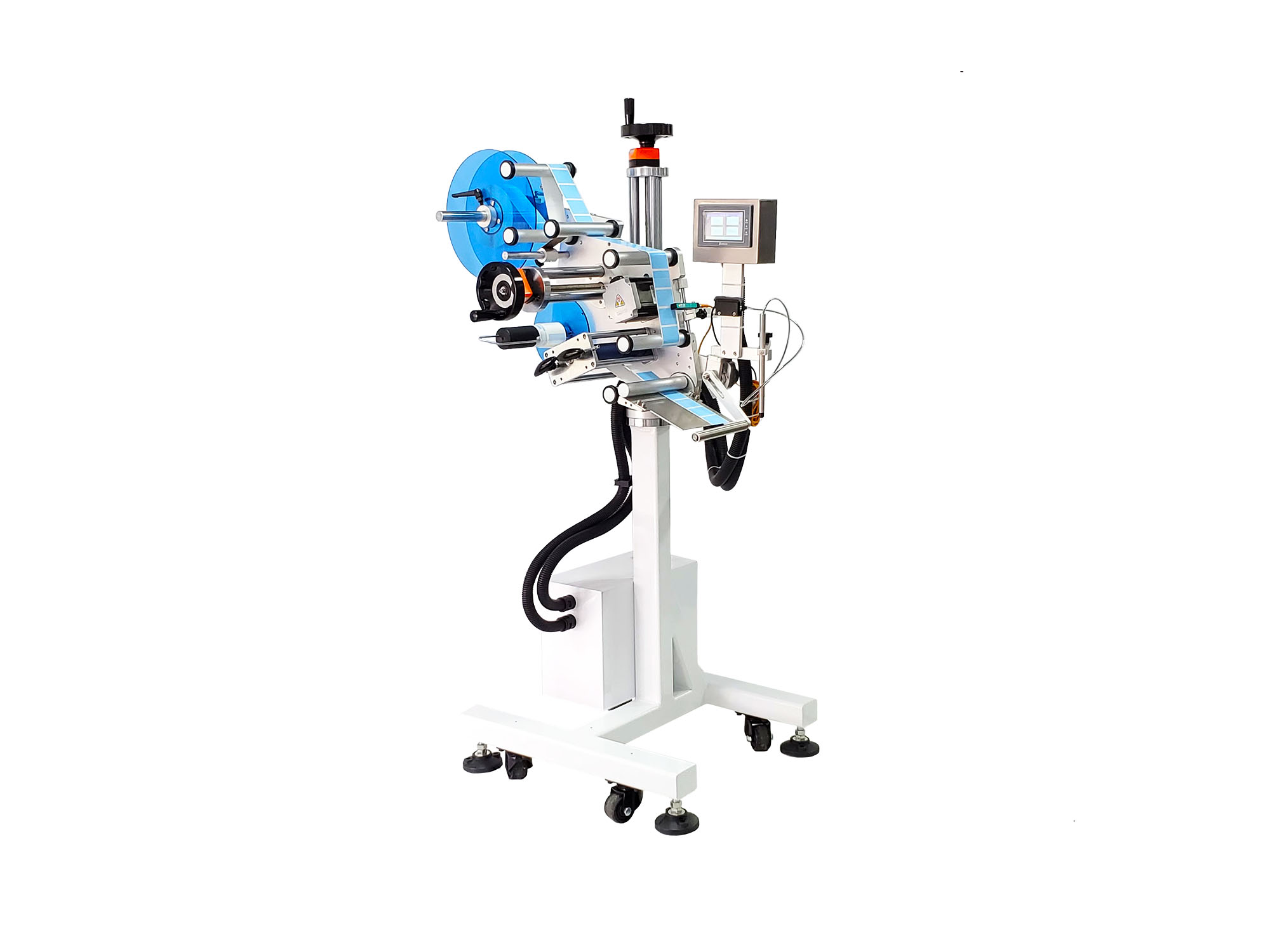
An applicator head is the full applying station without the frame: label sensor, peel plate, web drive, and the transfer mechanism, whether that is a wipe-on roller, a tamp pad, an air jet or a wrap fixture. It mounts on a conveyor you own, receives a product-present signal, and applies at whatever rate the conveyor delivers. HiPaks builds three of these as modules: the T951 for flat faces, the T952 for side panels and the T953 gantry for lines where the conveyor frame must not be touched.
A labeling machine is the head plus everything needed to run alone: base frame, conveyor, product guides, reject handling and a control cabinet. It is a self-contained cell. You buy it when there is no line to join, or when joining one would cost more than the machine.
The question that settles most cases
Ask it in this form: at the moment the label is applied, is the product moving on a conveyor that already exists, already runs at the required rate, and is already under your maintenance team’s care?
If the answer is yes on all three counts, a head is almost always the smaller project. If any of the three is false, the missing piece becomes the project, and it is usually cheaper to buy it inside a machine than to build it around a head. A head bolted onto a conveyor that stalls, wanders or has no speed reference produces a labelling station that is only as good as the belt underneath it, and the supplier of the head will spend the commissioning week proving that.
This is why the honest comparison is not head versus machine on price. It is head plus integration work versus machine plus installation work. Both columns contain labour, drawings, guards and a commissioning visit. Only one of them also contains a conveyor.
Five tests, in the order they decide
Work down this table before anyone quotes. Each row is a question with a factual answer, not a preference.
| # | Test | Head wins if | Machine wins if |
|---|---|---|---|
| 1 | Does a conveyor already carry the product past the station? | Yes, and it holds speed within a few percent | No, or the belt is shared with a process that stops without warning |
| 2 | Who controls product spacing? | You do, with a spacing screw, metering belt or star wheel already fitted | Nobody does, and gaps vary by more than one product length |
| 3 | Who handles a missed or skewed label? | Your line already has a reject or inspection point downstream | There is no reject path, and a bad label reaches the case packer |
| 4 | Who owns the controls? | Your PLC team wants the handshake and has the drawings | You want one supplier to hand over a working cell with one HMI |
| 5 | What volume justifies the work? | Steady volume on an existing line, where the head is the only missing station | Volume that needs a dedicated cell, or a product family with no line at all |
What you take on when you buy a head
Buying a head means buying a station and accepting the systems work around it. In practice the scope looks like this:
- The mounting structure. A bracket, a column or a gantry that puts the head at the right height and angle, and holds it there while the line vibrates.
- The trigger. A product-present sensor, its mounting, and the decision on whether the head fires on a sensor edge, a PLC bit or an encoder position.
- The electrical interface. Supply, signal wiring, and whatever your site requires for a stop circuit that actually stops the head.
- The guarding. A nip point appears wherever a web runs and a product passes. Somebody has to assess it and put a guard on it.
- The acceptance criteria. A number for placement, a number for throughput, and a reject definition, agreed before the first carton runs.
None of that is exotic. All of it has a cost, and a quotation for a head that does not mention it is not a cheaper quotation, it is a partial one. HiPaks ships each module with an integration drawing and an I/O list so an integrator’s electrician can wire it without reverse engineering, and supports commissioning, but the conveyor, the guards and the line logic stay with the line owner.
What you take on when you buy a machine
A complete machine moves the systems work inside one purchase order. You get a frame sized to the product, a conveyor with guides, a control cabinet with the sequence already written, and one number to call when a label lands crooked. The trade is footprint, money and flexibility: the machine occupies floor space whether or not the line is running, and it cannot be repurposed as easily as a head.
For a brand with no packaging line, the machine is not a luxury. It is the only way to get from boxes on a bench to a repeatable output, and the semi-automatic end of the range does that at 15 to 30 pcs/min with an operator feeding it. For a plant that already runs a case packer and a palletiser, adding a standalone labelling cell usually means buying transport twice.
Where the money actually goes
Published reference points make the comparison concrete without pretending to quote your job. HiPaks lists applicator heads from $3,000, semi-automatic applicators from $600 and print and apply units from $6,000, with the head range typically landing between $3,000 and $10,000 depending on platform and options. A complete automatic machine is a different order of purchase because it includes the conveyor, the frame and the controls.
The head looks cheaper on the invoice and can be more expensive in total if the integration is done badly. Two brackets, a week of an electrician, a guard fabricated on site and a month of tuning can consume the difference. The machine looks expensive and can be cheaper in total if the alternative is a one-off integration into a conveyor that was never designed to be timed.
The honest way to compare is to price four lines on the same sheet: equipment, integration labour, footprint and downtime. Buyers who do that usually find the gap narrower than the invoices suggest, and they find it before the purchase order rather than after.
The trigger, the controls and the PLC handshake
This is the part of a head project that decides whether commissioning takes two days or two weeks. A labelling head needs to know three things: a product is present, where its leading edge is, and how fast it is moving. A single photoelectric sensor answers the first two well enough for a tamp cycle on a stopped product. A moving product at line speed needs either an encoder signal or a timed delay calibrated against the belt, because a fixed delay is only correct at one speed.
HiPaks documents the I/O on every module so your controls team can see what the head expects and what it returns. The questions to settle in the kickoff meeting are concrete: which PLC owns the cycle, what happens on a web break, whether the head stops the conveyor or the conveyor stops the head, and how a reject is flagged. Each of those has a right answer for your line and no universal answer.
Who signs the declaration of conformity
For buyers in the European Economic Area this question belongs in the commercial negotiation, not in the technical file. A head supplied as a module is not a complete machine, and the assembly you build around it may need its own conformity assessment and its own declaration before it can be placed on the market. The European Commission machinery pages set out the current framework, including the incoming Machinery Regulation (EU) 2023/1230, which applies on a mandatory basis from 20 January 2027.
The commercial consequence is straightforward. The entity that puts the finished assembly on the market carries the obligation, and that entity is usually the integrator, not the head supplier. Agree in writing which documents travel with the module: the declaration supplied with it, the electrical drawings, the risk assessment for the head’s own hazards, and the guard specification for the transfer point. A supplier who cannot produce that pack has not shipped many modules into regulated markets. HiPaks states its own position plainly: ISO 9001 and CE are in progress, and the documentation pack ships with the module.
Three line profiles, three answers
The machine builder adding labelling to a standard product
Take the head, and take it as an OEM module with volume pricing and a documented interface. Your customer buys a machine with labelling built in, your controls team owns the sequence, and you are not reselling somebody else’s conveyor. HiPaks builds heads for this route, with unbranded or private-label bodies and test footage you can put in front of your own customer.
The converter with a conveyor and no labelling station
Take the head, and spend the saved money on the survey. Conveyor height, direction of travel, product spacing, sensor position and supply voltage are the five inputs that decide whether the bracket fits. A head that arrives without those numbers is a return shipment. The retrofit guide walks through the same five inputs in detail.
The brand with no line and a launch date
Take the machine. A semi-automatic unit at 15 to 30 pcs/min with one operator gets a first SKU to market without a conveyor project, and a floor-standing automatic machine takes over when the volume arrives. Buying a head in this situation means becoming an integrator on a deadline, which is a poor use of a launch schedule.
How to decide in one meeting
Put these five items on the agenda and the answer usually emerges before the coffee is cold:
- A photo of the product on the conveyor as it runs today.
- The measured spacing range over ten minutes, fastest and slowest.
- The rate the line must hit, and the rate it actually hits.
- Who owns the PLC and who will write the handshake.
- The destination market, because it decides which declaration has to exist.
If item two cannot be answered, that is the finding. A line with uncontrolled spacing is not ready for a head, and no transfer method compensates for it. Start with the applicator range for the hardware view, the head range for the module view, and the manufacturer page for how the two are built and tested.
FAQ
Is a label applicator just a cheaper labeling machine?
No. It is a different scope. A head applies labels onto transport you already own, so it is cheaper in equipment and heavier in integration work. A machine includes the transport, so it costs more and needs less of your engineering time.
Can a labeling head run at the same speed as a full machine?
Yes, up to the head’s rating. The T951 is rated 40 to 120 pcs/min and the T952 and T953 run 40 to 150 pcs/min on stepper drive or 50 to 200 pcs/min on servo, all at ±1 mm excluding product and label deviation. Whether your line actually delivers that rate depends on spacing and on how the product is presented.
Do I need a conveyor to use an applicator head?
Yes, and it has to hold a stable speed. A head triggered by a sensor on a belt that surges will place labels late. If the existing conveyor cannot hold speed, fix that first or buy a machine with its own transport.
Which option is easier to install?
The machine, because the sequence is already written and tested. A head installs quickly when the five inputs are correct and the PLC handshake is agreed in advance, and slowly when either is missing. Plan a commissioning day either way.
Still torn between the two? Send the photo and the spacing numbers. The answer follows from the line, and it is worth settling before the specification is written.
More comparisons and selection notes sit under label applicator guides. If a whole automatic cell is the likelier answer, start from the automatic labeling machine range instead.
