
Site acceptance is the test where a buyer signs an installed line. Noise and working height are the two items most often signed with no owner. The operator station carries three quantities, not one. The first is the declared machine emission, stated before shipment. The second is the in-situ cell level, which exists only when the whole line runs. The third is personal exposure, which the employer owns under the Control of Noise at Work Regulations. Working height divides the same way, between a datum on the drawing and a task an operator performs. A clause naming neither ends in two records with no signer.
Why Is the Distance to the Capper a Layout Fact, Not a Test Point?
Which of the Three Quantities Is the Clause Buying?
Three metres separates two machines, not a measurement point, so the clause buys a quantity rather than a gap. A declared emission value is a factory number, a cell level is a site number, and personal exposure is an employer number. Each row below carries a different signer, a different test date and a different document. The method behind row two is ISO 11202:2010, read at grade 2 or grade 3.
| Quantity | Party who evidences the value | When the value can be signed | Document that satisfies the clause | Party who cannot sign |
|---|---|---|---|---|
| Declared machine emission | Labeler supplier | Before shipment, from the factory test | Declared level with uncertainty and test code reference | Line owner, who holds no factory record |
| In-situ cell level | Line owner, with both machine suppliers present | At site acceptance, line in production configuration | Grade 2 or grade 3 report with positions and running conditions | Any single machine supplier |
| Personal exposure | Employer | On a normal shift after the line settles | Noise assessment and hearing conservation records | Machine supplier of any kind |
Who Can Sign a Cell Level Measured Beside Another Machine?
A cell level is a joint product of two machines and a room, and no single supplier can evidence the number. The labeler contributes its drive, vacuum pump and web path. The capper three metres away contributes its own sound, and the room contributes reflections. Workroom reflections, according to HSE guidance L108, can add between 1 and 5 dB to a machine emission figure, and sometimes more. The clause therefore names the line owner as signer of the cell level, with both machine suppliers present at the test and the running condition recorded. The labeler supplier signs the declared emission value from the factory. The employer owns personal exposure. In practice the signer is named before the test date, not after a reading disappoints. A cell level read to ISO 11202:2010 grade 2 with no frozen positions still fails an audit.
Which Number Can the Labeler Sign Before It Ships, and Which Only Exists on Your Floor?
What Must a Declared Emission Value Carry?
A declared emission value is the sound pressure level a manufacturer publishes for a workstation, measured on the machine alone. HSE guidance sets the threshold for publishing one. L108 paragraph 280, published by HSE, requires the emission sound pressure level and its uncertainty at workstations where the level exceeds 70 dB(A). The same paragraph requires the peak where the peak exceeds 130 dB(C), and the sound power level where the workstation level exceeds 80 dB(A). Paragraph 281 asks for a workstation representative of the noisiest operation in typical use. Paragraph 287 asks for the noise test code by part number and date. Four items belong in the clause: 1) the value, 2) the uncertainty, 3) the test code, 4) the operating condition. A declaration without the test code is a sentence, not evidence. In our production line the buyer’s own bottles run before the crate closes, so the operating condition has a witness.
What Only Exists Once the Whole Line Runs?
An in-situ level is the sound pressure a complete cell produces at a stated position. Only a running line can produce the value. ISO 11202:2010 defines the method for emission sound pressure levels at a workstation and at other specified positions nearby, in situ. The standard returns accuracy grade 2, engineering, or grade 3, survey. Running conditions belong in the record. Labeler and capper run together, at production speed, on the worst product and label, with every auxiliary on. A full cycle is recorded, including intermittent events. A background reading is taken with the line stopped. Workroom reflections can add 1 to 5 dB, and sometimes more, according to L108 paragraph 283, so the cell reading is not the declared value plus a fixed margin. A result taken on an incomplete installation is recorded as provisional, never as final acceptance.
Where Does the Microphone Position Come From, if the Standard Will Not Hand You a Number?
A measurement position is a coordinate plus a direction, and the purchase order needs both written down. The public description of ISO 11202:2010 fixes the method, the corrections and the accuracy grades. No universal microphone height forms part of that description, which is why published summaries of plant noise testing quote different heights and each still claims a standard. The clause resolves the conflict by naming the test code and putting coordinates on the drawing. Three coordinates belong on the drawing: distance from the machine reference plane, height above the floor datum, and the direction the microphone faces. Four positions are worth naming. The first is the operator ear position at the main station. The second is the roll loading and threading position. The third is a bystander position at the aisle. The fourth is the background position, with the line stopped. The drawing says where the meter stands, and the specification sheet guide covers the document that says what the machine is.
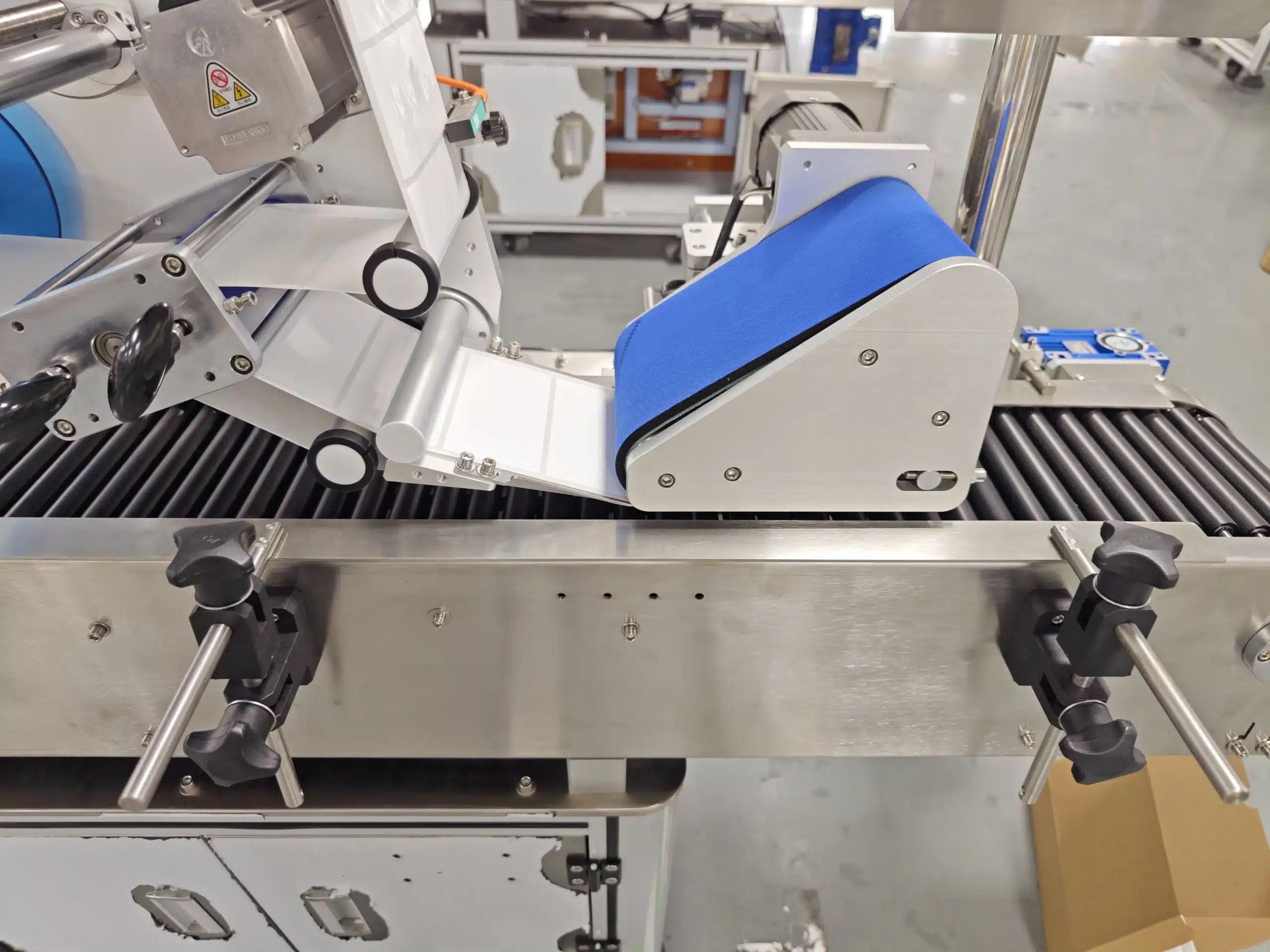
Working Height at the Roll: Which Datum Comes First?
Which Datum Does a Height at the Roll Refer To?
A working height is a distance from a named datum to a named point. The datum is the half of the pair that specifications leave out. Six datums appear at a labeling station: the floor, the spindle centreline, the peel point where the label leaves the plate, the loading surface, the control panel, and the operator reach envelope. A height quoted to the top of a full roll measures a different thing from a height quoted to the peel point. Both differ from the surface an operator lifts a roll onto. The clause lists each datum, the point measured to, and the drawing reference. In practice the station drawing carries four of the six, floor, spindle centreline, peel point and load surface, because those four decide where an operator’s hands go.
Which Task Defines the Height, and Does a Percentile Belong in the Clause?
A height means something only against a task. The task at a labeling station has five parts. 1) Lift a full roll onto the spindle. 2) Thread the web through the rollers and over the peel plate. 3) Splice a new roll to the running web. 4) Adjust the plate gap. 5) Clear a misfeed without tools. Each part has a different reach. The load surface matters most for the first, and the peel point matters for the second. Where the buyer claims an ergonomic basis, the clause states the percentile population behind the figure and the standard used for the comparison. Where the buyer only wants a reproducible measurement, the clause states datum and task and leaves the population out. For example, a station measured at an empty spindle reads lower than the same station with a full roll, so both roll states belong on the record. Threading and roll change are also where the roll seating and web path checks start.
What Re-Opens the Record, and What Do Buyers Ask Before Signing?
What Is the Decision Rule When the Reading Sits Inside the Uncertainty Band?
A decision rule converts a reading and an uncertainty into a pass, a fail or a hold. The clause carries the sentence before the test date. Without a rule, a reading a fraction of a decibel under a limit is a negotiation, and commercial pressure settles the argument instead of evidence. Three outcomes belong in the clause. 1) Pass, where the reading plus the expanded uncertainty stays at or below the limit. 2) Fail, where the reading minus the expanded uncertainty sits above the limit. 3) Indeterminate, where the band straddles the limit, and the record then states a re-test at the higher accuracy grade or a hold with a named owner. The clause also fixes the averaging time, the rounding and the instrument class, so two shifts measure the same way. The grade follows the method: according to ISO 11202:2010, the method returns grade 2 or grade 3, and a limit written this way needs grade 2. In practice a rule written after the test is a description of the result, not a test.
What Re-Opens a Signed Record?
A signed record covers one configuration, and a configuration change turns the record into a historical document. Five changes re-open a station record. 1) An added guard panel or enclosure. 2) A platform or step under the operator. 3) A change to the roll diameter range. 4) A re-levelled or re-sited machine. 5) A moved operator position. Each change alters a path length, a reflection or a reach, so the old reading no longer describes the station. The freeze list belongs in the clause, with the signer for each change named. For example, a guard panel fitted after acceptance changes the reflection path at the operator ear. The same logic drives the requalification file when one labeler moves to a second line. A measurement without a frozen configuration is a snapshot, and an audit asks for a baseline.
Which Accuracy Grade Should the Clause Demand?
An accuracy grade is the evidence class a noise measurement carries. Grade 2 of ISO 11202:2010 is the stronger of the two grades the standard offers. Grade 2 is an engineering method with tighter instrumentation and position control. Grade 3 is a survey method, useful for screening a plant and weak as an acceptance basis. A clause naming no grade accepts whichever grade the contractor brings on the day. Two signatures follow from the split. The labeler supplier signs the declared emission value with uncertainty and test code before shipment. The line owner signs the cell level and the height record at site acceptance. Where both records are bound into one acceptance file, the signers remain separate, and the bolt-on head qualification note covers the signatory split for validation stages. Send the operator station drawing and the test code reference with Get a Factory Quote and the clause is priced against a real machine.
Can Noise and Working Height Be Signed as One Item?
Noise and working height are two measurements, with two test methods and two signers, so one certificate line cannot cover both. A declared emission value is a manufacturer statement made before shipment. A height is a dimensional record made on the installed machine. One acceptance item invites a signature on whichever half happened to be witnessed. Two records, two dates, two signers.
Does Ear Protection Turn a Reading Into a Pass?
Ear protection never makes a machine pass. The OSHA noise standard requires a hearing conservation programme at or above an 8-hour time-weighted average of 85 dBA, according to the text of 1910.95. That figure governs worker exposure, not machine acceptance. The HSE employer page sets lower action values of 80 dB(A) and 135 dB(C) peak, upper action values of 85 dB(A) and 137 dB(C) peak, and exposure limit values of 87 dB(A) and 140 dB(C). A reading taken with defenders in place measures the protected ear. The clause therefore states that the machine test runs without protection factored in.
What Should the Clause Say About the Microphone Height?
The clause names the test code and the grade, then quotes the height from the drawing, not from a supplier summary. ISO 11202:2010 fixes the method and the grades. The standard publishes no universal height for every machine family. A drawing coordinate plus a stated direction is repeatable. A copied height is a number with no owner, and no supplier will sign it at site acceptance.
