
A second line rarely justifies a second labeler, and the rail is the cheap part of that decision. One machine can serve two filling lines when three conditions hold: the lines never run flat out at the same hour, the bottles share a family of diameter and label size, and the move follows a schedule rather than a panic. The expensive part is not the rail. It is the requalification that follows every move: the installation state, the label position check, the first article record and, on a regulated line, the change control entry that lets production restart. This page sets out the file that has to travel with the machine, the repeatability check that proves the move, and the point where a second machine is cheaper than the second move.
When Can One Labeler Serve Two Filling Lines?
A shared labeler is a scheduling decision before it is an engineering decision, and three tests decide whether the schedule holds. First, do the two lines peak in the same shift? If both fill at 8,000 bottles an hour between 06:00 and 14:00, one machine cannot cover both and no rail fixes that. Second, do the bottles share a family? A 60 mm round bottle and a 90 mm square bottle need different star wheels, different guide rails and different recipes, which turns a move into a changeover. Third, does the move repeat more than twice a week? Below that frequency a rail earns its cost, and above it the machine spends its week being adjusted. HiPaks asks for the filling schedule before quoting a rail, because the honest answer is sometimes a second machine.
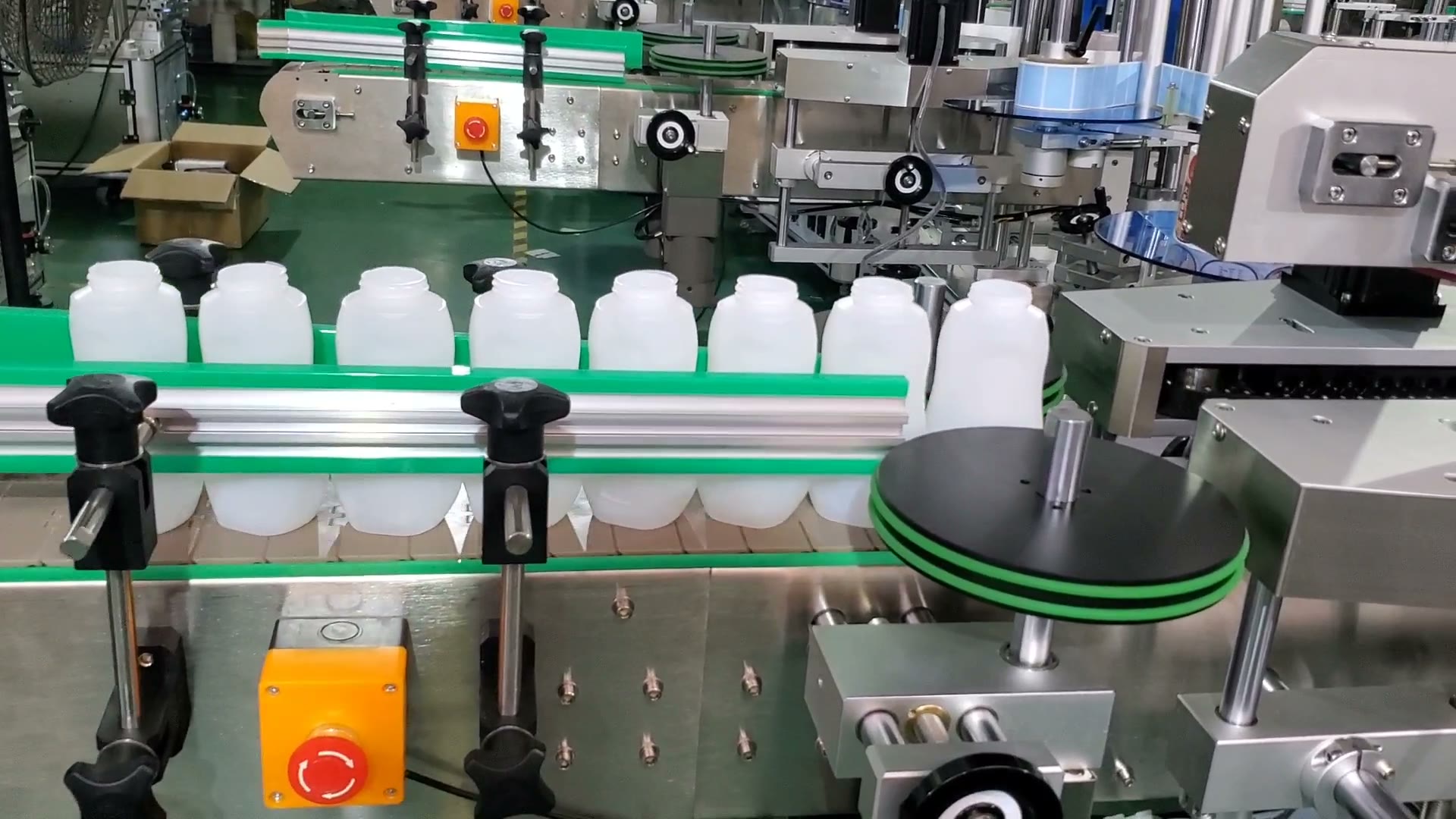
What Breaks First When the Machine Moves?
Position repeatability is the first thing a move destroys, and it fails quietly. The head returns to the same rail hole, but the conveyor below it does not return to the same height, so the gap between the peel plate and the bottle changes by the depth of a worn foot pad. Guide rails reset by eye drift inward over a shift, and a rail that sits 2 mm too tight tilts a round bottle at the wrap station. Speed matching fails next, because the line’s conveyor inverter keeps its own ramp and the labeler’s recipe assumed the other line’s ramp. Air and electrical quick couplings introduce their own faults: a swapped 8 mm line drops blow pressure, and a control cable routed over a walkway collects damage. The move ends with a first article bottle that looks correct at 40 bottles per minute and drifts at 200.
Which Repeatability Check Proves the Move?
A repeatability check is a measurement of the same position taken after repeated moves, and it is the only evidence that separates a good rail from a rail that merely looks solid. The check needs a magnetic base, a dial indicator with 0.01 mm resolution, and a datum on the labeling head that faces the same direction after every move. Record the reading at move one, then push the head off the rail, seat it again, and read the same datum. Ten cycles give a spread. Compare that spread with the label placement tolerance the line already holds, and write both figures on one sheet. A rail with taper pins and hard stops holds a tighter spread than a rail with castors and a clamp, and the difference appears in the tenth reading rather than the first.
The ten-move test, step by step
The ten-move test is a sequence of five actions repeated until ten readings exist, and it takes about twenty minutes with two people.
Step 1: park the machine at line A, fit the dial indicator on the conveyor frame, and zero the probe against the head datum.
Step 2: record the reading, release the rail locks, and move the head to line B.
Step 3: seat the head, lock the rail and read the same datum again.
Step 4: repeat the move in both directions until ten readings are on the sheet.
Step 5: mark the total spread, the date and the two operators on the sheet.
For example, a spread of 0.15 mm against a placement tolerance of 0.5 mm leaves room for thermal drift, while a spread of 0.6 mm explains a label that sits low on one line only. File the sheet with the factory acceptance test record, because it is the document that answers the argument six months later.
What Belongs in the Requalification File?
A requalification file is the evidence set that shows a machine is still in a qualified state at its new position, and six documents cover a bottle line. The file is built at the move, not after the first complaint. It starts with the location record, then the repeatability sheet, then the first article check, then the changeover checklist, then the line clearance record, and it closes with the change control entry that QA signs. Each document answers a different question, and a missing sheet turns a routine move into an unplanned deviation. The table below names the six, what each one proves, and who signs. On a pharmaceutical or a food line, the same six documents also feed the annual review, so the effort is spent once and used twice.
Six documents and what each one proves
| Document | What it proves | Who signs |
|---|---|---|
| Location record | Machine position, line ID and services after the move | Production and maintenance |
| Repeatability sheet | Head to conveyor position over ten moves | Maintenance |
| First article check | Label position, content and barcode on the first bottle | Quality control |
| Changeover checklist | Rail, star wheel, recipe and guard steps completed | Operator and supervisor |
| Line clearance record | No material from the previous batch left in the path | Quality control |
| Change control entry | Quality assurance approved the move before restart | Quality assurance |
Who signs, and why the signature matters
A signature on a requalification sheet is an assertion of fact by a named person, and that is why the sheet survives an audit. The maintenance technician signs the repeatability reading because that person held the indicator. The operator signs the changeover checklist because that person moved the star wheel and set the recipe. Quality control signs the first article and the line clearance because those two records decide whether product may be released. Quality assurance signs the change control entry because the move is a change to a validated state. Under EU GMP Annex 15, published in 2015, a change to qualified equipment requires an assessment before use, and the signature is the point where the assessment becomes a record rather than a conversation.
Does a Move Invalidate IQ, OQ and PQ?
Installation qualification is the documented proof that equipment is installed as designed, and a move breaks that proof at the moment the anchor bolts leave the floor. In the GMP sequence, IQ covers installation, OQ covers operation across the intended range, and PQ covers performance on the actual product. A move invalidates part of the IQ because position, services and surrounding equipment change. OQ may survive if settings are unchanged, and PQ usually needs a repeat because the line and the bottles are not the same. A risk assessment decides the scope, and that assessment is the document an inspector asks for first. A practical rule is to repeat the IQ in full, repeat the OQ items that touch the conveyor and the rail, and repeat the PQ on the first batch at the new position.
What Does a Move Cost in Hours, Not Money?
The cost of a shared labeler is measured in hours of lost line time, and the hours hide in the changeover rather than in the move itself. A move between two lines takes eight actions: release and lock the rail, swap the star wheel, reset the guide rails, recall the recipe, re teach the gap sensor, refit the guard, run the first article, and complete the line clearance. Two of those actions are mechanical, three are settings, and three are records. When the total sits above 30 minutes and the move happens more than twice a week, the shared machine spends more time being adjusted than labeling, and a second machine wins on line hours even before money is counted. Below that threshold the rail is the cheaper answer, provided the repeatability sheet and the change control entry are ready before the first move.
Eight actions in the changeover
A changeover is a fixed sequence of eight actions, and each has an owner.
First, release the rail locks and move the head, then lock and confirm the taper pins seated.
Second, swap the star wheel to the bottle diameter of the line.
Third, reset both guide rails against a sample bottle, not against the previous setting.
Fourth, recall the line recipe and confirm the speed ramp on the conveyor inverter.
Fifth, re teach the gap sensor on a real bottle from the new line.
Sixth, refit the guard and check the interlock before the conveyor runs.
Seventh, run the first article and measure label position, content and barcode grade.
Eighth, complete the line clearance record and hand the sheet to quality control.
For example, a skipped rail confirmation passes the first article and fails the fourth hour. The eight actions are the requalification in its shortest form.
One Labeler, Two Lines: Questions Buyers Ask
Do the rails need locating pins or clamps?
Locating pins are the better answer, and the reason is repeatability rather than strength. A taper pin seats in a hardened bushing with no sliding clearance, so the head returns to the same position after every move. A clamp relies on friction and operator force, and the position drifts as the clamp wears. A rail with two taper pins, a hard stop and a lock handle covers most two line installations. Ask for the pin and bushing drawing, because a pin pressed into a soft plate does not hold a position after a hundred moves.
Does the move need a new validation on a regulated line?
A move on a regulated line needs a change control assessment, and the assessment decides what is repeated. Under 21 CFR 211.63, equipment must be of appropriate design, adequate size and suitably located, so location is part of the qualified state rather than a housekeeping detail. A serialization line adds a second record, because the line identifier registered in the traceability system has to match the physical position. The 21 CFR 211 text is short and worth reading before the move is planned, and the DSCSA rules make the line to serial number link auditable.
Who pays when the shared machine stops?
A shared machine turns one breakdown into two stopped lines, and the purchase contract should say who pays for that. Three clauses cover the gap: a response time measured from the call rather than from the technician’s arrival, a spare parts stock list held at the buyer’s site, and a downtime credit calculated against both lines rather than one. A supplier who accepts only a single line liability has priced the risk on the assumption that the second line does not exist. Write the three clauses before the rail is ordered, because they are cheaper to negotiate than to argue.
The decision closes with two documents, not with a quotation. The first is a repeatability sheet from a real move on the buyer’s own bottles, and the second is the requalification file that travels with the machine. HiPaks records a trial labeling run on the buyer’s bottles and sends the video before shipment, which gives the first article check a baseline from the factory rather than from a brochure. Send the filling schedule and the bottle diameters with the enquiry, and the rail answer comes back with the retrofit scope attached. The quotation then covers the machine, the rail and the file.
