
The battery limit of a retrofit is the written line where the labeling machine stops and the plant starts. The applicator head, its local control cabinet and the guard around the head form one scope. The conveyor, the reject device, the line PLC and the air drop usually form another. No purchase order makes that split automatic, and published guidance stops at the technical steps. This page gives the split as a table, separates supply from install from commission, and names seven items that go blank before the first site meeting.
Why Does the Retrofit Scope Argument Start After the Purchase Order?
A retrofit dispute is a disagreement about a boundary rather than about machine capability. First, the machine quotation is written around the machine, so the conveyor appears as a note instead of a line. Second, the site works are priced by the plant’s contractor, often after the machine order is signed. Third, production signs the run-off while purchasing signs the order, and the two signatures sit on different documents. According to the European Commission machinery page, machinery is an assembly of components, at least one of which moves, joined together for a specific application. Join a labeling head to an existing conveyor and the combination becomes the assembly, so the boundary decides which party owns it. Every machine placed on the EU market before 20 January 2027 must comply with Directive 2006/42/EC. In practice the argument surfaces on day one, with two crews and two drawings.
Where Does the Labeling Machine’s Scope End on a Retrofit?
The battery limit runs along four interfaces, and each interface is a separate commercial line. Mechanical covers the frame, the mounting bracket, the height and pitch datum, the guard at the transfer point and the conveyor either side of the head. Electrical covers the feed, the isolator, the cabinet, the cable tray, the glands and the protective bonding. Controls covers the handshake with the line PLC, the speed reference, the reject trigger and the alarm word. Air covers the drop, the filter-regulator, the hose and the dryer. The label applicator head page lists what ships inside the head scope, and the labeling line retrofit guide covers the technical sequence, so the four verbs below are the commercial half.
What Does the Four-Part Battery Limit Table Look Like?
| Scope line | Who supplies | Who installs | Who commissions |
|---|---|---|---|
| Applicator head, baseplate, local cabinet | HiPaks | HiPaks, with plant fitters | HiPaks, placement settings |
| Mounting bracket to the conveyor | HiPaks bracket | Plant or integrator, drilling | Joint, both signatures |
| Transfer-point guard and interlock | Agreed at quotation | Plant or integrator | Both, interlock test |
| Feed, isolator and protective bonding | Plant | Plant electrician | Plant, witnessed by HiPaks |
| Line PLC handshake and alarm word | Both, per the I/O list | Plant controls contractor | Joint, signal forcing |
| Reject device and confirmation sensor | Plant | Plant | Joint, reject test |
| Air drop, filter regulator and hose | Plant drop, HiPaks regulator when quoted | Plant | HiPaks, applicator pressure |
| Drawing set, as-built file, sign-off sheet | HiPaks machine set | Both | Both, before balance payment |
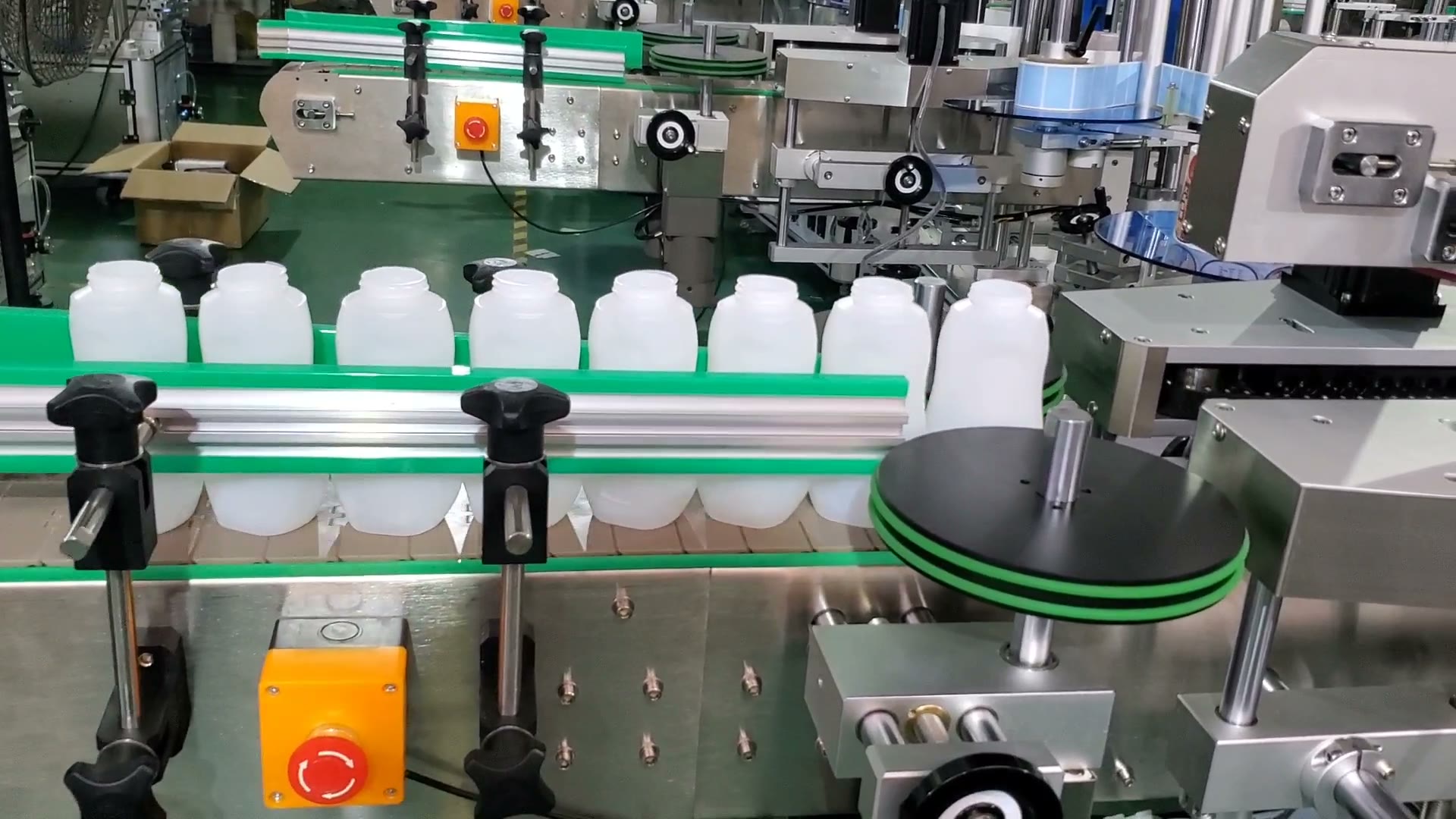
Why Is the Placement Number Only Valid Against a Written Interface?
A placement figure is a tolerance chain, so the promise only holds against a defined interface. HiPaks quotes plus or minus 0.5 mm on semi-automatic machines, up to plus or minus 0.2 mm on the MT-807, and plus or minus 1 mm on automatic machines, and those figures exclude product and label variation. The conveyor decides the rest. For example, a bottle that swings 0.5 mm sideways at the peel plate uses 50% of a 1 mm placement window before a label is applied, and the other 50% has to cover label placement, product variation and wear. That is why a retrofit is quoted against a written interface: pitch, speed, centre height and the datum face. Without the interface the figure is an intention, and no test run in 2026 settles a claim afterwards. HiPaks runs the buyer’s own bottles before shipment and films the run. Request a Free Test-Run Video and the film arrives with the offer.
Why Are Supply, Install and Commission Three Different Answers?
Three verbs hide inside the word supplied, and each verb carries a different cost, a different crew and a different signature.
Which Verb Does a Site Dispute Actually Turn On?
A supplied item is not an installed item, and an installed item is not a commissioned one. Disputes turn on the second and third verbs far more often than on the first. First, installation covers mechanical fixing, cable pulling, terminations and pipework, and the crew that does the work is rarely the crew that signed the machine order. Second, commissioning covers power-up, signal forcing, the first run at line speed and the signed record, and a machine can stand installed for a month before anyone commissions it. Third, the hand-off between the two is where a week disappears, because the installer waits for a drawing and the commissioner waits for the installer. Wrapping three verbs into one line hides two hand-offs. In our own retrofit quotations the three verbs sit on three separate lines, and every line carries a name.
What Four Sentences Split the Verbs in the Quotation?
Four sentences convert the verbs into a contract. First, name the party that supplies, the party that installs and the party that commissions each line item, and leave no cell empty. Second, require a drawing for every interface, with the revision and the date, so a bracket is drilled to a document rather than to a photograph. Third, state the sign-off test for each item, for example a handshake bit forced from the line PLC and a reject fired with the buyer’s own bottle. Fourth, state the working hours, the access route and the lifting equipment each crew assumes. The signal list behind the third sentence is the six-row PLC I/O list, and a quotation that survives the four sentences reads on site. Send the annex with the quotation, not after it.
Which Seven Grey Items Go Blank First?
Seven items sit outside the four interfaces as most buyers draw them, and every one of those seven turns into a delay when the cell is left empty.
Which Grey Items Go Blank on the Mechanical and Electrical Side?
Three of the seven grey items sit on the mechanical and electrical side. First, the speed reference: a driven shaft encoder gives the head a real ratio to the conveyor, while a timed delay gives an assumed one, and the choice changes who mounts the encoder and who owns the drift as belts wear. Second, the reject confirmation sensor: a reject device pushes a bottle, a confirmation sensor proves the bottle left the lane, and the two belong on separate lines with separate owners. Third, the guard interlock at the transfer point: ISO 14119 covers the interlocking device, and the party that builds the guard usually owns the switch, while the party that owns the PLC owns the input. In practice the encoder row is the one that goes blank most often. Two crews book one electrician.
Which Grey Items Go Blank on the Control and Air Side?
Four of the seven grey items sit on the control and air side. First, the single 0 V bonding point. A bonding point is the stud where every cabinet connects to the protective conductor, and two cabinets bonded at two points create a loop, so IEC 60204-1 expects one protective bonding system per machine and the drawing has to name the stud. Second, the air drop: the plant runs the drop and the isolation valve, the head needs a filter regulator and a hose, and the filter element belongs to whoever owns the regulator, as the air supply site drawing sets out. Third, the accumulation buffer: capacity is set by production and paid by the conveyor budget. Fourth, the stop category: IEC 60204-1 defines stop category 0, 1 and 2, and a labeler fault that stops the head and not the infeed fills the buffer and then stops the line.
What Does the Seven-Item Grey List Look Like?
| Grey item | Why it goes blank | Owner to name |
|---|---|---|
| Speed reference | Encoder or timed delay, and nobody prices the bracket | Party that owns the conveyor drive |
| Reject confirmation sensor | Priced inside the reject device | Party that owns the reject lane |
| Transfer-point interlock | Guard builder and PLC owner differ | Party that builds the guard |
| Single 0 V bonding point | Two cabinets, two studs, one loop | Party that owns the main cabinet |
| Air drop and filter regulator | Drop quoted, regulator and hose assumed | Plant for the drop, supplier for the head |
| Accumulation buffer | Paid by the conveyor budget | Party that owns the infeed conveyor |
| Stop category on head fault | Nobody states which category the line adopts | Party that owns the line safety circuit |
Frequently Asked Questions
Who Supplies the Conveyor on a Labeling Retrofit?
A conveyor is a plant asset, so the plant or its line integrator supplies and installs the conveyor in almost every retrofit, and the machine supplier states the interface. HiPaks supplies the applicator head, its local cabinet and the mounting bracket, and the bracket is drilled to a datum the plant agrees in writing. Name an owner for the encoder or the timed delay carrying the speed reference.
Does the Reject Device Include a Confirmation Sensor?
A reject device and a reject confirmation sensor are two items, and most quotations price only the first. The reject device pushes or diverts the bottle, and the confirmation sensor proves the bottle left the lane so the line PLC can count a verified reject. Put the sensor on its own line with its own owner, bracket and PLC input.
What Does the Annex Say When One Party Is Late?
A late scope is a standstill with a named cost, counted in crew days and calendar days rather than in money. Three lines do the work. First, each party records the date its scope was ready. Second, idle days are counted per crew, so two crews waiting is two crew days per day. Third, the party that caused the delay accepts the extension and confirms it within five days. Payment follows the machine rather than the site: 30% deposit with the order and 70% before shipment on most models, one unit minimum, FOB Shenzhen. Get a Factory Quote and the annex can be drafted against your site.
Which Documents Close the Hand-Off?
Four documents close a hand-off. The signed battery limit table names supply, install and commission per line item. The as-built drawing set carries the revision of every interface. The sign-off sheet carries the test, date and two signatures. The parameter backup closes the machine side.
Does the Split Change the Machine Warranty?
The split does not change the machine warranty, and the split does change what the warranty covers. HiPaks covers the machine for one year with lifetime technical support, and wear parts are excluded. Damage from a conveyor the machine does not control, for example a jam that pushes bottles into the head, is a site condition, so the annex should record the interface the machine was set to.
