
A UL 508A listed panel is not mandatory by federal statute for a labeling machine shipped to the United States, and a panel without a listing mark can still be refused at commissioning. The gap between those two statements is where most Chinese built machines lose time. The National Electrical Code requires an industrial control panel to carry a marking that names the manufacturer, the supply voltage, the rated current, the short circuit current rating and the enclosure type. The Occupational Safety and Health Administration requires equipment to be approved, and a nationally recognized testing laboratory is how approval is normally shown. The authority having jurisdiction, the insurer and the plant specification then decide whether a listed panel is required in practice. This page sets out the three routes that produce a listed panel for a machine built in China, the six documents that close the file, and the short circuit current rating that sinks projects with a valid label.
Is a UL 508A Listed Panel Mandatory for a Machine Shipped to the US?
A UL 508A listing is a voluntary certification that becomes mandatory through the code, the insurer or the customer specification, and the three should be read in that order. Article 409 of the National Electrical Code covers industrial control panels and requires a marking rather than a specific certification body, so a panel assessed by any recognized laboratory meets the marking rule. OSHA requires approved equipment under 29 CFR 1910.303, and the NRTL program is how a laboratory becomes recognized for that purpose. A plant insurer can add a requirement that no code text contains. In practice, an unlisted panel is often accepted after a field evaluation, and a listed panel avoids that step. A Chinese machine builder therefore faces a commercial question, not a legal one, and the answer depends on the buyer’s specification.
Who Is Allowed to Apply the UL 508A Mark?
The UL 508A mark is applied by a panel shop that holds authorization under the UL Industrial Control Panel Shop Program, and the authorization belongs to the shop rather than to the machine builder. Under that program, UL audits the shop’s quality system, reviews the panel designs against UL 508A, and inspects production on a follow-up schedule. A shop outside the United States can hold the authorization, and several Chinese panel shops do. The mark cannot be bought as a sticker, and a machine builder without authorization cannot legally apply it. According to UL, the scope of a panel listing also stops at the panel, so the listing does not certify the machine that the panel controls. That boundary matters when a buyer assumes a listed cabinet makes the whole labeler listed.
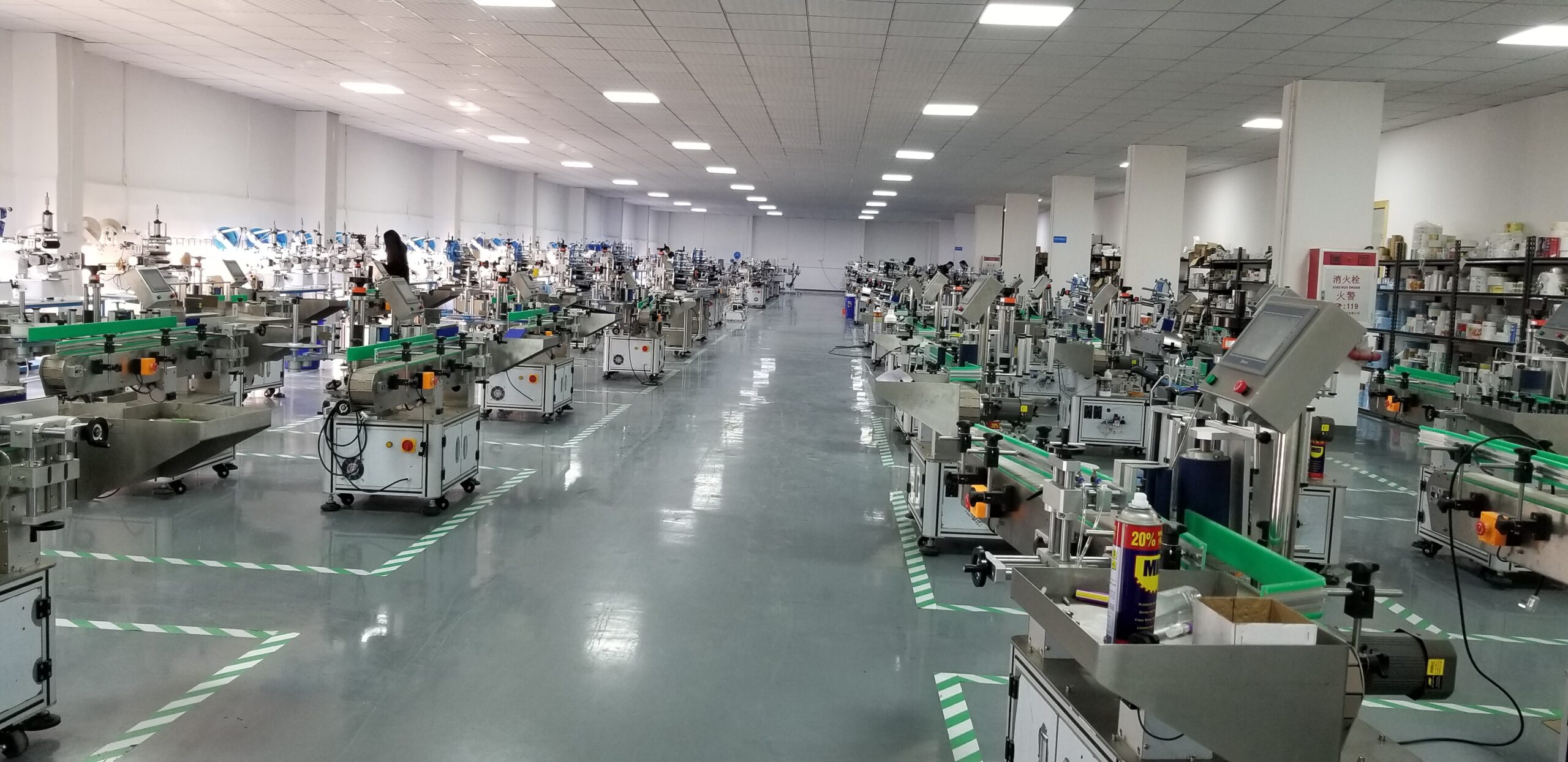
Route 1: A UL Authorized Panel Shop Builds the Cabinet
Route 1 is a panel built by an authorized shop in China, and it is the cleanest route when the machine is designed early enough to plan for it. The machine builder sends the electrical schematic, the component list and the enclosure specification to the panel shop, and the shop builds to UL 508A with components that carry UL Recognized or Listed marks. The shop applies the label under its own file number, and UL’s follow-up inspection covers the build. Two conditions decide whether the route works. First, the components must be recognizable: a Mean Well power supply, a SICK sensor or a Panasonic photoelectric head each carry a file number, while an unlisted switching supply stops the build. Second, the SCCR calculation must be part of the design, not an afterthought. The route adds a qualification step before the cabinet leaves China, and it removes the arrival risk that Route 2 carries.
Route 2: A Field Evaluation at the Port of Arrival
A field evaluation is an assessment of a specific machine at its installed location by a recognized body, and it produces a field label rather than a listing. The practice is defined by NFPA 790 for the competence of field evaluation bodies and NFPA 791 for the method, and UL, Intertek and CSA all offer the service in the United States. The evaluator works from the drawings, the component list, the SCCR calculation and a physical inspection, then issues a report and a label for that machine only. Three things go wrong on this route. The evaluation is priced per machine, so a second identical machine needs a second evaluation. A finding on site stops commissioning until the part is replaced, which is expensive when the part is in Asia. The report depends on documents that the machine builder must supply in English and in a form the evaluator accepts.
Route 3: Rebuild the Cabinet in the United States
Route 3 replaces the Chinese cabinet with a panel built by a US shop, and it is the route that most often follows a rejected delivery. The machine arrives as a mechanical assembly with motors, sensors and a wiring harness, and a US panel shop builds the control cabinet against UL 508A and the machine’s schematic. The route solves three problems at once: the panel is listed by a shop the local inspector already knows, the SCCR calculation is done against the actual supply, and the spare parts are domestic. It also adds cost and time, because the cabinet is built twice and the machine is commissioned after the panel arrives. Route 3 is defensible when the machine is a one off with a long life, or when the buyer’s specification names a US panel shop. It is a poor fit for a repeat order, where the cabinet cost repeats with each machine.
What Does SCCR Have to Do With the Listing?
A short circuit current rating is the maximum fault current a panel can withstand without a hazard, and it is the number that most often blocks a machine with a valid label. UL 508A Supplement SB sets the method for calculating the rating from the components inside the panel, and it assigns a default rating of 5 kA to a panel that carries no calculated value. The site then supplies its own number: the available fault current at the machine terminals, which follows from the transformer size and the impedance of the run. A panel rated 5 kA on a site with 10 kA available is a mismatch, and the inspector will ask for the calculation. According to Article 409 of the National Electrical Code, the panel marking must state the short circuit current rating, which is why the figure belongs on the drawing and on the nameplate rather than in a folder.
Which Six Documents Close the File?
A closed file for a listed panel is a folder in which every claim on the quotation has a document behind it, and six documents cover a machine built in China. The set is checked before the container is loaded, not after the machine is unloaded. Two of the six belong to the panel shop, two belong to the machine builder, one belongs to the component suppliers, and one belongs to the field evaluator when Route 2 is used. A buyer who asks for the six at the quotation stage learns more about the supplier than a factory tour shows, because a shop that holds an authorization can produce the file in a day, and a trader cannot produce it at all.
The six-document pack
The six-document pack is the evidence set a buyer, an inspector or a field evaluator reads, and each document answers a different question.
1. The panel shop authorization letter with the UL file number and the scope of the authorization.
2. The label photograph and the nameplate data, showing voltage, current, SCCR and enclosure type.
3. The SCCR calculation sheet prepared under UL 508A Supplement SB, per the 2023 edition of the National Electrical Code Article 409.
4. The bill of materials with the UL file number for each Recognized or Listed component.
5. The wiring diagram and the NFPA 79 compliance statement for the machine.
6. The field evaluation report and field label, when Route 2 was used instead of Route 1.
For example, a file missing item 3 passes a visual inspection and fails the electrical inspection. Request all six in English, and treat a missing item as a schedule risk rather than a paperwork detail.
Which Route Fits Your Project?
The route is chosen from three inputs: the order quantity, the buyer’s specification and the time available before commissioning. A repeat order with a US distributor points to Route 1, because the qualification cost is paid once and reused. A single custom machine with a fixed installation date points to Route 1 as well, provided the design starts early enough. Route 2 fits a machine that is already built and already shipped, and it fits a plant that has an evaluator on call. Route 3 fits a rejected delivery or a buyer who names a local panel shop in the purchase order. A fourth option, shipping an unlisted panel and hoping for acceptance, is not a route: it moves the risk to the commissioning week, where a rework costs more than any of the three.
Three routes side by side
| Route | What it needs before shipment | Where the risk sits |
|---|---|---|
| 1. Authorized panel shop in China | Authorization letter, UL file number, SCCR calculation, recognized components | Design must be fixed before the cabinet is built |
| 2. Field evaluation on arrival | Drawings, component list, SCCR sheet, evaluator booking | Findings on site stop commissioning |
| 3. Rebuild the cabinet in the US | A US panel shop, a shipped harness and a second build slot | Cost and time repeat with every machine |
| No listing, acceptance by inspection | A cooperative authority having jurisdiction | Refusal at commissioning, with no fallback |
How to decide in one meeting
A route decision is a single meeting with four documents on the table, and it takes less than an hour when the documents exist.
Step 1: read the buyer’s specification for the words listed, certified or NRTL, because that sentence decides more than the code does.
Step 2: read the site’s available fault current, and compare it with the SCCR the panel can reach.
Step 3: check the order quantity, because a repeat order spreads the Route 1 cost and a single machine does not.
Step 4: check the installation date against the panel shop’s build slot.
The route then follows from the four readings, and the six-document pack follows the route. On a HiPaks build the panel carries SICK and Panasonic sensing with Mean Well power and Leadshine steppers, so the component file numbers exist before the panel design starts, which is what makes Route 1 a scheduling question rather than an engineering one.
Two actions make the topic concrete. First, ask for the panel shop authorization letter and the SCCR sheet with the quotation, because a supplier who cannot produce them at that stage will not produce them at shipment. Second, write the route into the purchase order, so the commissioning week has one answer rather than three opinions. The CE and UL certification page sets out how the European file and the North American file fit together, and the quotation can be issued with the panel route named on it.
