
A wrap-around labeling machine does not push a label onto a bottle. It releases the leading edge of a self-adhesive label onto a bottle that is already turning, and the rotation carries the rest of the label around the body. Three contacts make that happen: the peeling plate that separates label from liner, the belt pair that spins the bottle, and the wrap belt that keeps the label pressed to the surface until the trailing edge lands. Everything that goes wrong in wrap-around labeling traces back to one of those three contacts, or to the timing between them. The bottle does not have to be perfectly round, but it does have to turn at a surface speed that matches the rate the label is being released.
Three contacts, one continuous motion
Start with the liner path. The label web is pulled from the roll, over a dancer arm that holds tension, and around a peeling plate with a deliberately small radius. A pressure-sensitive label is stiff enough to keep going straight when the liner turns sharply, so it lifts off the plate and projects into the air for a few millimeters. That projecting edge is the only part of the label the machine ever controls directly.
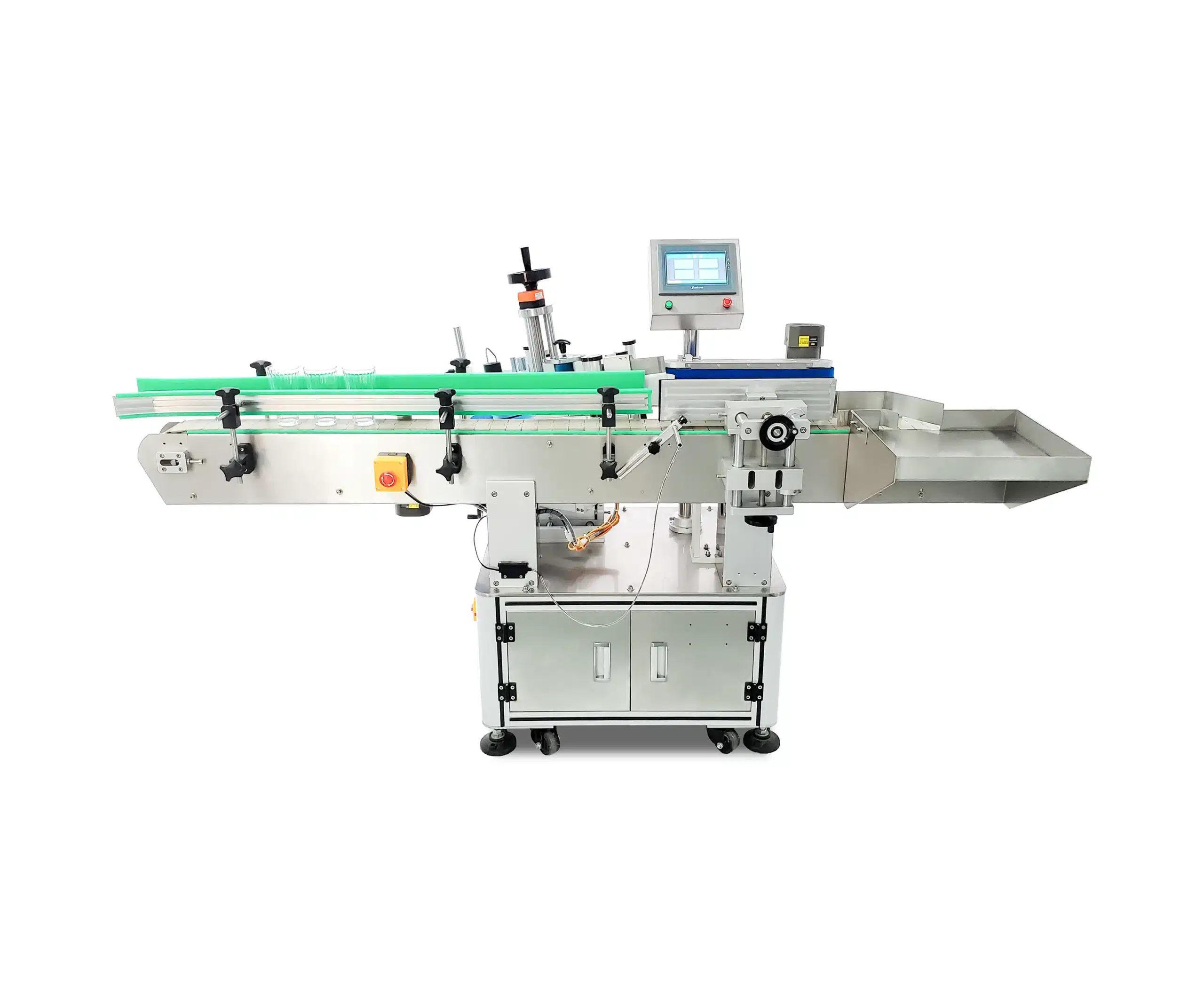
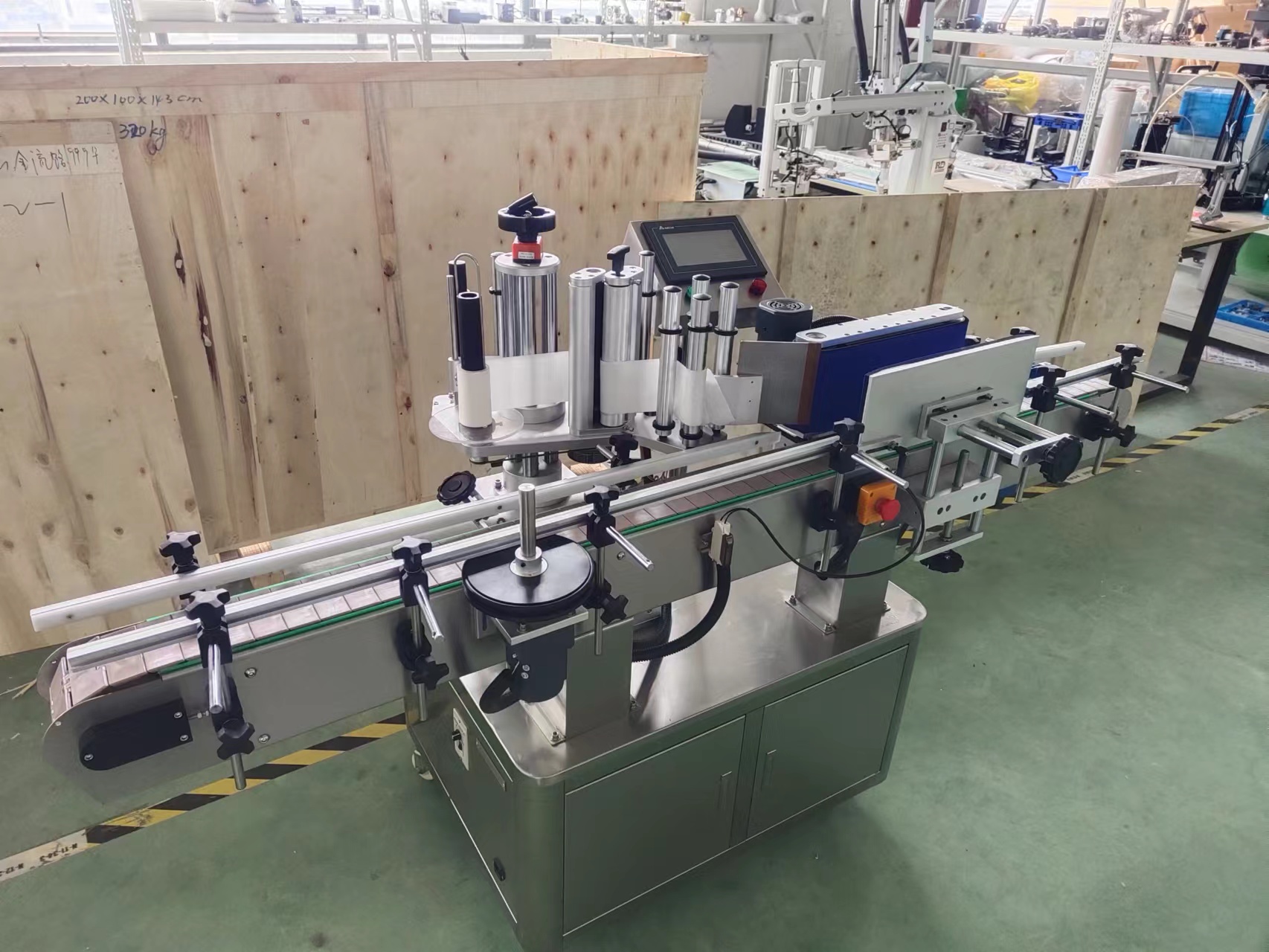
Now the bottle. It arrives on a conveyor, is picked up by a pair of belts running at the same height as the label band, and starts to spin around its own vertical axis. The gap between the belts is set so the bottle is gripped with enough force to rotate it without crushing it. On the other side of the bottle, the wrap belt or a curved wrap plate keeps the body in contact with the label as it comes around.
The three contacts meet at one point, and the whole machine is really a timing device for that meeting. If the leading edge arrives when the bottle surface is stationary, the label sticks in one spot and the rest of it wraps into a fold. If it arrives when the bottle is already at full speed, the label lands and travels with the surface cleanly.
One wrap, step by step
The sequence below is what happens between two bottles on a machine running at a steady rate. At 60 bottles per minute, one bottle leaves the star wheel every second, so the whole cycle fits inside that second.
- Gap detection. A sensor reads the gap between labels on the liner and tells the drive when to expect the next leading edge. On clear labels on a clear liner, this is where a standard optical sensor gives up, and the fix is a different sensing principle rather than more operator attention.
- Bottle present. A second sensor confirms a bottle is in the wrap station. Without it, the machine would release a label into empty space, which is the fastest way to wrap a label around a belt.
- Rotation starts. The belt pair accelerates the bottle to the surface speed that matches the label release rate. Surface speed is circumference times rotation rate, so a 60 mm bottle turning once every half second has a surface speed near 376 mm per second. Change the diameter and the same rotation rate produces a different surface speed, which is why diameter belongs in the setup sheet.
- Leading edge transfer. The label is released at the peel plate and touches the bottle at the tangent point. This is the single most sensitive moment in the cycle: a few tenths of a millimeter of height error here becomes a visible skew by the time the label comes around.
- Wrap. The bottle keeps turning and pulls the label off the liner. The wrap belt holds the label against the body so it cannot lift while the adhesive is still developing its grip.
- Trailing edge and overlap. The last part of the label lands, and on a full wrap it overlaps the leading edge by the amount built into the label length. A brush or a second belt presses the overlap down.
- Exit. The bottle leaves the station and the next one enters. The drive has already begun to reverse or index for the following label.
Why the leading edge lands first, and why that matters
A self-adhesive label has a stiffness that depends on its face material and caliper. Paper labels are relatively stiff and project cleanly off the peel plate. Thin film labels are floppier, and on a small bottle they can start to curl before they touch anything. That difference is the reason a machine that runs paper labels perfectly can wrinkle film labels on the same bottle at the same speed.
The transfer point is also where the label picks up its vertical position. If the peel plate is set a little high, every label on that run sits high, and the operator compensates with the height handwheel. If the plate is set at an angle, the leading edge lands skewed and the rest of the wrap follows the skew. The correct check is to stop the machine mid-wrap and look at the label on the bottle, not to judge the finished bottle at the end of the conveyor.
Full wrap, partial wrap, and the degrees that decide the label
A full wrap covers most of the circumference and leaves a narrow unlabeled strip, typically around 30 degrees, where the label ends and the overlap sits. A partial wrap covers a front panel only and stops well short of the back. The two jobs need different label lengths and, often, different machines.
For a full wrap, the label length has to equal the wrap arc plus the overlap. On a 70 mm bottle the circumference is about 220 mm, so a full wrap label is in the region of 200 mm long depending on the overlap agreed. That length is the number the machine is set up around: too short and the gap at the seam looks like an error, too long and the overlap doubles up and lifts.
For a partial wrap, the label is short relative to the circumference and the machine has to stop the wrap at a defined angle. That is a positioning job rather than a wrapping job, and it is easier on a machine with a servo-driven spindle than on one that relies on friction alone. If your artwork is a front panel plus a small back panel, say so at quotation: it may be two stations rather than one.
What changes when the line speeds up
Speed changes the wrap in three ways, and all three come from the same physics. First, the bottle has less time in contact with the label, so the adhesive has less time under pressure. Second, the label is released faster, which raises the force needed to peel it from the liner and makes a thin liner more likely to snap or curl. Third, any timing error that was invisible at low speed becomes a visible skew, because the bottle travels further during the error.
Semi-automatic wrap-around machines run 15 to 30 pcs/min, where an operator loads each bottle and the wrap is slow enough to watch. Automatic inline machines run 40 to 300 pcs/min, where the wrap station is timed by a star wheel or a timing screw and the operator is not part of the cycle. Moving a job from the first class to the second is not just a speed change: it changes how the bottle is presented, how the label is released and how the finished bottle is inspected.
This is where the build shows. HiPaks fits SICK sensors from Germany, Panasonic sensors and controls from Japan, MEAN WELL power supplies and Leadshine steppers. At 200 pcs/min a sensor has to see a 2 mm gap on a fast-moving web, and the drive has to hold speed through a label release that momentarily loads it. Cheaper components work at 40 pcs/min and become the maintenance queue at 200.
Faults that trace back to rotation
Most wrap defects are described by where they appear on the bottle, which is also where they come from. Use the table as a first triage before adjusting anything.
| Symptom on the bottle | Where in the cycle | Usual cause | First check |
|---|---|---|---|
| Label sits high or low but square | Leading edge transfer | Peel plate height or label sensor position | Height setting against a stopped bottle, not a finished one |
| Label runs diagonally | Whole wrap | Bottle axis not parallel to the wrap belt, or plate set at an angle | Belt parallelism and plate squareness |
| Trailing edge lifts or flags | End of wrap | Wrap belt lost contact, or label too long for the arc | Belt pressure at the exit and label length against circumference |
| Bubble or crease in the middle | Mid wrap | Label released faster than the surface is moving | Label release rate against bottle surface speed |
| Overlap doubles or bulges | Trailing edge | Label longer than the arc plus intended overlap | Measure the label, then the circumference at the band |
| One side of the label stretched | Whole wrap | Taper: the surface speed changes across the label width | Caliper readings top, middle and bottom of the band |
Two of those rows deserve a note. The diagonal label is almost never a sensor problem, and operators spend a shift adjusting sensors before someone checks whether the bottle is sitting square in the belt pair. The stretched side is the taper showing up as a speed difference: the top of the label travels a shorter path than the bottom, so one edge has to give. That case is covered in detail in the guide to tapered bottle labeling, and the parts that wear into it are listed on the labeling machine parts page.
Guarding the rotation
A wrap station is two belts running toward each other with a bottle between them. That geometry creates nip points at both ends of the belt pair, and a hand that reaches in to straighten a fallen bottle is a hand at a nip point. The machine has to be guarded so that the wrap area cannot be reached while the belts are turning, and the guard has to be interlocked so that opening it stops the drive rather than merely covering the hazard.
The EU requirement is set out in the machinery section of the European Commission single market pages, which describes the essential health and safety requirements that a machine placed on the EU market has to meet. HiPaks states its position honestly: CE is in progress rather than complete. A buyer in Europe should ask which directives apply, what the declaration of conformity will say, and whether the guard on the quoted machine is interlocked. Those are reasonable questions at quotation and unreasonable discoveries at installation.
What to watch on a first run
Run the machine slowly for the first twenty bottles, then at production speed for the next hundred. Watch the leading edge at the moment of transfer, not the finished bottle. Check the overlap at the seam with a fingernail: a lifted edge is a wrap belt problem, a bulged edge is a label length problem. Then stop the machine, take a bottle out mid-wrap and look at where the label actually is. That single check explains more defects than an hour of adjusting the sensor.
If the bottle is tapered, recessed or unusually tall, the standard wrap may not be the right answer at all, and the quotation should say so before the order. HiPaks runs a labeling pass on customer bottles and labels before shipment and sends the video back, which is the cheapest way to see the wrap on your own container before the machine leaves the factory.
Frequently asked questions
How does a wrap-around labeler make the bottle spin?
Two belts run parallel at the height of the label band and grip the bottle between them. Because the belts move in the same direction on opposite sides of the bottle, the bottle rotates around its own axis. The gap between the belts is set to the bottle diameter, and the belt speed is set to match the rate at which the label is released from the liner.
Can the same machine do a full wrap and a front panel label?
Often yes, but they are different jobs. A full wrap needs a label long enough to travel most of the circumference plus an overlap. A front panel needs the wrap to stop at a defined angle, which is a positioning task and easier with a servo-driven spindle. Tell the supplier both label lengths at quotation so the machine is built for the shorter one as well.
Why does the label wrinkle on one side only?
One-sided wrinkling is usually a diameter change across the label width. The surface speed at the wider end is higher than at the narrower end, so one edge of the label has to stretch or compress to follow. Measure the diameter at the top, middle and bottom of the band; if the numbers differ, the bottle is tapered and the fix is mechanical rather than a sensor adjustment.
What speed can a wrap-around machine run at?
Semi-automatic wrap-around machines run 15 to 30 pcs/min with an operator loading each bottle. Automatic inline machines run 40 to 300 pcs/min depending on bottle size, label length and how the bottle is presented to the wrap station. The upper end needs a star wheel or timing screw and a drive that holds speed through each label release.
If the wrap on your bottle is not behaving, send a short video of the stopped bottle mid-cycle plus the label length and the band measurements. That combination usually identifies the cause in one exchange.
See the mechanism running on real containers in the test-run video library, compare builds in the bottle labeling machine range, or read how the wrap station is assembled on the round bottle labeling machine manufacturer page. More of this cluster sits under round bottle labeling guides.
