
The short answer: three numbers decide which round bottle labeling machine you need, and only one of them is speed. Measure the diameter at the top, middle and bottom of the label band, record the height and where the center of gravity sits, then quote output at your busiest hour rather than your monthly average. Diameter sets the roller and belt geometry. Height sets the frame and the top hold-down. Peak output sets the drive, the number of stations and the conveyor interface. HiPaks quotes three round envelopes: 20 to 80 mm (Φ20-80) for standard work, 20 to 100 mm (Φ20-100) for wider bodies, and 10 to 30 mm (Φ10-30) for vials, ampoules and pens. A bottle inside a published range can still need a different hold-down, so the range opens the conversation rather than closing it.
Diameter: three readings, not one nominal size
A drawing gives one diameter. A real bottle gives at least three. Measure at the top of the label band, at the middle and at the bottom, and write all three down. A cosmetic bottle that reads 74.0 mm at the waist and 72.6 mm at the shoulder is a tapered bottle whether or not the artwork says so, and the difference is what the wrap mechanism has to absorb.
The arithmetic is simple and worth doing before you send an inquiry. Circumference equals pi times diameter. A 3 mm diameter difference across the band changes the circumference by about 9.4 mm. That 9.4 mm has to go somewhere: the label either compresses at one edge, lifts at the other, or the operator slows the machine until neither happens. On a straight-sided bottle the same machine runs at its quoted speed with no drama.
Diameter also sets two mechanical settings that fight each other. The roller gap is opened to clear the largest diameter in the batch, and the drive belt is tensioned to grip the smallest. Widen the spread between those two numbers and the compromise gets worse. This is why a supplier who asks only for the average diameter is planning to solve the spread during commissioning, on your line, with your production manager watching.
Height sets the frame and the hold-down
Height is a frame decision before it is a labeling decision. It sets conveyor height, column height and the stroke the labeling head has to travel. A 240 mm wine bottle and a 90 mm cosmetic jar do not share a column, and the difference shows up as a machine that either cannot reach the label position or towers over the line.
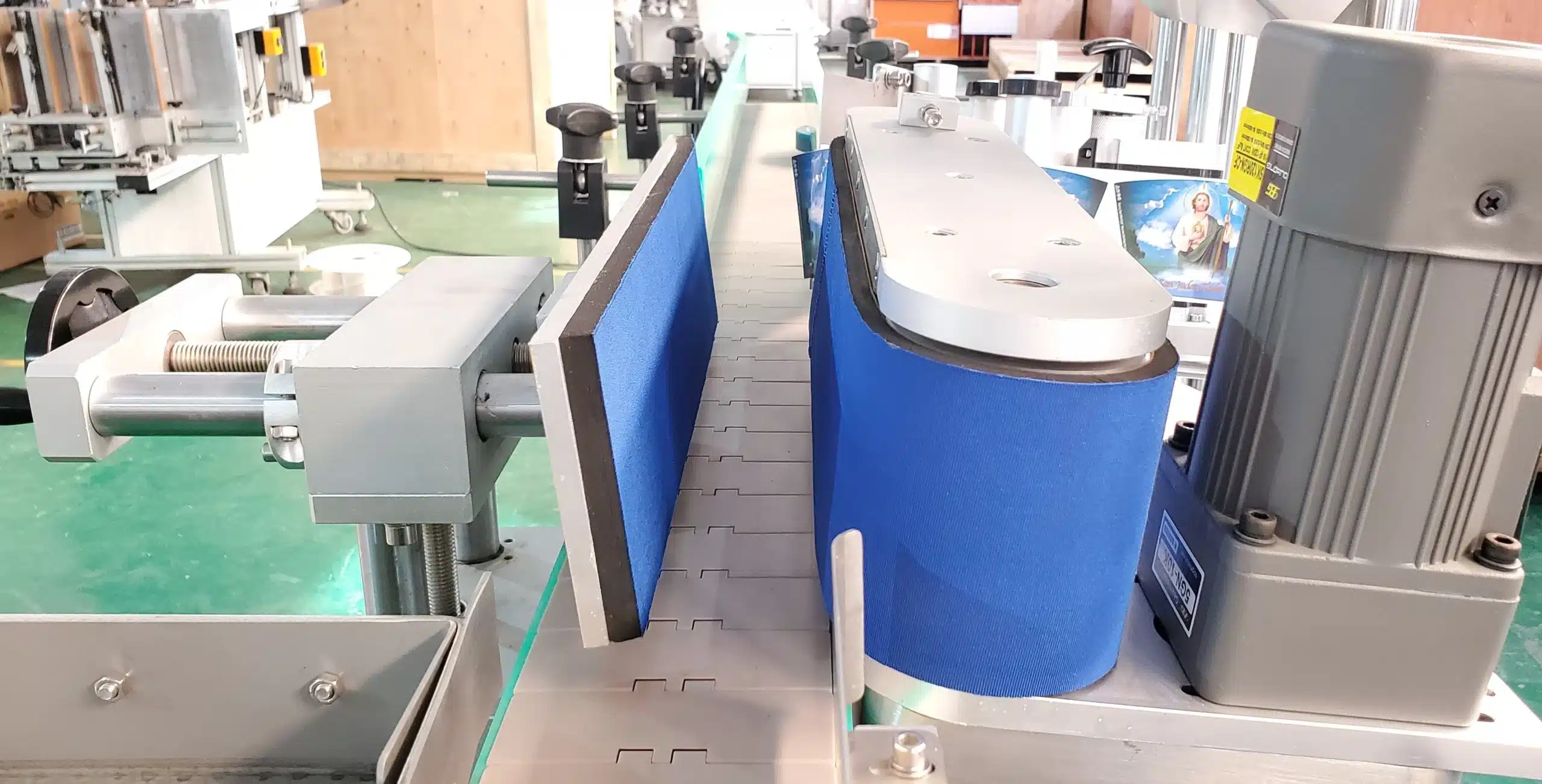
The center of gravity matters more than the height figure on its own. A tall bottle with a narrow base is stable while it sits on a conveyor and unstable the moment a belt starts it spinning. The usual answer is a top hold-down that presses on the closure, plus a guide rail that keeps the base from walking. Both are cheap at the specification stage and awkward to add after the frame is welded.
Wall thickness belongs in the same conversation. A thin-wall PET bottle deforms under a hold-down pressure that a glass bottle would not notice. If the bottle dents at the shoulder during the trial, the machine is not badly built, it is set for a heavier container than the one in front of it.
Speed: quote the peak hour, not the month
Fill in three numbers before you look at a catalog: bottles per shift, bottles in the busiest hour, and bottles in the busiest fifteen minutes. Size the machine against the second number and sanity-check the first after changeovers. Monthly volume divided by working days produces a figure that no shift ever actually sees.
The two machine classes sit in different ranges. Semi-automatic round bottle labelers are quoted at 15 to 30 pcs/min, which suits one operator feeding by hand, sample runs and short batches. Automatic inline machines are quoted at 40 to 300 pcs/min, which only pays off when the filling line upstream already produces faster than a person can load a bench unit.
Changeover belongs in the speed calculation, not in a footnote. If a line stops for ten minutes to swap format parts and does that twice a shift, twenty minutes of capacity disappear before any bottle is labeled. A machine quoted at 60 pcs/min with a fast changeover can beat one quoted at 80 pcs/min that needs a spanner and a manual every time the SKU changes. Ask for the changeover time in minutes and the format parts list with prices, then multiply by your real SKU count.
How the three numbers combine
The table below is a starting point for the inquiry, not a quotation. The model families are named because buyers ask for them by name; the exact build is confirmed against your bottle, your label and your line.
| Diameter at the band | Height and stability | Peak output | What it points to |
|---|---|---|---|
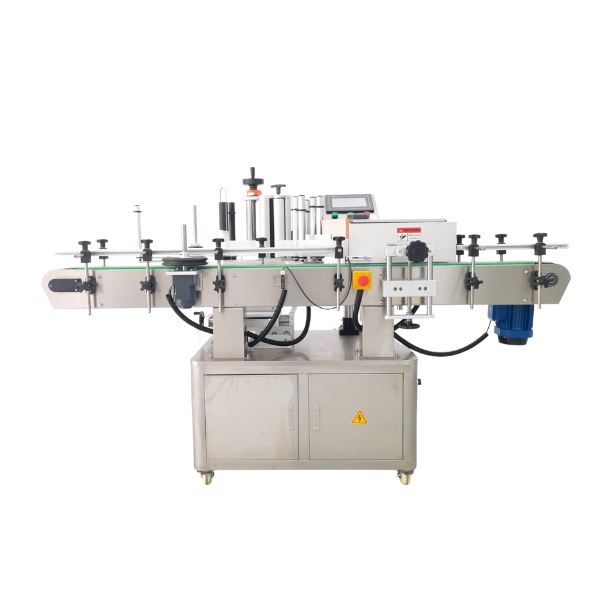
| 20 to 80 mm | Stands unaided on the conveyor | Under 30 pcs/min | Semi-automatic round bottle unit from the MT-801 family, one operator, bench or floor stand. |
| 20 to 80 mm | Tall or top-heavy, needs a hold-down and guide rails | 40 to 300 pcs/min | Automatic inline machine from the T921 family with a star wheel or timing screw matched to bottle pitch. |
| 20 to 100 mm | Wide body, mixed SKUs, check frame travel | Varies by shift | Automatic build with wider format parts; belt travel and wrap length grow with the body, so confirm the wrap angle first. |
| 10 to 30 mm | Short part, better supported lying on its side | Varies by batch | Horizontal handling from the T923 family, or a vertical machine with a small-radius roller and a lighter hold-down. |
What each diameter envelope actually changes
20 to 80 mm. This is the working range for most cosmetic, pharmaceutical, food and household bottles. Rollers, belts and wrap plates are standard, format parts are stocked, and the machine behaves the way the brochure says. If your bottle sits here with a taper under a couple of millimeters, a standard build is usually enough.
20 to 100 mm. The wider envelope exists for large-format cosmetic, sauce and spirit bottles. The mechanics do not change in principle, but the belt has further to travel, the wrap length grows with the circumference, and the format parts are specific to the build. Ordering a 100 mm machine to run 40 mm bottles is possible and usually a poor trade: the small bottle spends the wrap cycle under a belt sized for something twice its diameter.
10 to 30 mm. Below roughly 30 mm the label stops being flexible relative to the bottle. A 25 mm vial has a circumference near 78 mm, so a 60 mm label covers most of the way around and has very little room to recover from a positioning error. Small parts often run better horizontally, supported along their length, than standing upright on a conveyor. This envelope is covered in more detail in the guide to tapered and difficult bottle shapes and in the pharmaceutical labeling section of this site.
None of these envelopes is a guarantee. They describe what the frame and the tooling are built around. The confirmation step is a trial with your actual bottle, which is why HiPaks runs a labeling pass on customer bottles and labels before shipment and sends the video back.
Where selection goes wrong
- Sizing on the annual volume. Annual output divided by 250 days hides the seasonal peak that actually breaks the line.
- Quoting a speed with no bottle behind it. A pcs/min figure is meaningless without diameter, height, label length and operator count attached to it.
- Ignoring the taper. Two millimeters of taper is a geometry fact, not a cosmetic detail, and it decides whether the wrap belt can hold contact across the label width.
- Forgetting the label. A 20 mm tall label on a 70 mm bottle behaves differently from a 90 mm tall label that has to follow the shoulder curve.
- Buying accuracy you cannot inspect. Every tolerance needs a measurement point. Semi-automatic machines are quoted at plus or minus 0.5 mm and automatic machines at plus or minus 1 mm, both excluding deviation caused by the product and the label itself. Only the MT-807 is quoted up to plus or minus 0.2 mm, and that figure belongs to flat high-precision work rather than to every bottle job.
A tolerance figure is also a quality system claim. It is repeatable when the machine is built, assembled and checked under a documented process, which is the subject of the ISO 9000 family overview. HiPaks states its position plainly: ISO 9001 and CE are in progress, not complete. Ask any supplier whether the certificate is issued or in progress, and treat the answer as a signal about how the rest of the quotation was written.
The inquiry that gets a useful answer quickly
Five items settle most of the specification in one exchange:
- A photo of the bottle next to a ruler, plus caliper readings at the top, middle and bottom of the label band.
- One label roll, or the flat artwork dimensions with material, liner and adhesive grade noted.
- The line layout, even a hand sketch, with infeed height and available floor space.
- Peak hour output and the SKU list with typical run length per SKU.
- Site voltage, air pressure and any preferred control brands.
With those five, the answer comes back with assumptions written down: which envelope the bottle falls into, which wrap angle the label needs, and which parts change between SKUs. Without them, the answer is a price for a machine that may or may not fit.
HiPaks builds round bottle labelers from the semi-automatic bench unit up to the automatic inline machine, fits SICK sensors from Germany, Panasonic sensors and controls from Japan, MEAN WELL power supplies and Leadshine steppers, and ships to more than 50 countries with over 500 factories using its machines. The specification range is real, but the fit is decided by your bottle.
Frequently asked questions
What diameter range does a round bottle labeling machine cover?
HiPaks quotes three envelopes: 20 to 80 mm for standard round bottles, 20 to 100 mm for wider bodies, and 10 to 30 mm for vials, ampoules and pens. The envelope describes the frame and tooling, so a bottle inside the range is a candidate rather than a confirmation. Send caliper readings at the top, middle and bottom of the label band and the fit is confirmed at quotation.
Can one machine label several bottle sizes?
Yes, with format parts. A changeover set typically covers the diameter range, the label height and the wrap length. The honest limit is the taper and the spread between the smallest and largest diameter: a machine set up for 40 mm bottles will not hold a 100 mm bottle well, and the reverse is also true.
Is a semi-automatic machine fast enough for a retail launch?
Semi-automatic machines run 15 to 30 pcs/min, which covers sample runs, farmers markets and short retail batches. A launch that needs thousands of bottles a week usually moves to an automatic machine in the 40 to 300 pcs/min class, because the constraint becomes loading the bench unit rather than labeling the bottle.
How long does delivery take once the specification is agreed?
Semi-automatic machines ship in 7 to 10 days. Automatic machines ship in 7 to 25 days depending on configuration, and custom builds take 25 days or more. MOQ is one unit, payment is normally 30 percent TT deposit with 70 percent before shipment, 50/50 on some models, FOB Shenzhen. Add transit and customs clearance for your destination.
If the three numbers are still rough, send the bottle photo and the band measurements with the gaps marked. You will get a specification back that names the envelope, the wrap angle and the parts that change between SKUs.
Want to see the machine run on a bottle like yours? Request a Free Test-Run Video, compare models in the bottle labeling machine range, or read the build details on the round bottle labeling machine manufacturer page. The rest of this cluster sits under round bottle labeling guides.
