
Verify four things before any money moves: that the company legally manufactures instead of reselling, that the machine you are paying for exists as a build in progress, that the parts inside it are the brands printed on the quotation, and that the factory will run your own bottles and labels on video before it crates the machine. Everything else, the showroom, the framed certificates, the trade-show photographs, is supporting evidence. It is not proof. A factory that passes those four checks usually survives the paperwork questions further down this page. One that fails any of them will fail again after your deposit has cleared, when your bargaining position has gone and the schedule belongs to someone else.
Why the deposit is the moment of maximum risk
Before you pay, every lever is still in your hand. The specification can change, the price can still be compared, and walking away costs you nothing but a week. After a 30% deposit lands, three things move at once: the schedule becomes the factory’s to control, the quality argument becomes retrospective, and any disagreement is now about a machine that already exists rather than a machine you can still refuse to buy.
That is an argument for verification, not for avoiding deposits. The standard first-order split in this industry is 30% by telegraphic transfer with 70% due before shipment, and some models are quoted 50/50. HiPaks uses the 30/70 split on first orders and 50/50 on selected models, minimum order one unit, FOB Shenzhen. Neither split protects you by itself. What protects you is a written acceptance step sitting between the two payments, and a supplier who expects you to ask for one.
Checks 1 to 3: who you are actually paying
Check 1: the legal entity has to match the manufacturing claim
Ask for the business licence and read the registered scope, not the company name. A trading company can hold a licence whose scope covers sales of machinery, and a factory’s scope names manufacturing. The distinction matters because it tells you who holds the drawings, who can answer a technical question about your bottle, and who is responsible when a dimension is wrong.
Cross-check three documents against each other: the business licence, the bank account beneficiary, and the name on the quotation. If the invoice comes from one company, the bank account sits with a second, and the machine is built by a third, you have no single counterparty. That arrangement is common in the resale trade and it is the reason so many disputes end with nobody accepting responsibility.
Check 2: the factory has to be visible in real time
An edited factory tour is a marketing asset. A live video call is evidence. Ask for a walk-through on a call, unscripted, and ask the person holding the phone to open a machine’s electrical cabinet and show you the terminal markings. Then ask them to walk to the assembly bay and point the camera at the machine with your order number on the build card.
Two details separate a real plant from a rented showroom. First, the noise: an assembly bay has compressed air, grinding, and a forklift moving. Second, the mess: a working factory has sub-assemblies waiting, crates in the aisle, and a corner where reject parts accumulate. A spotless hall with six machines and no tools is a sales office with better lighting.
Check 3: the money has to go to the company, not to a person
Pay the company account named on the contract, in the company’s registered name, at a bank whose details you obtained from the contract rather than from a chat message. Requests to route a deposit to a personal account, to a friend’s company, or to a different beneficiary “for tax reasons” are the single most common precursor to a lost deposit. If the banking details change after the contract is signed, treat the change as a fraud attempt until a second channel confirms it.
Checks 4 to 6: proof that a machine is being built
Check 4: ask for the serial number and the build card
Every machine that leaves a serious factory has an identifier. Ask what your serial number will be, and ask for a photograph of the build card or the job sheet with that number on it. Then ask for the same photograph two weeks later. A number that appears on a document but never on a machine is a number someone typed.
Check 5: insist on a test run with your own containers
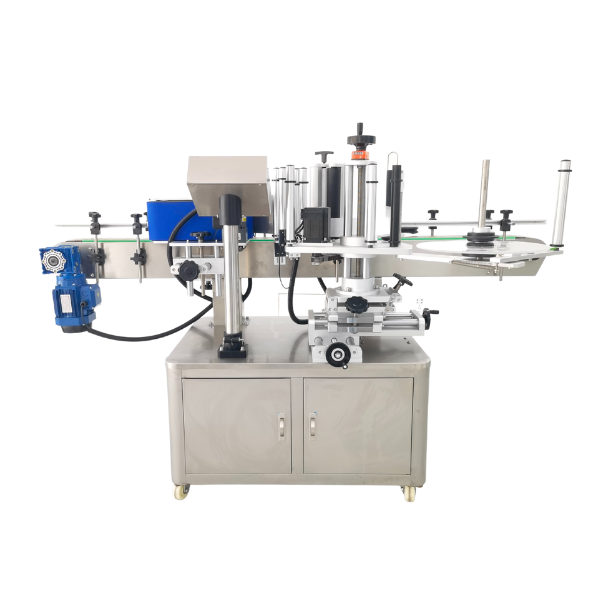
Catalog videos show the factory’s sample bottle, which is chosen because it labels well. Your bottle is the one that matters. Send three to five containers and a roll of your actual labels, and ask for a video of the run with a ruler or caliper in frame and the speed displayed on the HMI.
This is the step that separates suppliers who are confident from suppliers who are guessing. HiPaks runs customer samples on the machine before shipment and returns a video within 48 hours of the samples arriving, with the placement reading taken on your own product. The library currently holds 362 recorded test runs, of which 250 are published, and a buyer can request the run that matches their container shape rather than watching a generic clip.
Check 6: watch the machine run at your speed, not at its maximum
A labeler rated at 120 pcs/min and a line that needs 60 pcs/min are not in conflict, but the video should show the machine holding your target rate for a full minute without a hand touching a bottle. Ask for the reject count during that minute. Any factory that cannot produce this is telling you the machine has only been demonstrated, not run.
Checks 7 to 9: parts, paperwork, and the acceptance test
Check 7: the component list has to name brands you can buy
Ask for the electrical bill of materials and read the sensor, drive, and power supply lines. Named international parts are a proxy for serviceability, because a SICK sensor or a Panasonic inverter can be replaced from local stock anywhere in the world, while an unbranded sensor means waiting for a parcel from the original factory. HiPaks builds with SICK sensors from Germany, Panasonic components from Japan, Mean Well power supplies, and Leadshine stepper drives, and those names appear on the quotation rather than in a brochure.
Ask a follow-up that most buyers skip: which parts are consumables, and what do they cost. Belts, rollers, and suction pads wear on a schedule. A supplier who can quote a spare kit at order time has a parts desk. One who cannot has a photograph of a warehouse.
Check 8: certificates need a number and an issuer
A certificate without a number is a picture of a certificate. Take the number, the standard, the issuing body, and the scope, then verify them with the issuer. ISO 9001 is the usual quality management claim, and the ISO 9001 standard page notes that certification is not mandatory, which is exactly why a buyer should check it rather than assume it. The certificate also states a scope: confirm that the scope covers the manufacture of labeling machinery and not only trading.
Be equally careful with CE. A CE mark on a machine means the manufacturer has built a technical file and issued a declaration of conformity for the machinery directive and the applicable directives behind it. A certificate bought from a consultancy, with no technical file behind it, is not the same document and will not satisfy a European importer or a customs officer. HiPaks states its position plainly: ISO 9001 and CE are in progress, not finished, and the paperwork status is confirmed in writing on the quotation rather than implied by a logo.
Check 9: the acceptance test is the real contract
Agree, in writing, what will be measured, on what sample, at what speed, and who signs. A factory acceptance test worth the name records placement deviation on your container, the reject rate over a fixed run, the label roll and core size used, and the utility requirements at your site. It should produce a document with photographs and a signature, and it should happen before the balance payment is requested.
If a supplier resists a formal acceptance test, the resistance is the finding. Either the machine has not been run on a container like yours, or nobody has defined what good looks like. Both are cheaper to discover now.
Checks 10 and 11: the clauses that carry the risk
Check 10: warranty, spares, and response time in writing
A one year warranty on the whole machine, excluding wear parts, with lifetime technical support, is the normal offer from a factory that intends to stay in contact. What turns a warranty into something useful is the response path: who you email, in what language, and how fast a part ships. Ask for the parts dispatch time and the name of the person who owns the ticket.
Check 11: the trade term and the packing standard
FOB, CIF, and DDP produce three different numbers for the same machine. FOB Shenzhen stops at the Chinese port, which means freight, insurance, duty, clearance, and inland delivery are yours. DDP stops at your door and folds all of it into one price. Neither is better in the abstract, but comparing a DDP offer against an FOB offer is a comparison of two different products, and it is the most common reason a buyer thinks one factory is 30% cheaper.
Packing is the other clause that looks administrative until the crate arrives wet. Sea freight means humidity, condensation, and stacking. Ask for the packing specification: plywood grade, desiccant, stretch wrap, and whether the machine is anchored to the crate floor. A rotary machine that shifts two centimetres in transit will need a realignment that costs more than the packing saved.
The red flags that predict a bad shipment
| Signal | What it usually means | What to do |
|---|---|---|
| Price 30% to 40% below every other quote | Sensor, drive, or frame grade has been removed | Ask for the bill of materials before discussing price |
| Refuses a live video call | No assembly bay, or no machine in progress | Walk away, a call costs the supplier nothing |
| Payment to a personal or third-party account | Reseller with no legal link to the money | Contract and beneficiary must match |
| Custom machine quoted in two hours | No engineering review of your container | Ask which fixture design was chosen and why |
| No jig or tooling drawings offered | Repeat orders will be quoted as new projects | Request archived drawings as a deliverable |
| CE certificate with no technical file | Paper bought for the sales folder | Ask for the declaration of conformity and the file index |
| Warranty offered verbally only | Nothing enforceable after the balance clears | Put the term, the exclusions, and the response time in the contract |
Read the table as a pattern rather than a checklist of sins. One flag is a question. Three flags on the same quotation describe a business model, and the model is to sell a machine that is cheap because something inside it is missing.
What a good factory will refuse to do
The most useful signal is a limit. A factory that builds its own machines will refuse to promise a delivery date before it has seen your container, because the fixture design decides the schedule. It will refuse to certify an accuracy figure that depends on your label material. It will refuse to ship without a test run, because a machine that arrives and fails costs the factory more in support time than the test costs to perform.
Those refusals read as friction during a negotiation. They are the opposite. A supplier who agrees to everything in the first email has either not understood the requirement or has decided that the argument can wait until the balance is due.
Next step: if you want to run these eleven checks against a real quotation, send your container dimensions, label size, and target output through the factory quote form, and ask for the acceptance test scope at the same time. The factory acceptance test page shows what a signed test record contains, and the China buying guide covers the payment and shipping sequence around it.
FAQ
How long should verification take before I pay a deposit?
Two weeks is realistic for a first order: a few days for documents and a live factory call, a week for a sample test run to be scheduled and filmed, and the rest for contract terms. Compressing it to three days usually means skipping the test run, which is the part that predicts whether the machine works on your container.
Is a factory audit company worth hiring for a labeling machine?
It can be, if you cannot travel and the order value is high enough to justify the fee. Ask the audit firm to film the machine running your samples rather than to score the building. A generic social-compliance audit tells you about the canteen, not about label placement on a tapered bottle.
Should the balance payment be tied to the acceptance test?
Yes. Make the balance due after you have received and approved the test record, with the test criteria written into the contract. This single clause does more to protect a buyer than any warranty wording, because it gives the factory a reason to fix a problem before the machine leaves rather than after it arrives.
What if the supplier is a trading company but the machine is good?
Then buy from the trading company knowingly, with the factory named in the contract and the warranty held by the party you pay. The risk is not resale itself, it is ambiguity about who is responsible. Name the builder, name the account holder, and put both in writing.
Does a video test run replace a factory visit?
For a standard machine on a standard container, a filmed run with your samples and a visible measurement covers most of what a visit would show. For a custom fixture, a rotary line, or a container that has failed on another machine, travel is still the better spend, because the failure modes live in the setup rather than in the machine.
