
Almost every labeling machine imported from China is classified in HS heading 8422, and most are declared under subheading 8422.30, the line that covers machinery for filling, closing, sealing, or labelling bottles, cans, boxes, bags, and other containers. That subheading is where the duty rate, the free trade agreement eligibility, and any additional tariff action are applied. Three things then decide your bill: the ten digit national code your broker files, the country of origin printed on the certificate, and the customs value, which is FOB based in the United States and CIF based in the European Union. The rate itself is public. What catches importers is a code chosen from a supplier’s invoice without anyone checking it against the destination schedule.
Which HS code applies to a labeling machine
The Harmonized System is a six digit international nomenclature maintained by the World Customs Organization, and the WCO overview of the Harmonized System explains the structure: chapters, headings, and subheadings that every member country adopts, with national digits added beyond six. Chapter 84 covers machinery and mechanical appliances. Heading 8422 covers machinery for washing or drying bottles, for filling and closing containers, and for labelling.
A labeling machine therefore sits in 8422.30, not in the printing chapter and not in the general machinery catch-all. Three edge cases are worth knowing before you file:
| Machine type | Usual classification | What can move it |
|---|---|---|
| Automatic or semi-automatic labeler for containers | 8422.30 | Nothing, this is the core case |
| Label applicator head sold as a module for an existing line | 8422.30, sometimes 8422.90 for parts | Whether it is a complete machine or a part of one |
| Print and apply unit that prints the label as it applies it | 8422.30 in most filings | A ruling may treat the printing function as principal |
| Shrink sleeve applicator with a steam tunnel | 8422.30 for the applicator | The tunnel may be classified separately |
None of this is settled by a supplier’s opinion. Classification is decided by the customs authority of the importing country, and a written ruling is the only certain answer. What a supplier can do is describe the machine’s function precisely, because that description is what the broker and the ruling both depend on.
The three numbers that decide the duty
The code. Two importers can bring in identical machines and pay different rates because one filed 8422.30 and the other filed a broader residual heading. The difference is not a rounding error, because the residual headings often carry higher rates and are more likely to attract additional measures.
The origin. Duty is charged on where the goods were produced, not where they were shipped from. A machine built in China and routed through Singapore is still of Chinese origin for duty purposes, and the certificate of origin has to say so. Origin is also what triggers or avoids an additional tariff action and what qualifies a shipment under a trade agreement.
The customs value. This is the part importers most often get wrong, and it is covered next.
Customs value: why FOB and CIF markets disagree
The United States generally assesses duty on the transaction value of the goods, which in practice is the FOB price, with international freight and insurance excluded from the duty base. The European Union and most other markets assess duty on the CIF value, which includes the freight and insurance to the border. The same machine, sold at the same FOB price, therefore produces a different duty amount in each market before any rate difference is considered.
This matters twice. It matters when you compare a DDP quote from a supplier against an FOB quote from another, because the DDP price already contains a duty that was calculated on an assumption about your destination. And it matters when you estimate your own landed cost, because the number on the invoice is not the number the duty is applied to.
Two adjustments catch people out. Assists, meaning items you supply free of charge to the factory such as your own labels or a special fixture design, can be added to the customs value. Royalties and licence fees related to the imported goods can be added as well. Neither is common on a labeling machine order, but both exist, and a broker who asks about them is doing the job properly.
Building the landed cost, line by line
Landed cost is the invoice plus everything between the factory gate and your production floor. On an FOB Shenzhen shipment, which is the standard term from Chinese labeling machine factories, the buyer owns every line below the machine price.
| Line | Basis | How to estimate it |
|---|---|---|
| Machine price | FOB Shenzhen | The quotation, with the configuration written out |
| Ocean freight | Volume and weight, not value | Ask your forwarder for the current rate on the crate dimensions |
| Marine insurance | A small percentage of CIF | Usually quoted with the freight |
| Import duty | Rate applied to the customs value | Check 8422.30 in the destination schedule |
| Additional tariff measures | Origin based | Check whether goods of Chinese origin face a specific action in your market |
| Import VAT or GST | Customs value plus duty | Charged at your national rate, usually recoverable if you are registered |
| Broker and clearance | Per entry | Flat fee plus disbursements |
| Inland delivery | Distance and access | Include a tail lift or crane if the crate needs one |
| Installation | Days and travel | Remote commissioning is the cheaper route |
As an illustration, take a machine invoiced at $9,000 FOB, which is the published band for a double-side automatic unit. Freight of $700 and insurance of $70 bring the CIF value to $9,770. If your destination charges duty on CIF at an assumed 3.5%, the duty is $342. Import VAT at an assumed 20% is charged on $10,112, which is $2,022, and that part is normally recoverable. Clearance and inland delivery might add $450. The machine that cost $9,000 at the factory is therefore roughly $10,600 of cash out of the door before installation, of which about $2,000 comes back as recoverable tax. Substitute your own rates and freight, because both move, but keep the structure: duty is charged on a value that includes freight in CIF markets, and VAT is charged on the duty-inclusive figure.
What can change the rate after the machine ships
Additional tariff actions. Several markets apply extra duties to goods of a given origin, above the standard rate. These are political instruments and they change by notice, sometimes with retroactive effect. The US Harmonized Tariff Schedule at hts.usitc.gov carries the current rates and the Chapter 99 provisions that add to them, which is why a rate quoted from memory is worthless for a shipment that sails next month.
Origin rulings and transhipment scrutiny. A certificate of origin that says China while the bill of lading shows a different load port invites a query. Substantial transformation is the test, and repacking a machine in a third country does not meet it.
Classification challenges. A customs authority can reclassify an entry after the fact and issue a demand for the difference plus interest. The defence is a written description of the machine’s function, a ruling if you want certainty, and a broker who files consistently across shipments.
Valuation adjustments. If the invoice splits the machine and the tooling into two payments, or if a fixture is invoiced separately by a related company, the total may still be the customs value. Splitting an invoice to lower the duty base is the fastest route to a penalty.
Documents a broker will ask for
| Document | What it must show | Who issues it |
|---|---|---|
| Commercial invoice | Machine description, model, quantity, unit price, Incoterm, HS code, origin | Supplier |
| Packing list | Crate count, dimensions, gross and net weight | Supplier |
| Bill of lading | Shipper, consignee, port of loading, port of discharge | Carrier or forwarder |
| Certificate of origin | Country of manufacture, not the port of export | Chamber of commerce or authorised body |
| Declaration of conformity | The directives the machine meets, with the standards applied | Manufacturer, for CE markets |
| Test report or acceptance record | Placement result on your container, if asked | Supplier |
| Insurance certificate | Cover, value, and the insured party | Insurer |
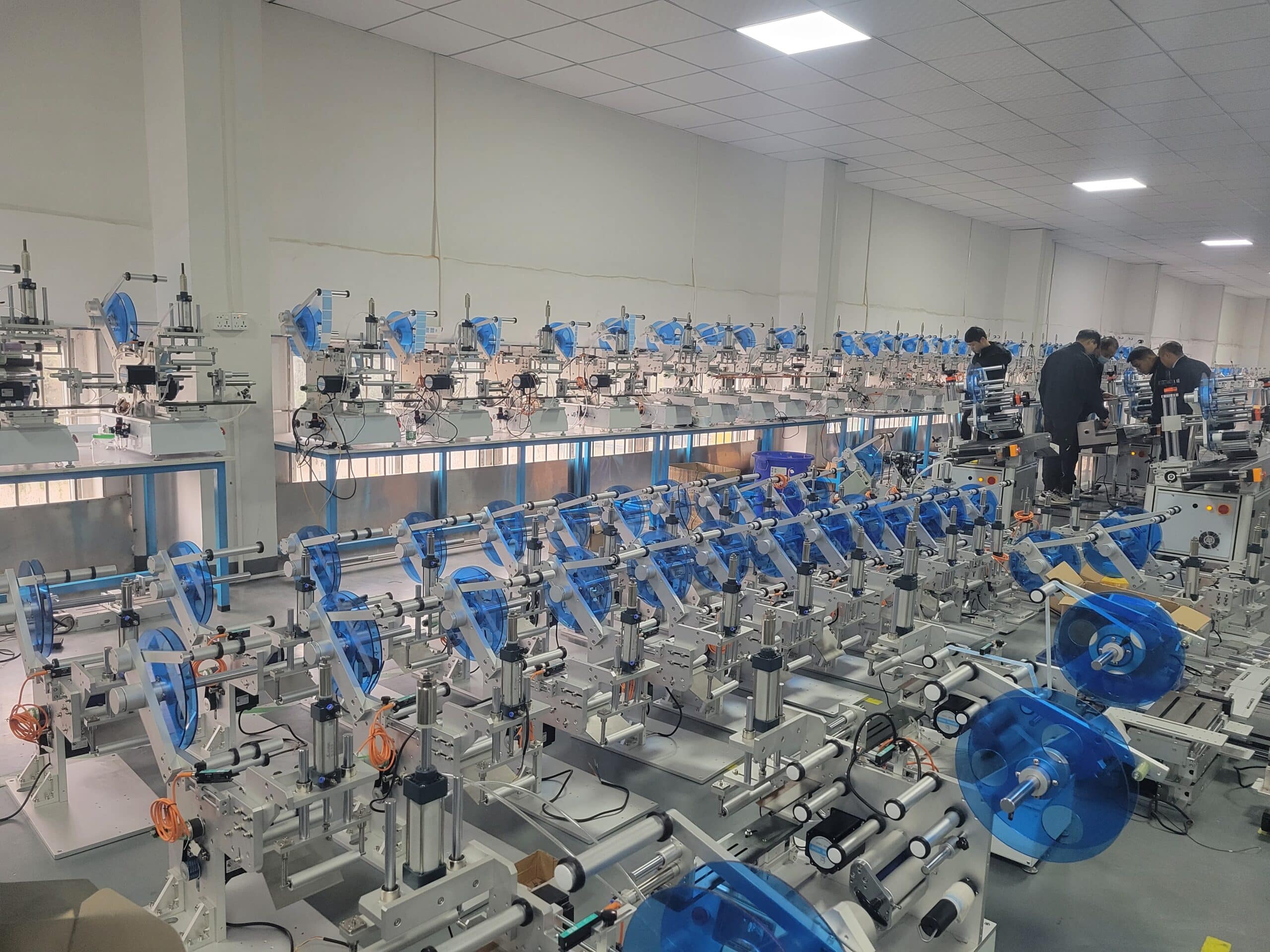
HiPaks ships FOB Shenzhen to more than 50 countries, which puts the import declaration in the buyer’s hands and makes the document set the buyer’s first job after the machine is booked. The invoice, packing list, and conformity paperwork are issued with the shipment, and the HS code on the invoice is 8422.30 for standard labeling machines. Ask for that line in writing before you pay, because it is far easier to correct on a proforma than on an entry that has already been lodged.
Where importers get the classification wrong
Using the supplier’s code without checking the national digits. Six digits are international. The four that follow are national, and they are where the rate and the additional measures live. A Chinese invoice with a six digit code is a starting point, not a filing.
Assuming a parts shipment is a machine. A replacement labeling head invoiced as a complete machine pays the machine rate. Invoiced as a part, it may pay a different rate and may qualify for a different treatment. Describe what is in the crate.
Forgetting that the tooling travels with the machine. Fixtures and change parts are usually part of the machine’s value. A separate invoice for tooling from the same supplier is a valuation question, not a tax plan.
Treating the DDP price as the duty. A DDP quote contains a duty estimate. If the actual rate is higher on the day of entry, the difference is a negotiation with your supplier, not with customs. Ask how the DDP price was built and which rate it assumed.
Ignoring recoverable tax when comparing suppliers. Import VAT is a cash flow item, not a cost, for a registered business. Buyers who add it to the machine price and compare it against a domestic quote are comparing two different things.
Next step: if you want the code and the document set confirmed against your destination before you commit, send the machine type and the destination country through the quote form. The China buying guide covers the payment and shipping sequence, and the certification comparison explains which conformity documents travel with a CE, UL, or CSA build.
FAQ
What HS code do labeling machines use?
Heading 8422, subheading 8422.30, which covers machinery for filling, closing, sealing, or labelling containers. National digits are added after the first six, and those digits carry the rate. Confirm the full code for your destination before the shipment is booked.
How much is the import duty on a labeling machine?
It depends on the destination rate for 8422.30 and on the origin, and additional tariff actions can sit on top of the standard rate. Duty is a percentage of the customs value, so the answer needs three inputs: code, origin, and value. Any single number quoted without those three is a guess.
Is duty calculated on the machine price or on the freight too?
In the United States the duty base is normally the transaction value, which excludes international freight and insurance. In the European Union and many other markets the base is the CIF value, which includes them. The same machine can therefore produce two different duty amounts in two markets.
Can the supplier declare a lower value to reduce duty?
No, and agreeing to it transfers the risk to you as the importer of record. An understated value is a false declaration, and the penalty falls on the party that filed the entry. The invoice value is also what your insurance claim will be measured against if the crate is damaged.
Does a CE mark change the duty rate?
No. Conformity marking is a market access requirement, not a tariff classification. A CE marked machine and an unmarked one can share the same code and the same rate. What the CE file does affect is whether the machine can be placed on the market at all, which is a separate question from what it costs to import.
