
A labeling machine costs what its weakest subsystem costs to upgrade. Published factory-direct bands in 2026 are $600 to $4,500 for semi-automatic, $1,500 to $4,000 for desktop automatic, $6,000 to $15,000 for fully automatic, around $9,000 for double-side, and from $25,000 for rotary hot melt. So $3,000 buys a competent semi-automatic machine, or the bottom of the desktop automatic range, and $30,000 buys the entry to rotary hot melt with options. The gap is not brand markup. It is servo label feed, sensor class, tooling, frame material, and paperwork. Every number below is indicative and confirmed against your bottle and label at quotation.
What $3,000 actually buys
Three thousand dollars sits in the middle of the semi-automatic band, and it is the most common first purchase in this industry. At that level you should expect a motorized label feed, a wrap-around or flat applicator, a foot pedal or sensor trigger, and a machine that an operator loads by hand. Output lands between 15 and 30 pcs/min depending on the container and how fast the operator can feed it. Placement accuracy is typically plus or minus 0.5mm.
What $3,000 does not buy is a conveyor, a reject system, or a machine that runs unattended. It also does not buy servo label feed, which is the component that keeps placement stable as the roll diameter changes. On a short run you will not notice the difference. On the third hour of a shift, a stepper that has drifted shows up as labels creeping up the bottle.
At the top of the semi-automatic band, around $4,500, the additions are usually a stainless frame, a better sensor for transparent labels, and a custom jig for a container that is not perfectly round. Those three items are worth more than they cost, because they are the ones that decide whether the machine runs your product or merely runs a sample.
The six bands, and what moves you between them
| Band | Indicative price | Typical output | What buys the step up |
|---|---|---|---|
| Manual or handheld | $300 to $800 | By hand | Nothing yet, this is a starter tool |
| Semi-automatic | $600 to $4,500 | 15 to 30 pcs/min | Conveyor, sensor trigger, servo feed |
| Desktop automatic | $1,500 to $4,000 | 20 to 40 pcs/min | Inline conveyor, higher duty cycle |
| Fully automatic | $6,000 to $15,000 | 40 to 300 pcs/min | Servo feed, star wheel, stainless, vision |
| Double-side | Around $9,000 | 60 to 120 pcs/min | Paired press plates, second head |
| Rotary hot melt | From $25,000 | 10,000 to 15,000 BPH | Carousel, glue station, servo label feed |
Two things are worth noticing. First, the desktop automatic band overlaps the semi-automatic band, which is why buyers get confused: a $3,500 desktop automatic and a $3,500 semi-automatic are different machines with different throughput assumptions. Second, the jump from $15,000 to $25,000 is not incremental, it is a change of machine class.
What $30,000 actually buys
A rotary hot melt line starts at $25,000, so $30,000 buys the base machine plus the options that make it usable on your line: a label feed tuned for your label length, a glue station configured for your label material, and a changeover set for a second bottle format. On a 12-station carousel that means 10,000 to 15,000 BPH; on a 16-station frame, 10,000 to 12,000 BPH, because the extra stations buy label placement options rather than raw speed.
The money goes into the carousel itself. A rotary machine needs a machined platform, twelve or sixteen bottle stations that hold position to a fraction of a millimetre, a glue wheel with temperature control, and a cut-and-transfer sequence that has to repeat tens of thousands of times per shift. That is machining capacity, not assembly labour, which is why very few Chinese plants offer this class at all.
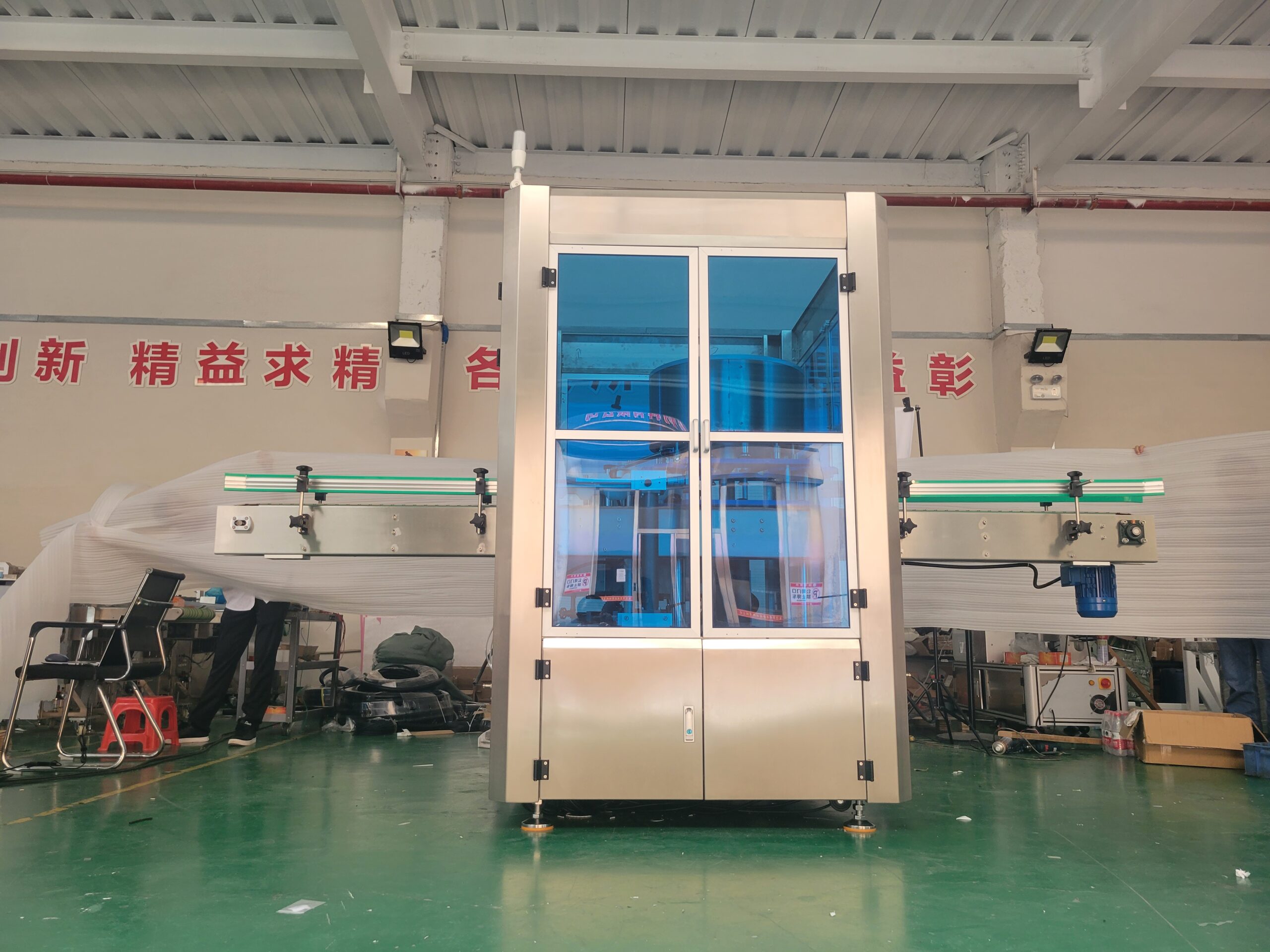
Above $30,000 the curve flattens. Adding vision inspection, a second label station, or a stainless washdown frame raises the price, but the throughput gain is small. Buyers who need more than 15,000 BPH are usually buying a different line, not a bigger labeler.
The eight levers that move the number
| Lever | Budget end | Premium end | Price effect |
|---|---|---|---|
| Automation | Operator places each bottle | Conveyor fed, no touch | Largest single lever |
| Label feed | Stepper | Servo, up to 100 m/min on hot melt | Stability at speed |
| Sensors | Standard photoelectric | SICK or Datasensor, ultrasonic for clear labels | Few hundred dollars, high value |
| Tooling | Standard round-bottle setup | Engineered jig for tapered or square | Quoted per project |
| Frame | Painted carbon steel | Stainless or washdown grade | Material cost plus finishing |
| Data | Pre-printed labels | Print and apply, coder link, vision | Print engine dominates |
| Compliance | EU documentation set | UL 508A or CSA panel versions | Panel build and paperwork |
| Documentation | Manual and wiring diagram | Full technical file, FAT report, spares list | Engineering hours |
Most quotations that look 40% apart are three levers apart, not eight. Ask which levers are included before you ask for a discount, because the discount usually comes out of the sensor or the documentation, and both are hard to add later.
The invoice is not the landed cost
The machine price stops at the Chinese port when the term is FOB Shenzhen. Everything after that is yours, and it is large enough to change a purchase decision. Budget for sea freight and insurance, import duty, clearance and inland delivery, installation, a spare-parts kit, and the cost of the days the line is not running while the machine is being commissioned.
Duty depends on classification, and packaging machinery is generally classified in heading 8422, with labeling machines under 8422.30. The current duty rate for your destination and the current Section 301 treatment for goods of Chinese origin should be checked against the Harmonized Tariff Schedule rather than taken from a supplier’s email. We confirm HS 8422.30 paperwork on every quotation, and it is worth asking any supplier to do the same, because a misclassified shipment is a cost that arrives months later.
A simple rule keeps comparisons honest: compare offers on the same trade term. FOB stops at the port, DDP stops at your door, and the difference between two quotes is often just the term rather than the machine.
Three ways buyers overpay
They buy speed they cannot feed. A 120 pcs/min machine needs a line that can deliver bottles at that rate and an operator who can keep up. If your filling line runs at 40 pcs/min, you are paying for capacity that sits idle for most of the shift.
They buy a second machine instead of a jig. A new container format often needs a fixture, not a new labeler. Engineered jigs are quoted per project and archived, which makes the second format far cheaper than the second machine. Ask for the jig price before you ask for a new quote.
They buy used to save 20% and pay it back in downtime. A used European rotary can list around $28,400 on resale marketplaces, close to a new $25,000 hot melt line. The used machine arrives with unknown wear, no acceptance test on your bottles, obsolete control parts, and no warranty. The saving is real only if the machine runs.
How to read a quotation line by line
- Machine model and configuration. A model number alone is not a configuration. Ask for the label feed type, sensor brand, and frame material in the same line.
- Tooling. Listed separately or hidden in the machine price. If it is hidden, you cannot compare two suppliers.
- Trade term. FOB, CIF, or DDP, with the named port or address.
- Lead time. In working days, with the trigger for the clock: deposit received, or drawing approved.
- Payment split. 30/70 is standard, 50/50 appears on some models, and the balance trigger matters more than the split.
- Warranty and exclusions. One year is normal, wear parts are excluded, and the exclusion list should be visible.
- Spares and documentation. A priced spare kit and a named documentation package turn a quote into a budget.
If you want the bands applied to your own container, the price guide breaks each band down by machine type, and the break-even calculator converts a price difference into months of payback. For a first-pass number, the product catalog lists the 36 models by range.
FAQ
Why is there such a wide price range for the same machine type?
Because the range hides configuration. A semi-automatic machine at $600 and one at $4,500 may share a frame and differ in label feed, sensor, tooling, and finish. Ask which of the eight levers are included before comparing the totals.
Is a $3,000 labeling machine good enough for a small factory?
For a first machine on a single container format, yes, provided the jig is made for your bottle and the sensor handles your label material. It will not run unattended and it will not hold speed on a long shift, but it will prove the market before you spend five figures.
What does a fully automatic labeling machine cost in 2026?
Indicative factory-direct pricing is $6,000 to $15,000 for a standard automatic line at 40 to 300 pcs/min, around $9,000 for a double-side configuration, and from $25,000 for rotary hot melt. The exact figure is confirmed after reviewing your bottle, label, and target speed.
Do I have to pay import duty on top of the machine price?
Usually yes, and the rate depends on classification and origin. Labeling machines generally fall under HS 8422.30, so confirm the rate for your destination against the current tariff schedule and budget freight, clearance, and installation as separate lines.
How much should I budget for spares and installation?
Price a spare-parts kit with the machine rather than after the first breakdown, and ask for the installation scope in writing. Remote commissioning with an English manual and a video of your own machine is the cheapest route; an on-site engineer adds travel, visa time, and daily cost.
Next step: send your container, label, and target output through the factory quote form and you will get a single indicative number with the configuration written out, or request a test-run video to see the band you are considering in motion.
