
A short run in sticker labeling usually means 300 to 5,000 units of one SKU, produced a few times a year, with artwork that changes between runs. For that pattern the machine is almost never the bottleneck. A bench semi-automatic at 15 to 30 pcs/min labels 2,000 units in about two hours, holds ±0.5mm and is listed from $600 on this site (indicative). What actually decides whether a short run makes money is the cost that repeats with every batch: setup waste, changeover time, label minimum quantities, and rework. A faster machine does not reduce any of the four. A machine that resets in five minutes, a written setup sheet and a label supplier who prints in small quantities do.
What short run means in numbers
Suppliers use the phrase loosely. It helps to define it by the numbers that change machine choice: units per SKU per run, runs per year, SKUs live at once, and label changes per year. A brand doing 60,000 units a year looks like an automatic-line customer until the detail arrives: twelve SKUs, four runs a year, and a seasonal range that changes artwork twice a year. That is a short-run business with a large annual total, and it needs quick changeover more than throughput.
- Under 1,000 units per SKU per run: setup dominates. The machine should be easy to reset and cheap to own.
- 1,000 to 5,000 per SKU: the standard short-run band. A bench or floor semi-automatic covers it inside a shift.
- 5,000 to 20,000 per SKU: short run by SKU count, not by volume. Automation starts to compete if the SKU count is low.
The number that separates these bands is not units per year. It is minutes of changeover multiplied by changes per month. That product decides whether a second machine is cheaper than a faster one.
The four costs that repeat with every run
| Cost | What drives it | How to reduce it |
|---|---|---|
| Setup waste | Bottles or packs discarded while settings are found | A recorded setup sheet per SKU, plus a first-article check with a fixed gauge |
| Changeover time | Format parts, sensor position, roller gap | Quick-change fixtures and a labeled position for every adjustment |
| Label minimums | Printer minimum quantities per design | Order the annual need in two releases, and keep one base label with a variable panel |
| Rework | Hand-corrected labels rejected at case level | Placement consistency from the machine, checked at the start of every run |
The fourth cost is the one small producers underestimate. A label that is 2 mm off looks acceptable on the bench and unacceptable on a shelf next to a competitor. Rework at case level means opening cases, peeling labels, cleaning adhesive and relabeling, and it consumes the margin of the whole run. Placement consistency is therefore worth more than speed in a short-run operation, which is why a ±0.5mm semi-automatic machine is a better short-run purchase than a fast machine with a loose applicator.
Machine routes for short runs
Bench semi-automatic
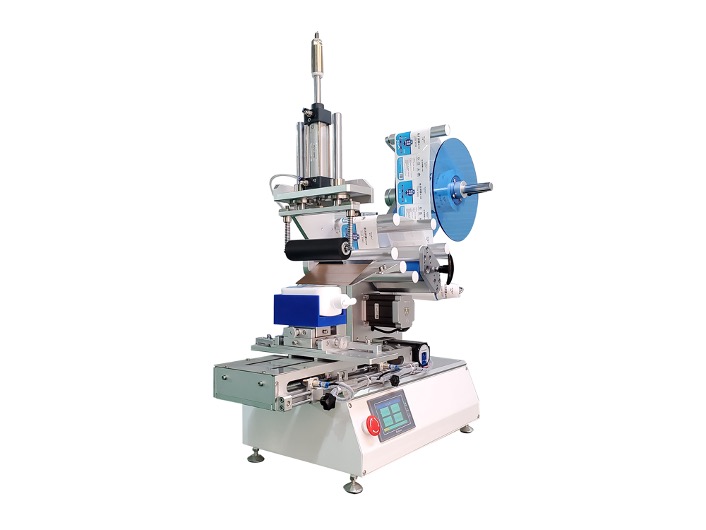
The default under 2,000 units per SKU. It needs a table, a standard outlet and one operator, and it changes from one label size to another in minutes because there is no glue system to clean. For a brand with a seasonal range, the ability to run twenty units of a limited edition without a production planning meeting is the real feature.
Desktop automatic
Self-feeding units in the $1,500 to $4,000 indicative band, at roughly 20 to 40 pcs/min. They remove the hand placement step, which matters when the label is small and the container is small, and they are still compact enough to sit in a small production room. The trade-off is setup: a desktop automatic has more parameters to set than a bench unit, so it suits a brand with fewer SKUs and more units per SKU.
A labeling head over an existing conveyor
If a filling or packing line already moves the product past a point, an applicator head mounted over that conveyor adds labeling without a second machine. Heads sit in the $3,000 indicative band and need a consistent pitch between products to work. For a short-run operation that already has a conveyor for another purpose, this is often the cheapest way to add a second label panel.
Inline automatic
At 40 to 300 pcs/min, this tier belongs to a business whose short runs are frequent rather than small. It earns its space when a single SKU family runs for days at a time and the operator is the constraint. It is the wrong purchase for twelve SKUs with four runs a year, because changeover time scales with format complexity.
The label supply chain is the real constraint
Short-run producers spend more time solving labels than machines, and the reason is structural. Label printing has setup costs per design: plates or digital setup, die cutting, and a minimum run length that keeps the press economical. A brand that changes artwork twice a year and orders 3,000 labels each time is asking a printer to absorb setup across a small quantity, and the per-label price reflects it.
Three practices soften that. Order the annual quantity in two releases so the second release carries the same design and avoids a second setup. Keep one base label size across SKUs and vary the printed panel rather than the die, so the die cost is paid once. And confirm the liner and adhesive spec before the artwork is final, because a material change after printing wastes the whole roll. None of these are machine decisions, and all of them affect the cost per labeled unit more than the machine does.
Seasonal production: plan the year around two peaks
Most short-run businesses have two peaks and a long trough, and the machine sits idle through the trough. That is normal and it does not make the purchase wrong, but it changes what to buy. A machine that costs less to own and takes less floor space is better than one that is faster for six weeks a year and idle for the rest. Plan the year in four blocks:
- Before the peak: confirm label stock, run a first-article check and photograph the correct result for the setup sheet.
- Peak: run the same SKU in longer blocks, because every changeover inside the peak costs peak capacity.
- After the peak: service the machine, replace worn rollers and check the sensor, while the line is quiet.
- Trough: use the machine for the samples and short promotional runs that would otherwise be hand labeled.
The fourth block is where a machine pays for itself in a way the spreadsheet misses. A brand that can produce twenty samples of a new design on a Tuesday afternoon makes decisions faster than one waiting for a co-packer’s minimum run, and speed of iteration is a competitive advantage in a seasonal category.
Barcodes for seasonal variants
Retail adds a constraint that catches short-run brands: every distinct product variant needs its own identifier, and a seasonal flavor is a distinct variant. In the United States, GS1 US issues the company prefixes and GTINs that retail systems read, and its barcode and prefix guidance explains the difference between a company prefix and a single GTIN.
For labeling, the practical consequence is space and print quality. A barcode needs a quiet zone on both sides, a minimum size that stays scannable after the label curves, and enough contrast that a worn print head does not degrade it. On a short run, the label is often printed digitally, so the barcode should be verified on the first article rather than assumed. A seasonal variant that will not scan is a returned pallet, and no machine setting fixes a barcode that was printed too small.
The changeover sheet that makes short runs profitable
Write one page per SKU. Record the label height, the sensor position, the roller gap, the speed setting and a photograph of a correctly labeled unit. The operator sets the machine to the sheet, labels three units, compares them to the photograph and the gauge, and starts. On a 500 unit run this takes five minutes and saves the twenty minutes of rediscovery that otherwise happens every time.
The sheet also converts an operator skill into a documented process, which matters in a small team where one person does three jobs. A new hire can run a short run on their first day, and the owner can leave the building during a production batch.
When outsourcing beats buying
There are honest cases for a co-packer: annual volume under a few thousand units, a container range that changes every season, or a label design that needs equipment no small brand should own. In those cases the per-unit fee is cheaper than owning a machine and the storage that comes with it.
The case for buying strengthens when the same machine also serves sampling, when the run repeats at least quarterly, and when placement consistency is the complaint about the current process. The breakeven arithmetic, including labor, is laid out in the break-even calculator, and the selection guide maps container and volume to a shortlist. For sticker-specific formats, the sticker labeling machine manufacturer page covers label shape, sensing and changeover across the range, and the sticker and self-adhesive guides go deeper on wrinkles and clear film.
If your peaks are the problem rather than your annual total, send the run pattern and we will quote the configuration that resets fastest, not the one with the highest speed on the sheet.
One practical detail makes short runs easier to buy here than from a distributor: MOQ is one unit, semi-automatic machines ship in 7 to 10 days, and every machine is tested on the customer’s own labels and containers before it leaves, with the video sent for approval. A 500 unit seasonal run is a normal order, not an exception that has to be negotiated.
Frequently asked questions
How small can a sticker labeling run be and still make sense on a machine?
A few hundred units is workable. Setup and first-article checks consume ten to twenty units, so a 300 unit run is still efficient, and the machine time is under an hour. Below that, hand labeling or a co-packer is usually cheaper unless placement consistency is the reason for labeling mechanically.
How long does changeover take between two sticker sizes?
On a semi-automatic machine, a few minutes: label height, sensor position and roller gap are the adjustments, and there is no glue system to clean. An automatic line takes longer because the format parts and the conveyor guides also change, which is why SKU count drives the automation decision.
Can one machine handle seasonal artwork changes?
Yes. Artwork changes do not affect the machine at all as long as the label dimensions and liner stay the same. The cost sits in the label order, not the labeler. Keeping one label size across the seasonal range is the simplest way to avoid resetting the machine between designs.
Do short runs need a different label material?
Not necessarily, but the liner and adhesive must suit the container and the storage conditions. Short runs are often printed digitally, and digital stocks vary in how they release at speed. Test the actual roll on the machine rather than a printed sample sheet, because release behavior is what the applicator depends on.
