
A packed lane is a force path, not a buffer. The pressure of a case packer stop travels up the lane and lands on the labeler’s metering device. Three clauses decide whether a full conveyor scuffs labels: the buffer allowed on each side and the point where the count stops, the backpressure cap with the measurement point, bottle and fill weight, and a jam test which names who makes the jam, what is watched and who signs. Each clause belongs to the party who can evidence the clause, which is rarely the party who asked. The buyer’s stop log supplies the inputs. The machines supply the response.
Which Five Clauses Belong at the Conveyor and Labeler Interface?
Why Is a Buffer Figure Not a Clause Yet?
A buffer figure is a number without an owner until the clause names four things: 1) whose buffer, 2) the point where the count stops, 3) the rate and bottle format used to size the clause, 4) the machine which stops first when the lane fills. First, the buffer upstream of the labeler protects the filler from labeler stops. Second, the buffer downstream protects the labeler from case packer stops. Third, the stopping point decides who carries the load, because a queue standing against the metering device is no longer a buffer. Fourth, the clause carries a signature, not a footnote. According to the Conveyor Equipment Manufacturers Association, conveyor standards and technical publications run from design and equipment selection through installation, operation and maintenance, so a conveyor’s acceptance rests on the conveyor’s own documents. In practice, a quotation which states a lane but not the stopping point cannot be checked by anyone.
What Does Each Row of the Interface Table Carry?
| Clause | What the clause must state | Party who evidences the clause | What the clause does not prove |
|---|---|---|---|
| Buffer on each side | The point where the count stops, the rate and bottle format, and the machine which stops first | Conveyor supplier, using the buyer’s stop log | That the labeler holds registration with a full lane |
| Backpressure cap | The force limit, the measurement point, the bottle and the fill weight | Conveyor supplier, witnessed by the line team | That the label stays in place at the cap |
| Scuff criterion | The retained sample, the contact band inspected, the keeper and the date | Buyer’s QC with the label supplier | That a laboratory rub test predicts a live queue |
| Blocked outfeed test | Who blocks the lane, what is recorded, how the release is watched, who signs | Controls integrator with the labeler supplier | That the line restarts without a second jam |
| Jam clearing | Who clears, with which tool, under which isolation, and the count per shift | Buyer’s line team with EHS | That the guard is adequate for the reach |
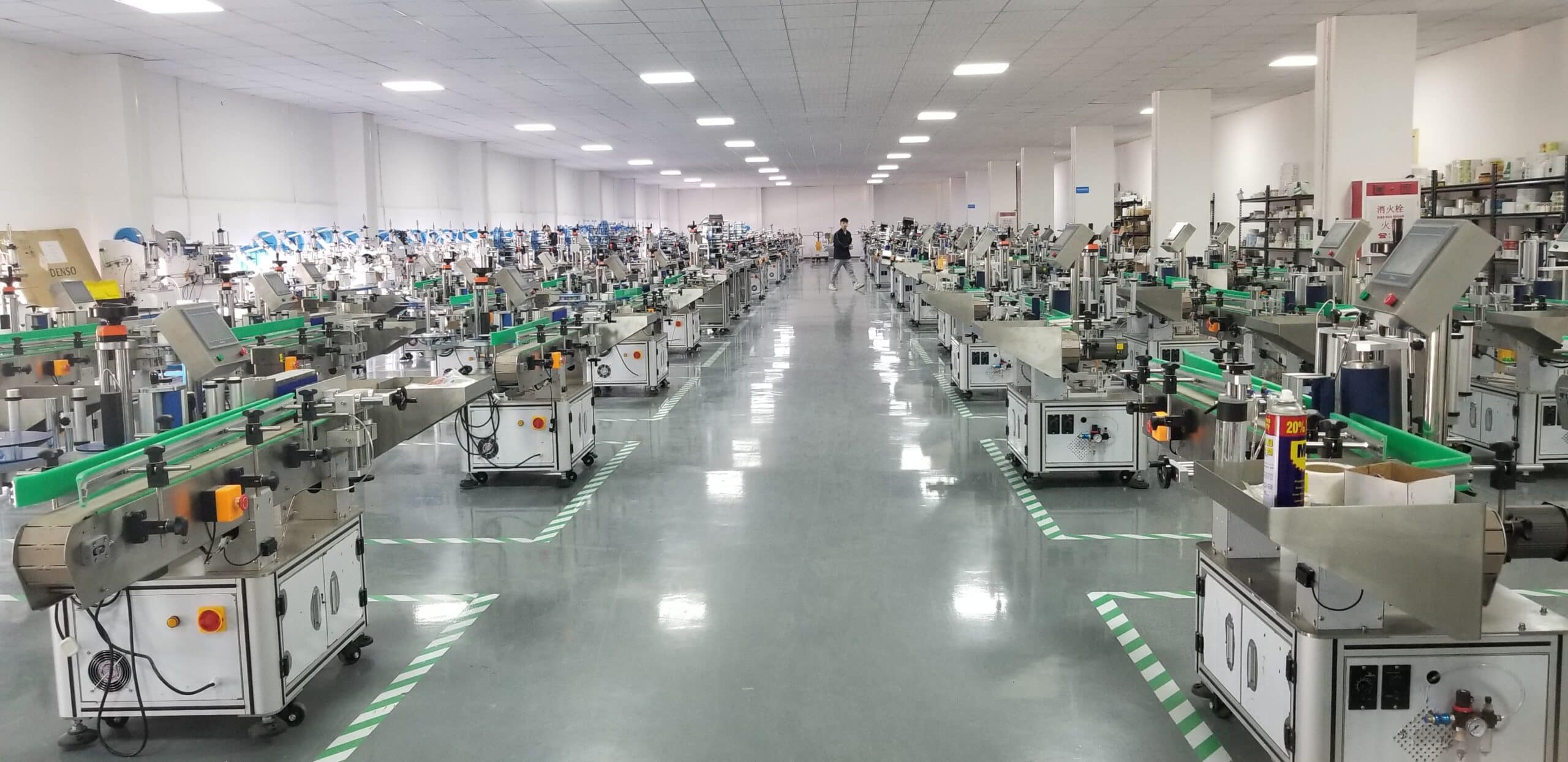
How Much Buffer on Each Side, and Who Owns the Number?
Which Point Does the Buffer Count To?
A buffer is a decoupling section, and the size means something only against a point. Three candidate points exist on a bottle line: 1) the last photo-eye before the labeler’s metering device, 2) the metering device, a timing screw, spacing wheel or star wheel, 3) the labeler’s discharge eye. First, the point is what the control signal uses. Second, the point is what the acceptance test blocks. Third, the point tells a fitter where the zone boundary sits on the rail. A clause which counts to the discharge eye and not the first eye has quietly made the lane part of the machine. According to one conveyor maker’s accumulation reference, three modes behave differently under load: zero pressure stops each product with a gap, minimum pressure allows contact under a manual tread roller adjustment, and mass flow groups products into slugs. The clause names the mode and the point.
Who Stops First When the Lane Fills?
A stopping order is a written sequence, not an outcome. Write three steps: 1) the zone nearest the discharge stops, 2) zones fill back toward the infeed, 3) the buffer-full signal reaches the labeler before the filler drive. The third step is the one most lines miss. A full queue standing against a timing screw is load on the device which sets pitch and angular position. Published accuracy is stated excluding product and label variation: up to plus or minus 0.5 mm on the semi-automatic class, up to plus or minus 0.2 mm on the MT-807, plus or minus 1 mm on a fully automatic machine. A packed infeed is exactly the variation those figures exclude, so a labeler which keeps accepting bottles while the outfeed is blocked has a registration problem before a scuff problem. The signal belongs in the process I/O list for a bottle labeler, with a row, an address and a test.
What Backpressure Cap Can You Write, and Where Is It Measured?
Why Does a Force Limit Need a Bottle, a Point and a Weight?
A backpressure cap is a force limit with three attachments: the bottle, the measurement point and the fill weight. Without all three the cap cannot be enforced. First, the limit belongs to the weakest format on the line, not to the average format, because a light bottle with a thin wall buckles where a heavy bottle only slides. Second, the measurement point decides the reading: force at the infeed guide is not force at the metering device, and a gauge placed mid-lane reads something else again. Third, the fill weight belongs in the same sentence, because one bottle at two fill levels stands two different ways. According to one conveyor maker’s accumulation reference, the low-force mode on a minimum-pressure conveyor is reached by a manual tread roller adjustment, and the same page recommends the mode for corrugated cases and rigid totes, with moderate product protection against zero pressure. A cap copied from a carton conveyor is a carton clause.
What Do You Accept Instead of a Number You Cannot Check?
Accept a curve and a sample instead of a single figure. The curve is force against lane fill, taken on the weakest bottle at the line rate, with the gauge position written on the sheet. The sample is physical: the first bottle and the last bottle released from a full lane, inspected at the contact band where guide and label meet, bagged with the date, the format and the run number. According to ASTM D5264, the standard practice for abrasion resistance of printed materials, abrasion damage happens during shipment, storage, handling and end use, and the amount depends on conditions including temperature, humidity and time, so the practice compares printed material under laboratory conditions. The scope covers labels and cartons on a flat substrate. The 2019 reapproval keeps that scope, and the practice stays a comparison between label constructions, never a pass mark for a bottle which stood in a queue.
How Do You Write a Jam Test Someone Can Repeat?
Who Makes the Jam, and For How Long?
A jam test is an acceptance run where the blockage is created on purpose, and the run counts only when the person, the place, the duration and the lane state are written before the first bottle moves. First, the person: the buyer’s operator blocks the lane, because the test is the buyer’s evidence. Second, the place: downstream of the labeler discharge, so the queue builds back through the labeler rather than through the filler. Third, the duration: taken from the stop log the buyer already keeps, not from a supplier’s example. Fourth, the lane state at each run, empty, part filled and full, because a full lane at release behaves differently from an empty one. The run repeats until two consecutive runs agree and the readings stop moving. A test which passes once and cannot be repeated is a demonstration, not a clause.
What Is Watched, and Who Signs the Sheet?
Four things are watched while the lane is blocked, and the last one is a count. First, the labels on the bottles held against the guide, inspected at the contact band against the retained sample. Second, the registration of the first bottles released, the check set out in the first-bottle route after a planned stop. Third, the machine signals: motor current, jam alarm, and whether the labeler stopped the infeed or kept accepting. Fourth, clears per shift, which is the number a purchasing director already asks about, so the test produces the number instead of the shift log. Who signs: the line team for the counts, the controls integrator for the handshake, the labeler supplier for the machine side, and EHS for the clearing method. According to OSHA 1910.212, the point of operation must be guarded, designed and constructed to prevent the operator from having any part of his body in the danger zone during the operating cycle, and handtools only supplement guarding.
What Do You Do When the Conveyor Already Runs Full?
Which of the Three Choices Is Left, and What Does Each Not Fix?
Three choices remain when the conveyor is built and the floor is fixed, and each leaves something unsolved. First, re-zone the last section before the labeler: spaced zones with a sensor and a drive per zone, which costs footprint and adds no upstream buffer. Second, re-time the discharge handshake: hold the labeler’s infeed release until the outfeed clears, which removes the pressure at the metering device and moves the stop upstream. Third, accept the stop and change the schedule, which is honest and turns clears per shift into a cost line. According to the Conveyor Equipment Manufacturers Association, conveyor standards and technical publications run from design through installation, operation and maintenance, so whichever choice is bought, the clause is written against the conveyor’s documents. The commercial split for a retrofit belongs elsewhere, in the retrofit supply boundary.
What Can You Test on Your Own Bottles Before You Buy?
Buffer and force figures cannot be checked on somebody else’s bottle. The commercial terms stay short: MOQ one unit, 30% deposit with 70% before shipment, FOB Shenzhen, one year of warranty with lifetime support, and machines running in more than 50 countries and more than 500 factories. The part worth reading is the trial, because a test-run video shows the first and last bottle of a run at the contact band before a lane exists, and the machine is run on the buyer’s own bottles before shipment. A factory quote follows the same route, with the bottle drawing, the fill weight and the stop log attached through the contact form.
Does a Faster Labeler Clear a Full Conveyor?
No. A faster labeler changes how quickly bottles leave the infeed, not how many wait in the lane. A lane which is full stays full while the downstream machine is stopped, and a higher rate fills the lane sooner. The buffer is sized from the stop log and the line rate, and the machine class rate, 40 to 300 pcs/min for a fully automatic unit and 15 to 30 pcs/min for a semi-automatic unit, is an input rather than a cure.
Is a Packed Lane Cheaper Than a Zoned One?
A packed lane costs less floor and less control hardware, and part of that price is paid at the labeler. Products touch under load, force rises along the lane, and the label at the contact band carries the wear. A zoned lane spends footprint and a drive per zone to keep products apart. Neither is wrong on its own. The clause decides, because a packed lane with a written force cap, a named measurement point and a retained sample is a managed risk, while a zoned lane with no test is unproven.
Which Clause Should Be Signed First?
The stopping order is signed first. Until the buffer-full signal reaches the labeler, every later clause describes a condition the line never reaches. The force cap comes second, with the bottle, the point and the fill weight. The jam test comes third, because the test uses the first two clauses as pass criteria. A quotation which inverts the order sells a test before a definition.
