
A stop function is a written promise that a named device brings a named hazard to a safe state, and the promise belongs to the machine which designed the device. When a labeler’s guard switch also trips the line relay, one switch carries two promises and neither is written down. The line stops, the operator sees a labeler guard open, and the person asking why has no document.
The electrical change moves a mechanical dimension. A distance rule governs the design: according to OSHA’s machine-guarding eTool, a guard’s design and placement depend on the time the mechanism needs to stop, so a guard built around the labeler’s own stop no longer matches a stop which carries a conveyor and two machines. The answer is three artefacts in order: the interface drawing with one row per stop function, a fault test of the joined function, and a record re-issued against the new revision.
What Did the Guard Switch Stop Being When It Tripped the Line?
Is the Line Relay a Safety Function Now?
A safety function is a defined response to a defined initiating event, and the response needs proof. A gate guard must be interlocked so the machine will not begin a cycle unless the gate guard is in place, and the labeler’s risk assessment covered that function. Feed the same contact into the line relay and the switch starts a second response: stopping a conveyor, a reject arm and two machines. Two adequate circuits do not stay adequate when cascaded, because the slowest element and the combined response now govern the stop. First, name the new response. Second, name the hazard. Third, name the party which signs for the combination: 1) the labeler supplier for the labeler half, 2) the integrator for the join. The relay was wired as a convenience and is now a safety function, and an unwritten function is unproven.
Where Does the Guard’s Own Position Come From?
A guard position is a calculated distance, and the calculation uses the time the hazard needs to stop. One sentence settles the mechanism: according to OSHA’s machine-guarding eTool, a presence-sensing device must be used only on machines which can be stopped before the worker can reach the danger area, and the placement of the guard depends on the stopping time of the mechanism and the speed of the reaching hand. A labeler guard was placed against the labeler’s own stop. Add a conveyor, a reject arm and two machines to the stop path and the stop becomes slower while the guard stays where the sheet metal was welded. Nobody has to touch the guard for the guard to be wrong, because the drawing changed and the geometry did not.
Step 1: Where Do You Draw the Boundary?
The boundary is a line on the drawing at terminal-block, connector-pin and wire-colour level, and the drawing only counts when a stranger can follow one conductor across it. A block diagram with two boxes and one arrow hides three places where a stop gets defeated: a spliced wire, a shared common, a jumper from commissioning week. Four items belong on the boundary sheet. First, every conductor crossing the line, labelled by what the signal does, not by a terminal number. Second, the side each conductor belongs to. Third, the isolation points for maintenance, drawn apart from the guard switch: according to OSHA 1910.147, push buttons, selector switches and other control circuit type devices are not energy isolating devices. Fourth, the drawing revision. A safety function is not a process I/O row, and the six-row list in the PLC I/O list for a bottle labeler is another document.
Steps 2 and 3: Which Stop Functions Cross the Boundary?
How Do You Decide Whose Stop It Is?
The reconciliation is arithmetic on paper, and the arithmetic settles what an argument cannot. One row per stop device on the labeler, from the labeler’s risk assessment and safety-function list. One row per stop device on the line, taken from the line’s list. Then the joined rows, written by whoever wired the circuits. Every row carries five fields, and the first three matter most: 1) the initiating device, 2) the hazard stopped, 3) the stop category, 4) the reset method, 5) the owning party. A function which ends with two names in the owning column is a finding, not a row to complete, because two owners means no owner on the morning the guard opens. In practice the reconciliation takes one afternoon and closes a dispute which has run for a fortnight, because the two lists were written by different people against different hazards. The output is one page a technician reads at the guard.
Which Functions Should Stay With the Labeler?
The shared set should be as small as the line can survive, and the default for every function is local. Guard interlocks protecting a reach into the labeler, applicator access, reel and threading access and loss of vacuum stay with the labeler, because the hazard sits inside the labeler and the response must be visible from the labeler. Line permissives, conveyor stops and upstream jam detection stay with the line for the same reason. A function is shared only where the line needs the labeler to stop with the conveyor, and each shared row carries a price: the person pressing the shared reset cannot see the zone being re-enabled. Two shared rows on a bottle line are defensible and twenty are a symptom. The commercial split belongs to the retrofit supply boundary, and the safety split is a separate sheet.
Step 4: Who Holds Reset and Restart Authority?
What Does Sharing Reset Cost?
Reset authority is the right to return a guarded machine to a ready state, and restart authority is the right to begin motion. The two rights are separate, and sharing either carries a visible cost. A reset button inside the zone it re-enables is a design fault, because the person pressing the button stands where the hazard returns. A line reset which also re-arms the labeler moves a labeler guard function to a button with no view of the labeler guard, so the local visibility the guard design assumed is gone. A separate start command keeps the two acts apart: 1) reset restores readiness, 2) start begins motion. Three rules follow. First, reset sits outside the safeguarded space. Second, restart needs a new command after every reset. Third, a shared reset names one person in writing. Reset is the last thing to share.
What Runs While the Argument Is Open?
An interim arrangement is a written, temporary operating rule for a line whose stop ownership is unsettled, and the alternative is an unwritten habit. Four fields belong on the page. First, who may run the line. Second, under which mode, with slow speed and hold-to-run named in that field and a supervisor standing at the guard. Third, which functions stay disabled until the drawing and the test are signed. Fourth, the review date, because an arrangement with no end becomes the design. One practice is not an arrangement: holding a button down to keep production moving defeats the guard and puts a hand where the guard was calculated to keep it out. If no page can be written which a supervisor will sign, the options are separating the circuits or taking the equipment out of service.
Step 5: Does the Guard Still Sit Far Enough From the Hazard?
The distance check compares the time the hazard needs to stop with the time a hand needs to cross the gap, and both halves are measured on the joined line. Stop time is now the labeler’s stop plus the line’s stop, at the worst credible speed and load. Two readings fix the check: 1) the stop time of the joined path, 2) the reach time from the guard to the danger zone. Three outcomes exist. First, the joined stop is fast enough and the distance stands. Second, the distance is short and the guard moves, which is sheet metal and a new drawing revision. Third, the guard stays and the labeler’s stop stays local, with the line stop wired as a permissive. The rule decides the case: according to OSHA, a presence-sensing device is valid only on a machine which stops before the worker arrives, so the calculation governs, not the meeting.
Step 6: What Must the Re-test Prove?
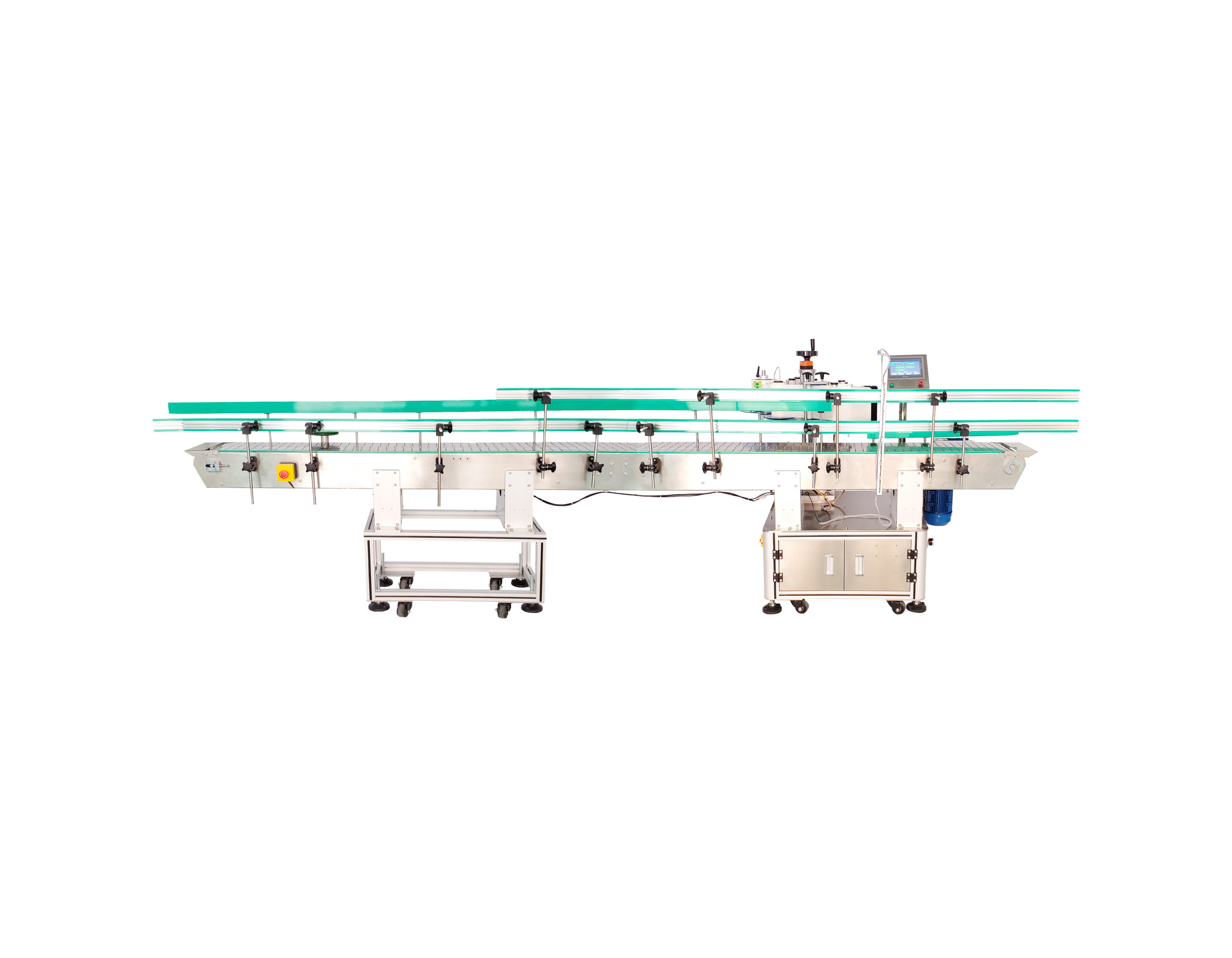
A re-test is a fault injection on the joined function, and a continuity check of the new wiring proves nothing about a stop. The pass criterion is written before the test, names the instrument, and quotes the drawing revision the test runs against. Four groups belong on the sheet. First, every guard device and every emergency stop, alone and in combination. Second, injected faults: a broken wire, a welded contact, a channel discrepancy, loss of power and restoration, loss of air pressure. Third, reset behaviour from every permitted location, plus an attempted restart before reset. Fourth, the measured stop time at the worst credible speed, written as 1) the measured value and 2) the criterion it is compared with. HiPaks runs the buyer’s own bottles before a machine ships and returns the video, and a joined line is tested on the joined line.
Step 7: What Makes the Record Re-runnable?
A validation record is evidence another person can repeat, and repetition separates a file from a baseline. The record holds the revised risk assessment, the function list and matrix, the as-built drawing revision, the test sheets with the pass criteria, the measured values, the fault-injection results, the deviations and compensating measures, and one approval with a date and a name. Two documents come out, not one: the interface schedule describes the current state, and the validation record describes the evidence at one point in time. The test of a good record is simple. Hand the pack to an engineer who was not in the room and ask which test would fail if the guard switch moved to a different relay. A pack which cannot answer re-opens the argument, and the signer is the person the argument returns to, as the qualification sign-off question shows.
The Interface Schedule and the Validation Record: One Table, Nine Columns
What Does Each of the Nine Columns Carry?
| SF ID | Initiator | Hazard or motion stopped | Stop category | Reset location | Reset authority | Owner | Test reference | Drawing revision |
|---|---|---|---|---|---|---|---|---|
| SF-01 | Labeler guard switch | Applicator and carousel motion | Controlled stop | At the guard, outside the reach | Labeler operator | Labeler | FT-01 | Rev C |
| SF-02 | Line emergency stop | Conveyor, reject arm, infeed | Controlled stop | Line station, outside the cell | Line supervisor | Line | FT-02 | Rev C |
| SF-03 | Reel access door | Unwind and web drive | Controlled stop | At the door, outside the guard | Labeler operator | Labeler | FT-03 | Rev C |
| SF-04 | Upstream jam permissive | Labeler infeed only | Protective stop | Line station | Line supervisor | Shared | FT-04 | Rev C |
| SF-05 | Loss of vacuum | Applicator pick and head | Controlled stop | At the labeler HMI | Labeler operator | Labeler | FT-05 | Rev C |
What Do Integrators Ask About a Shared Stop?
Who Owns the Stop Function After the Relay Change?
The owner is the party which joined the two circuits, and the labeler’s original validation does not cover the joined function. Ownership is written in the owning column of the interface schedule, one name per row, and two names in a row is an open finding. A third-party integrator which made the join owns the combined function. Get the ownership in writing before production.
Does the Joined Assembly Need a New Conformity Assessment?
The Machinery Directive applies when existing machinery is modified to such an extent that it becomes de facto new machinery, according to the European Commission machinery page. Regulation (EU) 2023/1230 applies on a mandatory basis as of 20 January 2027. The classification belongs to the party placing the assembly on the market, so ask that party in writing. Who signs a declaration is a separate question, set out in the CE declaration route for a labeling head.
What Is Re-tested and Re-issued After the Change?
Three items move together: the interface drawing, the functional test and the validation record. A new stop time invalidates the distance calculation, so the test measures stop time again, and the record is re-issued against the new drawing revision. Re-testing one half alone proves nothing about the joined stop. In practice the three items are signed on the same day.
