
Wet glue labeling is the oldest mechanized way to put a paper label on a glass bottle, and it remains the cheapest way to do it at volume. A stack of pre-cut paper labels sits in a magazine. A roller lifts a film of water-based adhesive out of a tank and lays it on the back of the leading label. The label is carried to a bottle that is already spinning, pressed on by a wipe-on pad or brush, and released. The paper takes up water from the glue, expands, then dries and shrinks tight against the glass. There is no liner, no silicone release coat and no pre-applied adhesive. That single fact explains both the economics and the constraints: consumable cost is the lowest of any labeling method, and the label must be paper.
What wet glue labeling actually is
The trade calls it wet glue, cold glue or simply paper labeling. All three names describe the same mechanism: an adhesive that is liquid at room temperature, applied to the label at the moment of use, curing by absorption and evaporation rather than by cooling or by pressure. The adhesive is usually a starch, dextrin or casein dispersion in water, sometimes a synthetic cold glue for difficult surfaces. The label is uncoated or lightly coated paper, printed sheet-fed or web-fed and then cut into a stack.
Because nothing is pre-applied, the label is just printed paper. That is why the material cost per thousand labels is the lowest in the category, and why the machine has to do work that a pressure-sensitive labeler delegates to the label supplier. The machine applies the adhesive, controls the film thickness, registers the label and wipes it down. Every one of those steps is a mechanical adjustment that a self-adhesive line does not have.
The five stations every wet glue labeler shares
Layouts differ between linear machines and rotary carousels, but the functions do not. Any wet glue labeler, from a small in-line unit to a rotary carousel serving a high-speed filler, contains these five functions.
| Station | Function | Where it fails in service |
|---|---|---|
| Label magazine | Holds the stack, separates one label, presents it in register | Double feeds, mispicks, labels torn at the leading edge |
| Glue unit | Tank, roller or pad, doctor blade that sets film thickness | Film too thick (label slides, glue squeezes out), film too thin (corners lift) |
| Pickup and transfer | Takes the glued label out of the magazine and carries it to the bottle | Label drops, rotates out of register, sticks to the pallet |
| Wipe-on station | Rolls the bottle against a brush or pad so the label wraps | Wrinkles at the trailing edge, bubbles on the overlap |
| Container handling | Infeed screw, star wheels, change parts, discharge | Bottle scuffing, wobble at the wrap point, jam on size change |
The glue unit deserves separate attention because it is the station that most often decides whether the line runs well. Film thickness is set by the gap between the doctor blade and the application roller, measured in fractions of a millimeter. Too much glue and the label hydroplanes on the glass before the wipe-on pad can press it down. Too little and the edges dry before they touch, which shows up an hour later as lifted corners on the pallet.
The label path, station by station
A stack of labels is loaded into the magazine with the printed face outward and the unprinted back ready to receive glue. The stack sits on a plate that rises as labels are consumed, and the leading label is held forward by a gate or by air. The separation is mechanical: friction, suction or a small blast of air, depending on paper weight and stack height.
The application roller or glue pallet travels past the magazine, picks up adhesive from the roller train, and contacts the exposed back of the leading label. Surface tension and the tack of the glue do the rest: the label adheres to the pallet and is pulled out of the stack. This is why glue viscosity matters more than glue quantity. A glue that is too thin will not lift the label cleanly. A glue that is too thick will lift two.
The pallet then swings or indexes to the bottle. On a linear machine the bottle passes in front of the pallet on a conveyor. On a rotary machine the bottle sits in a station on the carousel and the pallet meets it as the carousel turns. In both cases the bottle is rotating, driven by a belt or by friction against a fixed pad, so that the label wraps around the circumference as it is released.
The wipe-on station finishes the job. A brush, a foam pad or a set of rollers presses the label from the leading edge to the trailing edge while the bottle continues to turn. The overlap, if the label wraps more than once around, is pressed last. A wet glue label with a visible bubble almost always traces back to a wipe-on pad that is worn, glazed or set at the wrong angle.
From there the bottle is transferred to the next machine, usually a capper, a date coder or a packer. On a returnable line it may go to a bottle washer first, which is where wet glue shows one of its structural advantages: hot caustic and a short soak lift a paper label and dissolve a starch glue, and the bottle comes out clean.
Why paper and glass are the real system
The machine is only half of the mechanism. The other half is the behavior of paper when it gets wet. A paper label takes up water from the glue along its whole back, expands across the sheet, becomes limp enough to follow a curved surface, and then dries. As it dries it shrinks, and because it is already bonded to glass it cannot shrink freely. The result is tension in the sheet, which is what makes a wet glue label look tight, flat and painted on. A pressure-sensitive film label sits on top of the bottle. A wet glue paper label is pulled onto it.
Grain direction is the variable that decides whether that tension helps or fights you. Paper has a direction, set when it is made, and it expands far more across the grain than along it. A label cut with the grain running around the bottle will wrap cleanly and shrink into the curve. A label cut across the grain will fight the wrap, lift at the leading edge and wrinkle at the overlap. When a buyer sends label artwork for a test run, the grain direction is one of the first things the label supplier should be asked to confirm.
Glass is the other half. It is non-porous, dimensionally stable and heavy, which is exactly what a wipe-on process needs. The paper can move, the glass does not, and the strain ends up where it belongs. Change the container to PET and the same machine behaves differently: the bottle flexes under the wipe-on pad, the label can wrinkle when the bottle is squeezed, and the tension that makes paper look good on glass can make it look starved on plastic.
Where wet glue still wins in 2026
Three years of packaging regulation, film label price movement and pressure-sensitive capacity growth have not removed the case for wet glue. They have narrowed it. These are the conditions where a wet glue line is still the right purchase.
- Returnable glass with a bottle washer. Paper and starch glue wash off in the caustic bath. Film labels do not, and a returnable pool that has to remove film needs a different and more expensive process. For any brewer or beverage plant running refillable bottles, this is usually the deciding argument.
- Long runs of one SKU. The wet glue penalty is changeover: glue preparation, magazine reset, wipe-on adjustment, cleaning. Run one bottle and one label for weeks and that penalty disappears into the shift.
- Label cost at volume. Printed paper with no liner, no release coating and no adhesive layer is the cheapest label you can buy. At millions of labels a year, the difference in label spend is larger than the difference in machine price.
- A paper look that sells. Uncoated paper has a texture and a matte finish that film imitates badly. Heritage brands, craft spirits and premium mixers still specify it because the shelf impression is part of the product.
- Mono-material packaging pressure. A glass bottle with a paper label and a starch glue is easy to describe in a recycling or deposit-return scheme. Mixed material packaging is under increasing scrutiny in Europe, which pushes some brands back toward paper.
Where wet glue loses, and loses badly
Honesty here saves a failed project. Wet glue is the wrong system in five common situations.
First, when the label is film. A paper-and-glue machine cannot place a BOPP or OPP film label, because film does not absorb water, does not shrink onto the bottle and needs an adhesive that sets at the label ends. If the brand wants a film label, the choice is hot melt or pressure-sensitive, not wet glue.
Second, when the SKU count is high and runs are short. Every changeover costs glue preparation, cleaning and adjustment time, and a plant running twenty labels a month spends more of the week cleaning than labeling. Pressure-sensitive wins that argument on labor alone.
Third, when there is no bottle washer and no returnable pool. The wash-off advantage is the strongest structural argument for wet glue, and without a washer it disappears. What remains is label cost against cleaning labor, and the arithmetic often does not favor paper.
Fourth, when the container is PET or a lightweight glass bottle with wide dimensional spread. Wet glue needs a stable, rigid container at the wrap point. Thin-wall PET and lightweighted glass both move under the wipe-on pad, and the defect rate rises in a way that is hard to tune out.
Fifth, when the plant has no appetite for a wet process. Glue has to be mixed, monitored for viscosity, topped up and cleaned. That is a daily discipline. A site that wants to load labels and walk away should buy pressure-sensitive, whatever the label cost says.
What a wet glue project quote has to fix
There is no standard wet glue machine, which is why this category is quoted per project rather than listed from a price. Six inputs decide the drawing, and a quote that does not name all six is not comparable with another quote.
| Input | What the supplier needs | Why it changes the machine |
|---|---|---|
| Bottle | Drawing with diameter at label height, height, taper, ovality, glass weight | Sets the infeed screw, star wheels, wrap station and change parts |
| Label | Finished size, paper grade and weight, grain direction, stack height | Sets the magazine, pickup method and wipe-on geometry |
| Glue | Type, solids content, working viscosity, supplier datasheet | Sets the tank, roller or pad material, and cleaning route |
| Speed | Required bottles per hour at the labeler, not at the filler | Decides linear frame against rotary carousel, and station count |
| Panels | Body, back, neck, shoulder, or a combination | Each panel is a station, a glue unit and a magazine |
| Utilities and site | Voltage, air, floor space, glue kitchen, drain, ambient humidity | Decides the electrical package and the cleaning layout |
Two of those inputs are routinely underestimated. Ambient humidity in the plant changes how a paper stack behaves, and a label that runs perfectly in a dry room can mispick in a humid one. Speed at the labeler is not speed at the filler, because accumulation and conveyor transfer cost time; quoting a labeler at the filler’s nominal rate is the most common specification error in this category.
How a wet glue project is scoped here
HiPaks builds around pressure-sensitive and hot melt in its published catalog, and wet glue lines are quoted as projects rather than listed as stock models. That is a deliberate position: a wet glue machine is built around a glue chemistry, a paper stack and a bottle, and a catalog entry cannot carry those variables honestly. The wet glue labeling machine manufacturer page sets out how a project is scoped, from the bottle drawing through to the acceptance run.
The process starts with the bottle and the label, not with a model number. Once the drawing and the label specification are fixed, the station count and the handling are determined, and only then does a price mean anything. Before shipment, the machine is run with the customer’s own bottles and labels and a video of the run is sent back, so that the wrap, the registration and the wipe-on can be judged on the real container instead of on a demo bottle. Core components are SICK sensors and Panasonic controls, with Mean Well power supplies and Leadshine steppers. ISO 9001 and CE are in progress rather than issued, and the current document status is stated in writing at inquiry.
A wet glue build is a project with a drawing approval step, so lead time runs from drawing approval rather than from deposit. Buyers comparing it against a stock self-adhesive machine should compare it on that basis, because the two are not the same kind of purchase.
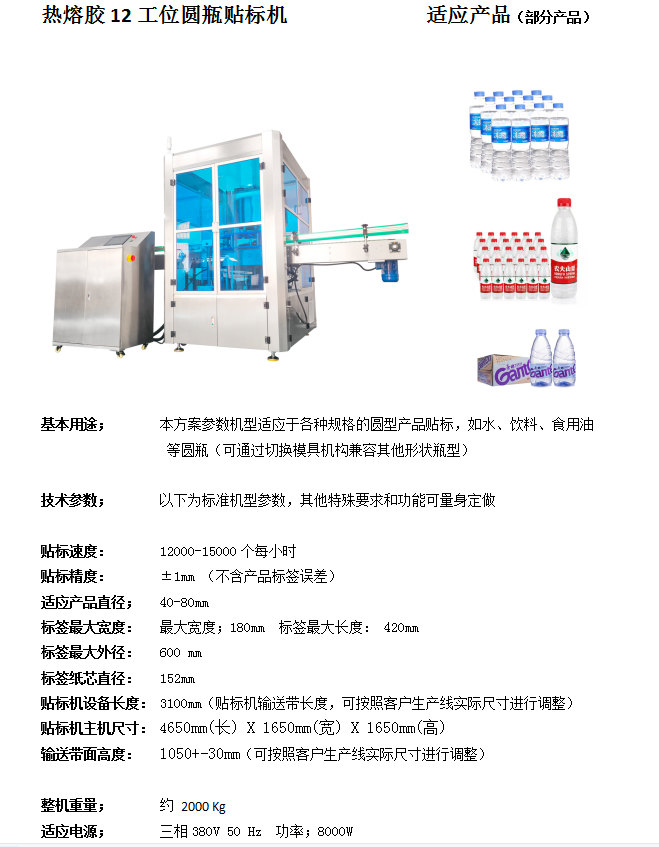
If the label is film, the honest recommendation is the hot melt glue labeling machine series, where a 12-station rotary runs 10,000 to 15,000 bottles per hour. If the run is short and the SKU count high, the recommendation is pressure-sensitive. The hot melt versus pressure-sensitive comparison covers the film side of that decision in detail, and the wet glue labeling guides cover paper selection, cut-and-stack labels and the direct comparison with hot melt.
Send the bottle drawing, the label specification and the annual volume, and the project can be scoped against a real bill of materials instead of a brochure.
Frequently asked questions
Is wet glue labeling still used in 2026?
Yes, mainly on returnable glass lines, on long single-SKU runs and on brands that want a paper label. It survives because the consumable is the cheapest available and because paper labels wash off glass in a bottle washer. It has lost the film label market entirely and most short-run work.
Can a wet glue machine apply a plastic or BOPP label?
No. Wet glue depends on the label absorbing water, becoming limp and then shrinking onto the container as it dries. Film does not absorb water, so the mechanism does not close. Film labels need hot melt or pressure-sensitive application.
What speed can a wet glue labeling machine run at?
It depends on the frame and the station count rather than on a single published figure. Linear machines suit moderate output and rotary carousels serve high-speed filling lines. The number that matters is the rate your labeler must sustain, which is set by the filler and the accumulation between them, not by the filler’s nominal rating.
Why is a wet glue machine quoted per project instead of from a price list?
Because the glue system, the label magazine and the container handling are all built around your bottle, your paper and your adhesive. Station count, panel count and format parts change the bill of materials, so a published figure would describe a machine nobody is buying. A specification with the price is the only comparable quote.
