
The semi-automatic machine is cheaper to buy and often more expensive to run. Published factory-direct bands put semi-automatic labelers at $600 to $4,500 for 15 to 30 pcs/min, and fully automatic machines at $6,000 to $15,000 for 40 to 300 pcs/min, with double-side units around $9,000. The gap is real, usually $4,000 to $10,000, but it is not the number that decides the purchase. Operator hours decide it. A semi-automatic machine converts your labour into output at roughly 1,200 containers per operator hour. An automatic machine converts capital into output and needs one person to supervise a line instead of one person to feed a machine. Below about 2,000 containers a month, the semi-automatic wins on cash. Above about 8,000, the automatic usually wins on cost per label. Between those figures, the answer depends on what your operator could be doing instead.
What the price gap really is
| Class | Indicative price | Output | Placement accuracy | Operator role |
|---|---|---|---|---|
| Semi-automatic | $600 to $4,500 | 15 to 30 pcs/min | Plus or minus 0.5mm | Feeds every container by hand |
| Desktop automatic | $1,500 to $4,000 | 20 to 40 pcs/min | Plus or minus 0.5mm on flat work | Loads a small hopper or conveyor |
| Fully automatic | $6,000 to $15,000 | 40 to 300 pcs/min | Plus or minus 1mm | Supervises, reloads labels, clears jams |
| Double-side automatic | Around $9,000 | 60 to 120 pcs/min | Plus or minus 1mm | Supervises a line |
Read the table twice, because two rows contradict the sales story. The desktop automatic band overlaps the semi-automatic band, so a $3,500 desktop unit and a $3,500 semi-automatic are competing products at the same price. And the fully automatic machine carries a wider accuracy tolerance than the semi-automatic one, which is covered further down. The two product families are laid out side by side on the semi-automatic labeling machine and automatic labeling machine pages, including the models that sit at each price band.
The cost that decides it: operator hours
Every labeling decision is a trade of money for time. The semi-automatic machine buys you a lower invoice and spends operator time. The automatic machine spends money and buys operator time back. To compare them honestly, convert both to cost per 1,000 containers.
A semi-automatic labeler running at 20 pcs/min produces 1,200 containers an hour, and it needs one person at the machine for that entire hour, plus handling time to move containers in and out. Call it 1.1 operator hours per 1,200 containers, or 0.92 hours per 1,000. A fully automatic machine at 100 pcs/min produces 6,000 an hour and needs roughly one supervisor per shift, plus label roll changes and jam clearing. Call it 0.25 operator hours per 1,000, which is a fair figure for a machine that is running well and an optimistic one for a machine that is running badly.
Multiply the difference, 0.67 hours per 1,000 containers, by your loaded labour rate, and you have the annual saving. At $5 per operator hour, that is $3.35 per 1,000 containers. At $15 per hour, it is $10.05. The same machine therefore pays back three times faster in a high-wage market than in a low-wage one, which is exactly why the same question has different answers in Germany, Poland, Vietnam, and Mexico.
A worked payback, with the assumptions exposed
Take a plant labeling 4,000 bottles a month, which is 48,000 a year. Two operators currently label by hand or on a semi-automatic machine, at a combined $2,000 a month in wages. Labour cost is therefore $0.50 per bottle, or $500 per 1,000.
An automatic machine at $6,000 does not remove the labour cost, it reduces it. Assume the automatic still needs a quarter of an operator’s attention, so the wage bill falls from $2,000 to $500 a month, a saving of $1,500. The machine pays back in four months. That is the calculation the industry usually shows you, and it is arithmetically correct.
Now change one assumption. Suppose the plant labels 1,500 bottles a month, not 4,000. The same machine still saves $1,500 a month only if those 1,500 bottles needed two operators, which they do not. At 1,500 a month, the semi-automatic machine needs one operator at $1,000, and the automatic needs a quarter of one at $250, so the saving is $750 and the payback stretches to eight months, before the conveyor, the compressed air, and the floor space are counted.
The industry already has a framework for this. The PMMI OpX Leadership Network, which works on total cost of ownership and factory acceptance practice for packaging machinery, treats the purchase price as one line in a longer model rather than the model itself. Applying that view to a labeler means adding conveyor, air, spares, training, changeover time, and the cost of the floor space, then comparing annual cost per 1,000 containers instead of invoice totals.
HiPaks publishes these bands and the break-even arithmetic rather than a single promise, and the break-even calculator runs the same model on your own volumes. The number that matters is not the payback month. It is whether the volumes you are assuming will still be there in month nine.
Where each class quietly costs more
Both machines have a second price, paid monthly rather than at the invoice. The lists below are the ones that decide whether the payback model survives contact with a real shift.
Where the automatic machine quietly costs more
The conveyor is part of the machine. An automatic labeler needs infeed and outfeed, which means a conveyor, supports, and a transfer that matches your existing line height. Some quotations include it, some do not, and the difference between two $9,000 quotes is often the conveyor.
Compressed air and floor space. Pneumatics need a supply that is dry and stable, and a machine with a conveyor occupies a line, not a bench. If the space does not exist, the project includes building work.
Changeover skill. A semi-automatic machine is adjusted by the operator in a minute. An automatic machine with a star wheel, a wrap belt, and a reject station has more settings, and a changeover done badly produces a shift of rejects. Budget for training, not just a manual.
Spares that stop the line. A failed sensor on a semi-automatic machine slows one operator. A failed sensor on an automatic machine stops a line, and the cost of that hour is measured in downstream idle time. Keep the critical spares on the shelf, which is a real cost that belongs in the comparison.
The idle machine. An automatic labeler bought for a volume that has not arrived yet still depreciates, still needs maintenance, and still occupies the floor. This is the most common expensive mistake in the category, and it is invisible in a payback spreadsheet.
Where the semi-automatic machine quietly costs more
Labour that scales with output. Every additional 1,200 containers an hour needs another person. Growth is linear and hiring is not.
Drift across a shift. A semi-automatic machine holds placement well when the operator is fresh. On the third hour, labels creep, and the reject rate rises in a way nobody records. The accuracy specification is met on a sample, not necessarily at 4pm.
One person is a single point of failure. If the only trained operator is absent, the line stops. An automatic machine with a documented setup can be run by anyone who can read the HMI.
A ceiling you will hit. A 30 pcs/min machine cannot be made to run at 90. The upgrade path is a second machine or a replacement, and the semi-automatic unit becomes a spare that occupies space.
The accuracy comparison that surprises buyers
The specification sheet says plus or minus 0.5mm for a semi-automatic machine and plus or minus 1mm for a fully automatic one, and a buyer reasonably asks why the cheaper machine is more accurate. The answer is that the two numbers describe different conditions.
On a semi-automatic machine the container is held in a fixture while the label is applied. The only variable is the label feed and the applicator, so the machine can hold half a millimetre. On an automatic line the container is moving, held by a belt or a star wheel, and the number includes the variation introduced by that handling. The machine is not less precise. The process has more moving parts.
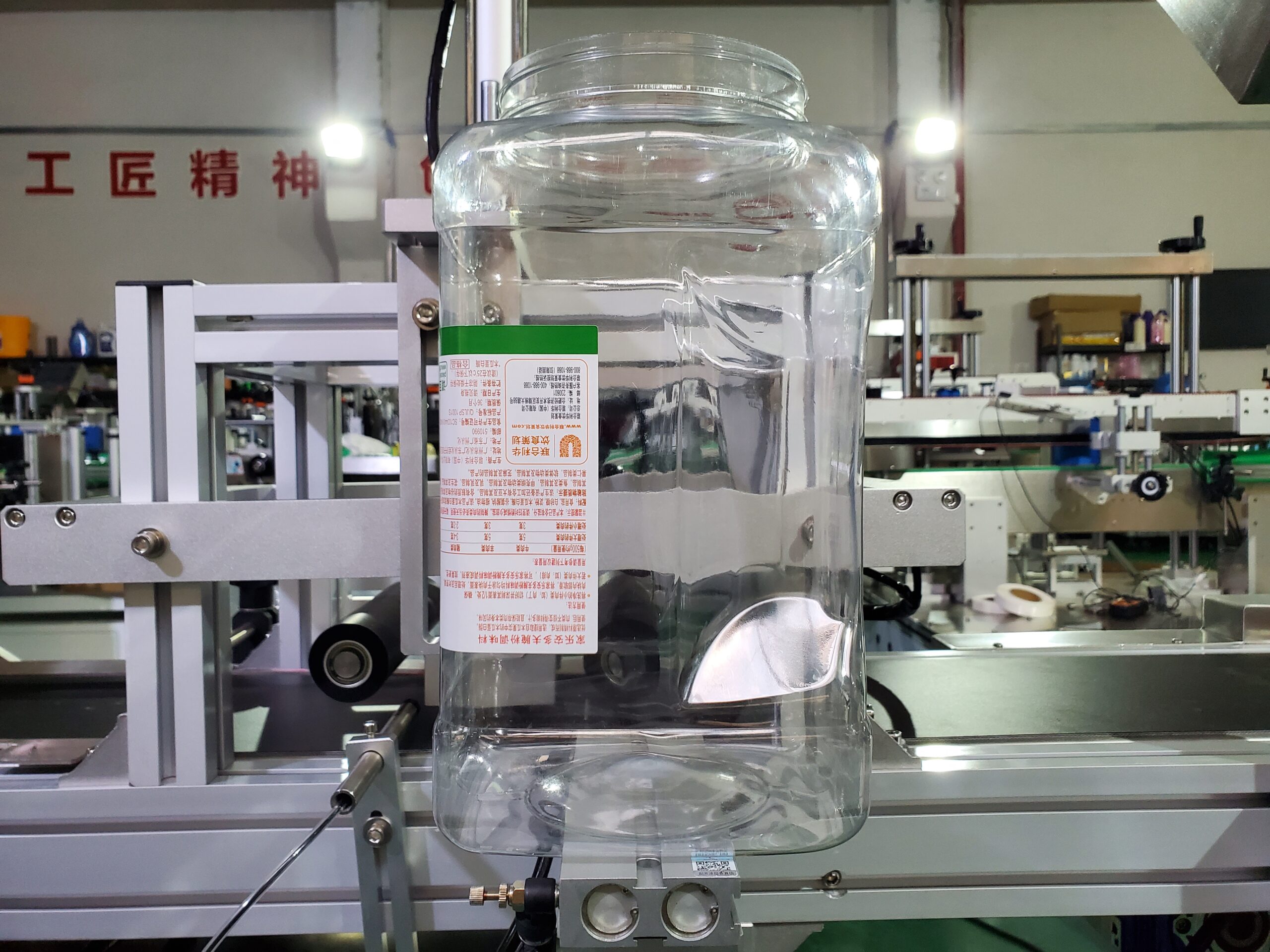
Both figures exclude the product and the label, which is why a quotation that promises 1mm on a tapered bottle with a soft label is promising something the machine cannot control. Where flat, high-precision work is the job, a purpose-built semi-automatic unit such as the MT-807 reaches up to plus or minus 0.2mm, better than either general-purpose class, because it removes container handling from the equation entirely.
The decision rule, in five questions
How many containers a month, at the peak week rather than the average month? Size the machine for the peak, because a line that cannot cover the peak is a line that ships late.
What is one operator hour worth where you are? This is the single input that flips the answer. Under $4, the semi-automatic holds longer than most consultants admit. Over $12, the automatic pays back quickly.
Is the container stable enough to run unattended? A soft pouch, a tall tapered bottle, or a container that will not stand on a conveyor needs handling that costs more than the labeler.
Do you have the utilities and the floor? Air, power, and three metres of line are preconditions, not afterthoughts.
Will this volume exist in two years? If the answer is uncertain, a semi-automatic machine plus a good fixture is the cheaper way to be wrong, and it keeps its resale value in a small plant.
There is a third option that buyers forget: a semi-automatic machine today and an automatic machine when the volume is proven, with the fixture drawings archived so the second machine is cheaper. That sequence costs more in total than buying the automatic first, and less than buying an automatic machine that runs four hours a day.
Next step: if you are between the two classes, the selection guide maps container shape and volume to a machine type, and the quote form will price both options on the same container so the comparison is real. Buyers who want to see the difference in motion can request a test-run video of either class on their own bottles.
FAQ
Is a semi-automatic labeling machine worth it for a small business?
Yes, below roughly 2,000 containers a month, provided the fixture is made for your container. It costs a fraction of an automatic line, needs no conveyor or compressed air, and can be running the same week it arrives. The limit is labour: output rises only by adding people.
How long does an automatic labeling machine take to pay for itself?
On the published illustration, a $6,000 machine replacing $1,500 a month of labelling labour pays back in about four months. At a third of that volume the payback stretches past eight months, and the conveyor, air supply, and floor space still have to be paid for. Run your own numbers before accepting a vendor payback figure.
Why is the automatic machine rated at plus or minus 1mm when the semi-automatic is 0.5mm?
Because the automatic figure includes container handling. The labeler itself is precise, but the bottle is moving on a conveyor or held in a star wheel, and that motion adds variation. The semi-automatic machine holds the container still, so the only variable is the label feed.
Can I add a conveyor to a semi-automatic machine later?
Sometimes, and it rarely produces an automatic machine. A conveyor removes the carrying, not the feeding, and the labeler still needs an operator to place each container. Treat it as an ergonomic improvement rather than a capacity upgrade.
Which machine needs fewer spare parts?
The semi-automatic machine, by a wide margin, because it has fewer motors, no conveyor, and no reject system. The automatic machine’s parts cost is not the issue, it is the downtime cost when a part fails mid-shift. Budget a critical spares kit with the machine rather than after the first stoppage.
