
The short answer: a labeling machine pays for itself when the monthly saving it creates exceeds the monthly cost of owning it, and payback in months is total capital cost divided by net monthly saving. Total capital cost is not the machine price. It is the machine, the format parts for every SKU, freight, duty, installation, the spare parts kit and the training time. Net monthly saving is labour hours removed multiplied by the loaded hourly rate, plus rejects avoided, plus changeover hours recovered, minus consumables. Most ROI arguments fail on the inputs rather than the arithmetic: an unmeasured reject rate, an hourly rate that excludes overhead, or a speed figure taken from a brochure instead of from a stopwatch on your own line.
The payback formula, written out
Write the calculation on one page before you read a quotation. If a supplier cannot answer within this structure, the payback number in their proposal is a sales device rather than a financial case.
Payback in months = total capital cost / net monthly saving
Where total capital cost includes:
- Machine price for the configuration you actually need, including the second station if you run two labels.
- Format parts for every SKU in the first two years, not only the launch SKU.
- Freight, insurance, duty and inland delivery to the plant.
- Installation and commissioning, if quoted separately.
- One spare set of wear parts and a first consumables order.
- Operator and maintenance training hours, valued at the loaded rate.
And net monthly saving is:
- Labour hours removed per month multiplied by the loaded hourly rate.
- Rejects avoided, valued at contribution margin rather than at selling price.
- Changeover hours recovered, valued at the same loaded rate.
- Label and liner waste avoided, if the current process has a measurable scrap rate.
- Minus consumables, spares and the maintenance time the new machine adds.
The loaded hourly rate is the number finance uses, not the wage on the payslip. It includes employer contributions, paid leave, supervision and the cost of the space the operator occupies. Eurostat figures for hourly labour costs show the scale of that gap: the EU average was €34.9 in 2025, ranging from €12.0 to €56.8 between member states, with non-wage costs at 24.8% of the total. Use your own figure, and use the loaded one.
Four inputs you can measure this week
Every input below can be measured with a stopwatch and a shift report. None of them requires a consultant, and all four are more reliable than a supplier’s assumption.
- Labour minutes per 1,000 bottles. Time the full cycle, including fetching labels, feeding bottles, packing and clearing jams. Do it on a normal shift, not on the day the line runs best.
- Reject rate, split by cause. Count rejects for a week and sort them into mispositioned, wrinkled, missing and damaged. A single blended percentage hides the fact that only two causes may be worth fixing.
- Changeover minutes and frequency. Time a changeover from last good bottle of SKU A to first good bottle of SKU B. Multiply by the number of changeovers per week.
- Uptime. Hours the line was available divided by scheduled hours. This is the number that turns a brochure speed into a real output, and it is the input buyers most often leave out. Define it the way ISO 22400-2 defines manufacturing KPIs, so your figure and your plant report use the same formula.
A worked example, with the assumptions visible
The example below uses round numbers so the arithmetic can be checked by hand. Replace each one with your measured figure. The capital cost appears as a variable because the quotation is yours, not ours; the three levels in the grid are hypothetical quote levels chosen to show how payback moves.
| Input | Value used | How it was derived |
|---|---|---|
| Annual bottles | 750,000 | 3,000 per day, 250 days |
| Operators before | 2 | One feeding, one packing and inspecting |
| Operators after | 1 | One attends the automatic labeler and packs |
| Hours removed per year | 1,250 | 5 productive hours per day, 250 days |
| Loaded hourly rate | €30 | Below the 2025 EU average of €34.9, so the saving is conservative |
| Labour saving per year | €37,500 | 1,250 hours multiplied by €30 |
| Reject rate before and after | 3.0% to 0.8% | 16,500 bottles avoided per year |
| Contribution margin per bottle | €0.35 | Use your own margin, not the selling price |
| Reject saving per year | €5,775 | 16,500 multiplied by €0.35 |
| Changeover hours recovered | 150 per year | Four changeovers a week, 45 minutes saved each |
| Changeover saving per year | €4,500 | 150 hours multiplied by €30 |
| Added consumables and spares | €1,800 per year | Wear parts, filters, occasional sensor |
| Net saving per year | €45,975 | 37,500 + 5,775 + 4,500 minus 1,800 |
| Net saving per month | €3,831 | Annual saving divided by 12 |
With a net saving of €3,831 per month, payback depends entirely on the capital number:
| Capital cost (hypothetical) | Payback | Three-year net after capital |
|---|---|---|
| €30,000 | 7.8 months | €107,925 |
| €50,000 | 13.1 months | €87,925 |
| €80,000 | 20.9 months | €57,925 |
Read the grid as a shape rather than as a forecast. The saving is dominated by labour in this example, which means the payback is sensitive to whether the operator is redeployed or removed. If the operator is redeployed to packing and the packing headcount falls instead, the saving is real but it lands in a different cost line and finance may not count it. Agree with finance which line the saving hits before you sign the purchase order.
The inputs that are usually wrong
Labour rate without overhead
A payback built on the wage rate overstates the months and understates the saving. A payback built on a fully loaded rate that includes allocated rent can overstate the saving. Use the rate your finance team applies to a business case, and show it in the calculation so the number can be challenged.
Brochure speed instead of line speed
An automatic labeler is quoted at 40 to 300 pcs/min depending on configuration, and that range is real. What the range does not say is what your line will achieve. Uptime, infeed gaps, label roll changes and downstream blocking decide the actual figure. A machine rated at 120 pcs/min that runs at 70% uptime delivers 84 pcs/min of good output, which may still be more than enough, but the payback must use 84.
Reject baseline measured on a good week
If the current reject rate is 1% on the week you measured and 4% in the week after a label supplier change, the saving from the new machine is somewhere between those numbers. Measure for a month, split by cause, and use the median rather than the best week.
Changeover optimism
Suppliers quote changeover in minutes with a trained technician and the next set of format parts already on the bench. Your plant will do it at shift change with the parts in a cupboard. Time a changeover on your existing machine and use that number as the baseline; then ask the supplier for a filmed changeover as part of the factory acceptance test.
Costs the payback sheet leaves out
- Freight, duty and inland haulage. FOB Shenzhen means the machine is yours once it is loaded; the rest of the journey is a cost line.
- Format parts per SKU. A machine that covers one bottle cheaply can cost more than expected when the second and third SKUs arrive.
- Compressed air and power. Pneumatic units add a compressor load and a maintenance item that a bench unit does not have.
- Floor space. Space has a rent value even when the building is owned, and an automatic line needs access at both ends.
- Commissioning downtime. Three days of reduced output during installation belongs in the first-year numbers.
- Training and documentation time. Writing the changeover sheet and the daily check takes hours that nobody budgets.
None of these is large on its own. Together they typically add a visible percentage to the capital number, and a payback that ignores them is shorter than the one finance will calculate.
When the saving is not labour
In markets where the loaded hourly rate is low, labour removal rarely justifies an automatic machine on its own. The case has to come from somewhere else, and there are three honest versions of it.
Capacity without a second shift. If the filler already outruns the labeling station, the machine releases output that is already paid for. That saving is measured in bottles sold, not in hours removed, and it is usually the strongest case in a low-wage plant.
Rejects that reach the customer. A mislabeled bottle that ships is a recall risk, a rework cost and a customer conversation. If your reject rate is low but the escapes are expensive, the case is risk reduction, and it should be presented as such rather than dressed up as labour saving.
Contract requirements. Some retail and pharmaceutical customers require a validated labeling process or a documented accuracy figure. In that case the machine is a condition of the order, and ROI is the wrong frame. Say so in the business case; a project justified by a contract is more defensible than one justified by an optimistic saving.
HiPaks has machines in more than 50 countries and over 500 factories, and the pattern is consistent: the projects that pay back fastest are the ones where the buyer measured rejects and changeover before asking for a price, not the ones that bought the fastest machine in the catalog.
Test the number before you commit
Three checks cost almost nothing and remove most of the risk from the business case.
- Run the break-even calculator with your measured inputs, then run it again with the saving cut by 30%. If the project still pays back inside your capital horizon, the case still holds.
- Watch the machine run on your bottle. A test-run video on your own container and label is evidence about your product. HiPaks films that trial before shipment and sends it back, so the reject rate in the video is a data point rather than a demonstration.
- Ask for the accuracy figure with its measurement point. Automatic machines are quoted at ±1 mm excluding product and label deviation, semi-automatic at ±0.5 mm, and the MT-807 reaches up to ±0.2 mm on flat high-precision work. A tolerance without a measurement point cannot be inspected, and an uninspectable tolerance cannot be used in a payback calculation.
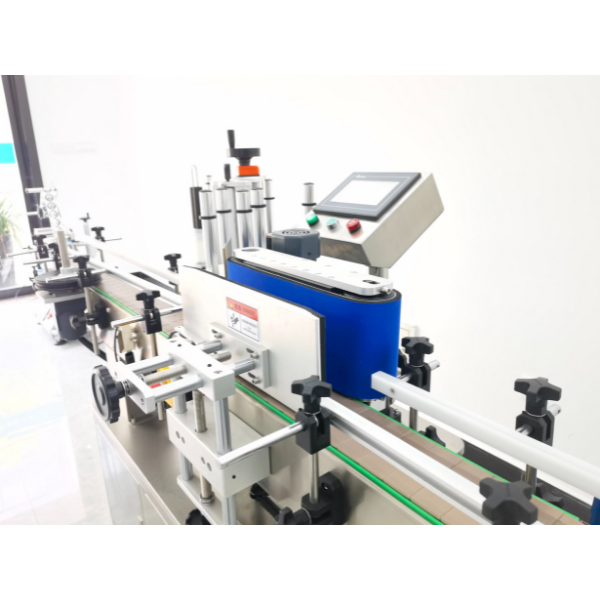
Then compare the total capital number with the price guide and with the configuration you actually need from the automatic labeling machine range. If the payback is longer than your capital horizon, a semi-automatic unit or a labeling head on the existing conveyor is often the better first step.
Send your measured inputs with the inquiry and the quotation can be built around them. For the machine side of the calculation, request a free test-run video, and for more buying guides read automatic labeling.
Frequently asked questions
What is a good payback period for a labeling machine?
It depends on your capital horizon rather than on an industry norm. A project that pays back inside 18 months is usually easy to approve, and one that takes longer than three years needs a strategic reason such as a customer contract or a capacity constraint. The number that matters is the one your finance team will sign, calculated with measured inputs.
Should I use labour saving or reject reduction in the calculation?
Use both, but keep them in separate lines. Labour saving is easy to verify and easy to challenge, because the operator either leaves the line or does not. Reject reduction should be valued at contribution margin and measured over a month, not a single shift.
Does a faster machine always improve ROI?
No. Payback depends on good output, which is speed multiplied by uptime, minus rejects. A faster machine that stops for label roll changes or downstream blocking can deliver less than a slower machine that runs steadily. Measure uptime before you pay for speed.
How do I account for changeover in the payback?
Time a changeover on your current machine, count how often it happens, and multiply the hours by the loaded rate. Then ask the supplier for a filmed changeover on the new machine with the format parts at hand, and use the filmed number rather than the quoted one.
