
A label change before a purchase order is two approvals, not one, and the two approvals carry different signatures. One approval states whether the finished label is acceptable to the recycling stream receiving the bottle. The other states whether the applicator still places the new construction with a stable web at line speed. The purchasing manager signs the first. The line engineer signs the second.
The test behind the first approval is a wash and float screen run on finished, printed production bottles, read on the PET flake rather than on the label. A floating label is a necessary result and not a sufficient one. Adhesive left on the flake fails the candidate whatever the label does on the bottle.
According to Plastic Recyclers, every design feature of a package must be assessed, so substrate, print coverage, ink and adhesive stand as separate rows with separate evidence in 2026. The chain below runs from the specimen through the recycler’s conditions to the register that closes the order.
Which Two Answers Does the Purchase Order Need, and Who Signs Each?
Asking for a label quote is a request for two answers, and one document answers neither well. First, does the recycling stream accept the finished label as part of the bottle? Second, does the applicator still place the new construction with a stable web at line speed?
The first answer belongs to purchasing and compliance, because the customer’s EPR declaration and recyclability claim rest on the evidence. The second belongs to the line engineer, because a qualified run on the buyer’s own bottles is the only speed evidence both sides accept.
The adhesive class chosen at the label order settles much of the first answer, and the adhesive class for recycled PET bottles has a post of its own.
For example, mixing the two produces the usual failure: a good laboratory result tearing on a cold bottle, or a perfect run record attached to a failed claim. Two owners, two evidence files, one order.
Step 1: What Specimen Does the Screen Have to Use?
A specimen for a label screen is a finished, printed, applied production bottle drawn from the customer’s own stock, and anything less cannot pass or fail the job. An unprinted film swatch, a converter’s generic sample and a bottle from a different filling run all answer a different question.
First, the facestock and the adhesive must match the purchase order lot. Second, every ink must be present, including the white laydown under a coloured design, because print coverage changes what the recycler sees on the flake. Third, the varnish or topcoat belongs in the sample, since a coating surviving the wash leaves a different flake surface.
Fourth, coverage must be the ordered coverage: full wrap, partial wrap and a small front panel are three designs and three outcomes. Fifth, the bottle must be the production bottle rather than a jar from the laboratory shelf. Step 1 closes when the sample is photographed with the lot code visible and the draw is signed by both owners.
Step 2: Which Document Covers Bottles, and Which Covers Thermoforms?
The document governing a bottle label is the PET rigid design guide published by the Association of Plastic Recyclers, and the thermoform resource document is a different file for a different package. Both sit on the same site, so a search result for one can land a buyer on the other.
Open the PET rigid design guide and read the label rows for bottles. Note the four categories a design feature can fall into, according to Plastic Recyclers, from preferred through detrimental and requires testing to a feature rendering the package non-recyclable. Check the label as separate features: substrate, coverage, metal decoration, ink and adhesive, because the guide assesses each feature on its own.
The thermoform resource document appeared in the citation set behind this article as if it were bottle guidance, and a buyer following a summary can run the wrong protocol. The page’s own terms also restrict reproduction of its material, so Step 2 ends with the reader on the current document.
Step 3: Why Do the Wash Conditions Come From the Recycler?
The wash conditions for a label screen are properties of the recycling plant receiving the bottle, not of the packaging laboratory, and a result carries weight only when the conditions travel beside the number.
Ask the customer’s recycler, or the recognised protocol the design guide names, for the wash temperature, the wash chemistry, the residence time and the flake size. Record all four with the result, because a result without conditions cannot be compared with the recycler’s own trial. Repeat the run on the same specimen when a condition changes, rather than assuming a favourable direction.
A bench recipe printed in a supplier brochure makes the buyer’s number incomparable with the recycler’s number, and the disagreement surfaces after the purchase order. In practice the instruction to a converter is short: conditions come from the people who run the wash, specimen comes from the buyer, and the report names both.
Step 4: What Does a Floating Label Prove, and What Does It Not?
A float and sink result reports the fraction a label joins when the washed material separates in water. A label film that floats reports to the surface fraction while PET flake reports to the bottom, and the split is what the recycler wants.
A floating label proves separation of the substrate from the flake under the tested condition. A sinking film, including a film carrying mineral filler, reports with the flake and adds a contaminant to the PET stream. A paper label pulps and leaves fibre and adhesive residue, and PVC is, according to Plastic Recyclers, a material extremely hard for the recycler to remove.
A float result does not prove the release of the adhesive, the cleanliness of the ink on the flake, or a pass in every category of the guide. For example, a film floating clear while the flake still carries a milky patch has failed the bottle.
Step 5: Why Is the Flake the Specimen and Not the Label?
The flake is the specimen because the recycler sells flake and fibre, and a clean label over a contaminated flake has solved nothing. Inspection happens after the wash and after separation, on the fraction the flake joined, under one consistent light.
Inspect for adhesive residue, haze, specks and discoloration on the flake surface rather than on the label. Photograph the flake against a scale card, so a later comparison uses the same reference, and retain the sample in a labelled bag with the conditions recorded beside the photograph.
The failure worth naming is a label floating while much of the adhesive stays on the flake. A wash-off adhesive is designed for the conditions of the wash rather than for weaker adhesion, and adhesion strength is not the mechanism at work. A screener opening the bag a month later must separate a pass from a fail without asking the person who ran the trial, so Step 5 is a photograph and a bag, not a memory.
Step 6: How Do You Re-Qualify the Line on a New Construction?
A re-qualification run is a documented applicator trial on the new construction, and the run is the second signature on the change. A good wash result can still fail the line, and a perfect run record can still fail the claim.
Release force and liner change with the adhesive, so peel behaviour at the dispensing edge is re-checked rather than assumed. Tack on cold or wet bottles is the usual surprise. Thin film carries static and web breaks, so web path, splice and roll format are watched over a full roll, and wrinkles and flagging are read as line faults rather than label faults.
Label area and position may move, so registration is re-checked against the ordered accuracy class, plus or minus 0.5 mm general or up to 0.2 mm on the MT-807, excluding product and label variation.
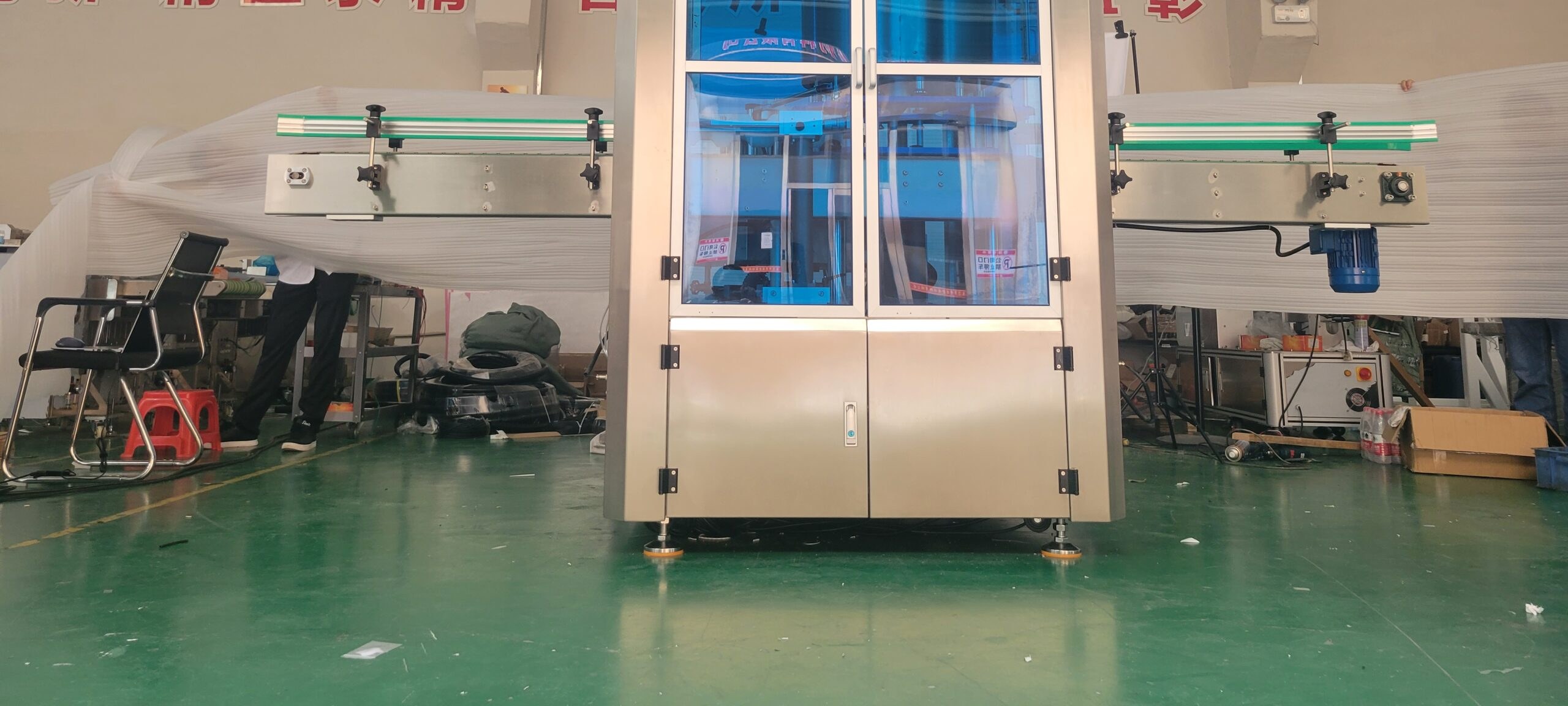
For example, a semi-automatic line at 15 to 30 pcs/min and a fully automatic line at 40 to 300 pcs/min load the web differently, so the trial runs at the ordered speed. The run uses the buyer’s own bottles with a video returned beside the record. A trial on your own stock answers the speed question, and the specification sheet carries the numbers into the order.
Step 7: Which Clause, Which Remedy, and Which Register Row?
The three-way clause and the remedy come last because both rest on the evidence above, and a remedy written after a failed screen is a negotiation rather than a term.
What Does Each of the Three Parties Put in Writing?
A three-way clause is a written split of evidence, test and consequence across three parties. First, the buyer owns the specimen and the recycler’s conditions. Second, the label converter owns the construction, the adhesive class and a recognition letter naming the construction, the converter and the test. Third, the machine supplier owns the applicator qualification on the supplied stock.
The clause names who holds each document, because a datasheet is not a recognition letter, and names who funds a second construction when the screen fails.
The commercial frame around a 2026 order is ordinary: MOQ one unit, 30% deposit with 70% before shipment, FOB Shenzhen, one year of warranty with lifetime support. In our own trial runs the applicator record travels beside the video of the buyer’s bottles, and the deviation wording sits in the same paragraph. To start the run behind the clause, request a factory quote with the construction and the ordered speed.
The Register
| Construction | What the applicator must re-prove | What the screen must show | Who holds the evidence | The sentence the order needs |
|---|---|---|---|---|
| Wash-off pressure-sensitive film | Peel-edge release force, tack on a cold or wet bottle | Float separation, and a flake free of adhesive, haze and specks | Converter for the construction, buyer for the flake photographs | Change accepted, subject to a recognition letter for the named construction |
| Paper pressure-sensitive | Web breaks, dust at the dispensing edge, splice strength | The fraction the fibre joins, and the flake after the wash | Buyer, with the construction record attached | Change accepted only with the flake photographs beside the result |
| Shrink sleeve | Sleeve application, seam quality, grip on the bottle | The fraction the sleeve material joins, with the conditions recorded | Converter and buyer, jointly | Change rejected until a sleeve result carries the recycler’s conditions |
| Glue-applied dense film | Glue pattern, transfer, station settings on the hot-melt unit | The fraction the film joins, and the flake surface | Machine supplier for the run, buyer for the flake | Change accepted for the line, claim still open |
| Current permanent construction | Nothing new, and no pass claimed on the line | The fraction the label joins, recorded as the baseline | Buyer | Keep the current construction, re-test only when the design changes |
Frequently Asked Questions
Does a Wash-Off Adhesive Make a Label Recyclable?
No. A wash-off adhesive is one feature of one design, and the Association of Plastic Recyclers assesses substrate, coverage, ink, decoration and adhesive separately. A favourable wash result on a single feature does not convert the package into a recyclable item, and no label supplier decides the claim alone.
Can the Applicator Run a Wash-Off Film at Line Speed?
Line speed is qualified on the buyer’s own stock, not on a datasheet. Release force, tack on a cold or wet bottle, web behaviour on thin film and registration at the ordered accuracy class are re-checked in one documented run, and the run is the second signature on the change.
Which Document Decides the Claim, the Datasheet or the Letter?
A recognition letter names a construction, a converter and the test behind the letter. A datasheet describes a product family and names none of the three, so the letter is the document a buyer files beside the purchase order.
What Happens When the Screen Passes and Recognition Never Arrives?
The purchase order needs a written remedy: hold the change, fund a second construction, accept with a recorded deviation, or keep the current label. Choosing the remedy before the trial starts keeps a favourable screen from becoming an unfunded programme.
