
The short answer is that the label material makes the decision before any cost comparison starts. Wet glue applies paper. Hot melt applies film. If the brand needs a BOPP or OPP label, the wet glue question is closed, and the real comparison is hot melt against pressure-sensitive. If the label is paper on returnable glass, wet glue is usually the lower-cost system and the comparison is against staying on paper at all. Everything else, speed, capex, labor, changeover, is a tiebreaker between two systems that only overlap on one narrow case: a paper label on a high-speed single-trip line, where hot melt can also apply paper with a hot adhesive. This page works through the six variables in the order that actually decides the question, then sets out the decision procedure and the hybrid answers that are often better than picking one system for the whole plant.
Why the label decides first
A wet glue system applies a water-based adhesive to the back of a paper label. The mechanism depends on the paper absorbing water, becoming limp, wrapping the bottle and then shrinking tight as it dries. Film does not absorb water. A BOPP label applied with a water-based glue will sit on the bottle as a loose sheet with lifted edges, and no amount of glue or pressure will make it behave like paper.
A hot melt system applies a thermoplastic adhesive, molten at the point of application, that sets by cooling in a fraction of a second. It works on film because it does not need the label to absorb anything: the adhesive grabs the film at the leading and trailing ends and holds it under tension around the bottle. It also works on paper, which is why the two systems overlap on paper labels, and why the overlap is the only place where a genuine head-to-head comparison is possible.
So the first question in any review is not which system is cheaper. It is what the label is made of, now and in three years. A brand plan that includes a film label for an export range has already decided the machine question for that range, whether or not the packaging team has noticed.
The six variables, side by side
| Variable | Wet glue | Hot melt |
|---|---|---|
| Label material | Paper only | Film, and paper on some machines |
| Container | Rigid glass, stable dimensions | Glass and PET, tolerates more variation |
| Speed | Moderate on linear frames, high on rotary | High on rotary carousels, 10,000 to 15,000 bottles per hour on a 12-station build |
| Consumable | Cheapest label plus cheap glue | Film label plus melt, higher per label |
| Changeover | Glue prep, magazine, wipe-on, cleaning | Roll change, melt temperature, cutting and glue timing |
| Bottle reuse | Washes off in caustic | Film does not strip in a standard washer |
Read the table as a set of constraints rather than a scorecard. Two of the rows are absolute: label material and bottle reuse. The other four are cost and throughput questions that can be modeled.
Variable one: the label, now and later
Paper labels are printed on uncoated, machine-glazed, coated or wet-strength stock, cut into stacks, and applied with a water-based adhesive. Film labels are printed on BOPP or OPP, supplied either as a roll for hot melt or as a liner-backed roll for pressure-sensitive, and applied with a hot adhesive or a pressure-sensitive acrylic.
The practical test is the brand plan. If the packaging team has approved a film label for any SKU that will run on the line in the next three years, wet glue cannot serve that SKU. If every SKU is paper and the brand intends to keep it that way, hot melt is buying capability the plant will not use, at a capital cost that has to be justified on speed alone. For food and beverage packaging, the adhesive and the label also sit inside the food contact discussion, and the European Commission maintains a database of substances assessed for food contact materials that buyers and quality teams use when a new adhesive is proposed.
Variable two: the container and the bottle pool
Wet glue needs a rigid container at the wrap point. Glass is ideal: non-porous, dimensionally stable and heavy enough to resist the wipe-on pressure. Lightweighted glass with wide dimensional spread and thin-wall PET both move under the pad, and the defect rate rises in a way that is hard to tune out.
Hot melt is more tolerant. The adhesive grabs the label ends and holds the film under tension, so a container that flexes slightly does not automatically produce a defect. That is why hot melt dominates water, CSD and high-speed beverage lines, including PET.
The bottle pool matters just as much. A returnable glass pool with a bottle washer is the strongest case for wet glue, because paper and starch glue strip in the caustic bath. A single-trip bottle has no wash-off requirement, and the strongest argument for paper disappears with it. Ask the question directly: are these bottles coming back, and if they are, what removes the label?
Variable three: speed, and where the bottleneck sits
Speed comparisons are usually made between machine maximums, which is the wrong number. The labeler has to sustain the rate the filler delivers, minus whatever accumulation absorbs, and it has to do that while the line is running, not in a demo.
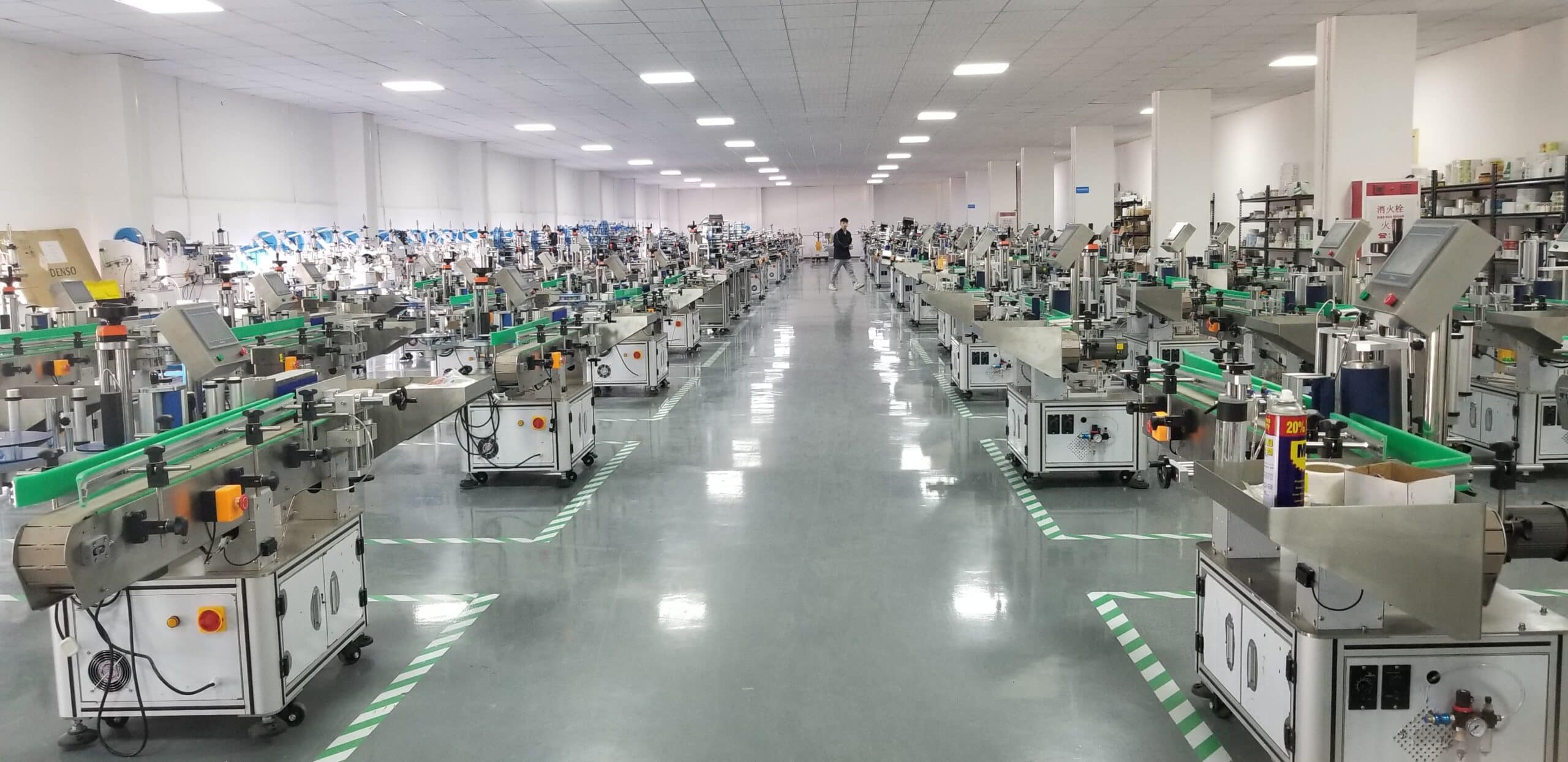
A linear wet glue machine suits moderate output and long runs. A rotary wet glue carousel serves the high-speed end, and a rotary hot melt carousel is built for the same class of line. On this site the hot melt rotary is quoted at 10,000 to 15,000 bottles per hour with 12 stations, and 10,000 to 12,000 with 16 stations, which is the band where a wet glue line stops being competitive on footprint and starts being competitive on consumable cost.
The bottleneck question is worth answering with data before the machine question. If the filler runs at 8,000 bottles per hour and the labeler can hold 9,000, the labeler is not the constraint and buying more labeler speed buys nothing. If the filler has been upgraded and the labeler is now the limit, the format question and the speed question arrive together.
Variable four: consumable and cost per bottle
Wet glue wins the consumable comparison by a wide margin on paper. The label is printed paper with no liner, no release coat and no adhesive layer, and the glue is a starch or dextrin dispersion priced per kilogram. Hot melt consumes a film label plus a melt adhesive, and pressure-sensitive consumes a film label with adhesive and a liner that is discarded.
The comparison that matters is cost per labeled bottle, not cost per label:
Cost per bottle = label cost + adhesive cost + labor + energy + wear, all divided by the bottles produced in the same period, plus the machine delta amortized over the volume.
Two adjustments decide the result more often than the label price. Labor: wet glue needs glue preparation, viscosity checks and a cleaning routine at every shift change, while hot melt needs temperature discipline and nozzle care but no glue kitchen. Bottle reuse: if the bottles come back, the washer and the label removal are part of the system, and film changes that cost. The break-even calculator runs the same arithmetic with your volume and labor inputs, and the four-block model behind it is set out in full there.
Variable five: changeover and SKU count
Changeover is where wet glue loses small plants. Glue has to be prepared or topped up, the magazine has to be reset for a different label size, the wipe-on pad has to be adjusted, and the glue unit has to be cleaned before a different adhesive goes in. A plant running twenty labels a month spends more time cleaning than labeling.
Hot melt changeover is faster on the label side, because a roll swap is quick, but it has its own disciplines: melt temperature, glue timing at the leading and trailing ends, and cutting registration. A hot melt machine that is not set up correctly produces flagging at the trailing edge, which is the defect most associated with the technology.
The honest comparison is minutes per changeover times changeovers per week. A brewery running four SKUs on long campaigns does not care. A co-packer running forty does, and for that plant pressure-sensitive is usually the better answer than either glue system, because it has no glue at all.
Variable six: labor, maintenance and spares
Both systems need a daily routine, and the routines are different rather than unequal. Wet glue needs the glue unit cleaned, the rollers and pads inspected for glazing, the magazine checked for wear and the wipe-on pad replaced on a schedule. Hot melt needs the pot brought to temperature before the shift, the adhesive stored dry, the nozzles and rollers cleaned of carbonized glue, and the cutting knives checked.
Spares follow the same pattern. Wet glue wears rollers, pads, grippers and magazine fingers. Hot melt wears knives, glue rollers, nozzles and heater elements. The labeling machine parts page lists the wear items and the recommended first-year spares list, which is the document to compare rather than the machine price.
One labor difference is worth stating plainly: wet glue is more forgiving of a machine that is slightly out of adjustment, and less forgiving of an operator who skips cleaning. Hot melt is the reverse. A plant with high operator turnover often does better with pressure-sensitive than with either glue system, and that is a legitimate reason to choose it.
The decision procedure
Work through these five steps in order. Each one can end the review, which is the point.
- Fix the label. Paper or film, for every SKU that will run in three years. Paper keeps wet glue alive. Film ends it.
- Fix the bottle pool. Returnable with a washer, or single-trip. Returnable paper is the strongest wet glue case there is.
- Measure the required rate at the labeler. Sustained bottles per hour, from production data, not from the filler nameplate.
- Count changeovers per week. High changeover frequency argues against both glue systems and toward pressure-sensitive.
- Run cost per bottle. Only now, with the first four answers fixed, is the arithmetic meaningful.
Most reviews that go wrong start at step five. A cost model built before the label and the bottle pool are settled produces a precise number for a question that has already been decided by packaging.
Where neither system is the answer
Three hybrid answers come up often enough to name.
Two lines, two systems. A plant with a returnable core range and an export range in film can keep the wet glue line for the core and add a hot melt or pressure-sensitive line for the export SKUs. That is often cheaper than replacing a working wet glue line, and it keeps the wash-off advantage where it matters.
Pressure-sensitive for the tail. Short runs, seasonal labels and sample packs are usually better on a pressure-sensitive applicator than on either glue system. No glue kitchen, no melt pot, fast changeover, and the higher label cost is irrelevant at low volume.
Co-pack the film SKUs. Below a certain volume, paying a co-packer to run the film-labeled SKUs is cheaper than buying a second machine. The threshold is a volume question, and the cost-per-bottle model answers it directly.
What to ask either supplier
The questions are the same for both systems, which makes the answers comparable.
- What label materials and weights has this exact configuration run, and at what speed?
- What is the glue or melt consumption per thousand labels at that speed, and how is it measured?
- What are the changeover steps and the measured time for each?
- Which parts wear, at what interval, and what do they cost?
- What is the cleaning routine per shift, and what happens if it is skipped?
- Can the machine be run with our bottles and labels before shipment, with video evidence?
- What is the documented standard status, and what exactly is issued today?
The last two questions separate suppliers more than the first five. A test run on the customer’s own container is the only way to see the wrap, the registration and the glue behavior at production speed, and it is standard practice here: bottles and labels are run before shipment and a video comes back with the machine.
On the wet glue side, HiPaks quotes per project rather than from a catalog, because the magazine, glue unit and handling are built around the bottle and the stack. The wet glue labeling machine manufacturer page explains that sequence. On the hot melt side, the hot melt glue labeling machine series covers 12 and 16 station rotary builds, and the hot melt labeling machine manufacturer page covers how the line is scoped. Lead time on an automatic machine is 7 to 25 days depending on configuration, with custom builds running longer, and the commercial terms are one unit minimum with 30 percent deposit and 70 percent before shipment.
Both systems ship with a one-year machine warranty and lifetime technical support, excluding wear parts, and both are covered by the same pre-shipment test run. The hot melt versus pressure-sensitive comparison covers the third option, which is the right one more often than buyers expect.
Frequently asked questions
Can one machine run both paper and film labels?
Not with a single adhesive system. A hot melt machine can apply paper with a hot adhesive on some configurations, but a wet glue machine cannot apply film. If both materials are needed, the usual answer is two machines or a hot melt machine configured for both, confirmed against the label specification.
Which system is cheaper to run per bottle?
Wet glue on paper, by a clear margin, when the bottles are returnable and the runs are long. Hot melt wins where film is required or where line speed makes the labeler the bottleneck. The answer depends on label cost, volume and bottle reuse, so it belongs in a cost-per-bottle model rather than a general rule.
Is hot melt harder to maintain than wet glue?
It is different rather than harder. Hot melt needs temperature discipline, dry adhesive storage and nozzle cleaning. Wet glue needs glue preparation, viscosity control and a cleaning routine every shift. A plant with experienced operators handles either; a plant with high turnover struggles with both.
What happens to a film label on a returnable bottle?
It does not strip in a standard caustic washer the way paper does. Plants either modify the wash, add a release step or accept a residue. That is a packaging-system cost that belongs in the comparison before the machine is ordered.
