
Cut-and-stack labels are pre-cut paper labels, printed on sheet or web presses, die-cut to finished size and delivered as a stack rather than a roll. A wet glue labeler lifts them one at a time from a magazine, glues the back and wipes them onto a rotating bottle. The format is older than the roll-fed alternatives and it is still the default on returnable glass beer lines, because it is the cheapest label per thousand, it strips cleanly in a bottle washer, and it wraps a curved glass surface without the tension problems that film brings. What decides whether it still fits a modern brewery is not the label itself but the four conditions around it: the bottle pool, the pasteurizer or cold chain, the line speed and the number of SKUs. This page covers the format, the supply chain, the magazine, the beer-specific failure modes and the specification a brewery should put in writing.
What cut-and-stack means on a real line
Three label formats reach a labeling machine. Pressure-sensitive labels arrive on a silicone liner, wound in a roll, and are peeled and pressed on. Roll-fed film labels arrive as a printed film roll, are cut at the machine and glued at the ends with hot melt. Cut-and-stack labels arrive as a printed stack of individual paper labels, with nothing on the back, and they depend on the machine to add the adhesive.
That difference drives everything downstream. There is no liner to discard, no roll to thread and no adhesive to keep cool. There is a magazine that has to separate one sheet from a stack of several hundred, a glue unit that has to lay a controlled film on the back, and a wipe-on station that has to press the label around the bottle while the paper is still limp. The consumable is cheap and the machine has to be good, which is the opposite of the pressure-sensitive model where the label carries the technology and the applicator can be simple.
Why breweries stayed on cut-and-stack
The format survived the arrival of film for reasons that are still valid, and any brewery reviewing its labeling should test each of them against its own operation. For independent breweries, the Brewers Association publishes packaging and operations resources where bottle handling and label choice come up in the same terms.
Wash-off. A paper label with a starch or dextrin glue lifts in the caustic bath of a bottle washer. The bottle comes out clean and goes back into the pool. A film label does not strip the same way, and a returnable pool that switches to film has to change its washing process. For any brewery running refillable bottles, this is the structural argument, and it is the reason cut-and-stack remains common in markets with deposit systems.
Cost per label. No liner, no release coating, no adhesive layer and no film. The label is printed paper, and at the volumes a brewery buys, that is the lowest cost per thousand of any format.
Glass and paper behave well together. Paper takes up water from the glue, goes limp, follows the curve and shrinks tight as it dries. Glass does not move. The result is a label that looks painted on, with no bubbles and no visible carrier film, which is still the look many beer brands want.
Supply chain simplicity. Stacks are printed, cut and packed by local label converters in most markets, with short lead times and simple artwork changes. There is no liner specification, no adhesive coat weight and no film gauge to agree.
Speed on long runs. A rotary cut-and-stack labeler with multiple stations keeps pace with a high-speed filler on a single SKU. The format is slow to change over and fast to run, which suits a brewery with a narrow core range and long production runs.
The label supply chain a brewery actually manages
Cut-and-stack labels are a print job with a cutting and stacking step at the end, and that last step is where most supply problems start.
The labels are printed sheet-fed or web, then die-cut and stacked. The stack is packed in a box or a wrapped bundle, and the orientation of the stack relative to the print matters: the magazine has to present the printed face consistently, and a stack packed upside down or rotated will stop the line until it is reloaded. Good converters pack with a marker sheet and a direction arrow, and they will tell you the stack height and weight per bundle.
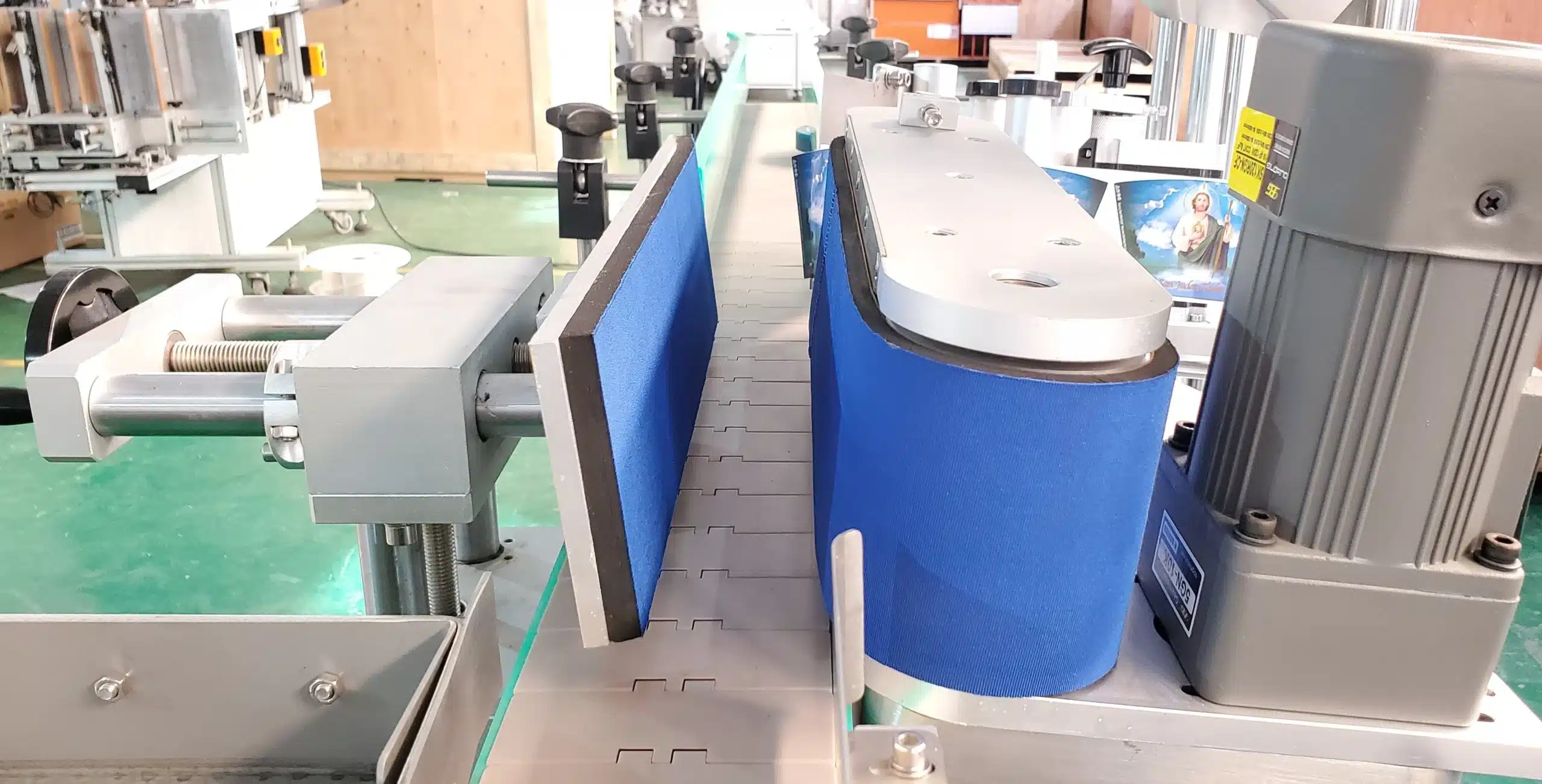
Three supply variables cause most of the trouble. Stack height and weight decide how long the magazine can run between reloads. Paper moisture content at packing decides how the stack behaves when it is opened in a different climate. And grain direction, fixed when the paper is made and preserved through cutting, decides whether the label wraps or fights. A brewery that specifies only size and print will eventually receive a stack that will not run, and the argument will be about the machine.
Freight and storage matter more than they look. Paper is hygroscopic, so a container that crosses a climate zone arrives with a stack that has either gained or lost moisture. Letting the boxes settle in the labeling room for a shift before opening them is a cheap habit that prevents a class of mispick that gets blamed on the magazine.
Matching the magazine to the stack
The magazine is the part of a cut-and-stack labeler that has no equivalent on a film line, and it is where the format’s productivity is won or lost.
Labels are held forward by a gate, a set of fingers or air, and separated one at a time by friction, suction or a blast of air. The setting depends on paper weight, stack height and how much curl the stack has picked up. A stack that has been standing open in a dry room will curl at the edges and double-feed. A stack in a humid room will block and refuse to separate. Neither is a machine fault, and both are fixed by controlling the room rather than by adjusting the gate.
Double-feed detection is worth specifying. A missing label is a bottle that goes to the packer unlabeled and is caught downstream. Two labels fed together are a bottle with a doubled edge that may pass inspection and reach a customer. A sensor at the transfer point that stops the machine on a double is cheaper than the recall it prevents.
Reload time is a production number, not a convenience. A magazine that holds a taller stack runs longer between reloads, and on a high-speed line the reload is a stop that the filler also feels. Ask for the stack height the magazine accepts and calculate how many minutes of production one bundle buys at your speed.
Beer line conditions that decide the paper
Beer is a demanding environment for a paper label, and the conditions are specific enough that a general paper grade rarely covers a full range.
Condensation. A bottle taken from a cold room or packed in ice pulls water into the label from the edges. Uncoated paper wicks it, the print darkens and the edges lift. A wet-strength sheet and a water-resistant glue cost more per label and are the correct answer for brands that live in ice baths.
Pasteurizer tunnel. Bottles that pass through a tunnel pasteurizer after labeling meet steam and heat within minutes of application. The glue has to be fully set before the tunnel, which means a compression zone long enough for the set speed of the glue, and the paper has to survive the condensate without cockling.
Returnable handling. Pool bottles arrive with chips, scuffs and dimensional spread. The labeler has to tolerate that variation, and the label has to sit flat over a surface that is no longer perfect. A label that looks good on a new bottle can show a shadow over a scuff on a pool bottle, and no glue setting fixes it.
Washer chemistry. Caustic concentration, temperature and contact time decide release. A glue that is too water-resistant leaves a film behind, which dries as a haze on the next fill and shows worst on a clear bottle. Give the washer operating window to both the label supplier and the glue supplier, together.
Where the defects come from
| Defect | Most common cause | First thing to check |
|---|---|---|
| Leading edge lift | Grain cut across the wrap, or too little glue at the leading edge | Grain direction on the label drawing |
| Wrinkle at the overlap | Wipe-on pad worn or set at the wrong angle | Pad condition and contact point |
| Double feed | Stack curl, static, or gate set too open | Room humidity and stack storage |
| Label slides after application | Glue film too thick, or glue too wet for the line speed | Doctor blade gap and glue viscosity |
| Bubbles under the label | Air trapped at the wrap point, or bottle surface contaminated | Wipe-on pressure and bottle rinse |
| Label releases in the washer | Glue too water-resistant for the caustic condition | Glue family against washer chemistry |
The pattern in that table is worth noticing: four of the six causes sit outside the machine. A brewery that treats every defect as a machine adjustment will keep adjusting the machine and keep finding the defect.
What a brewery should specify in writing
These fields belong in the label purchase specification and in the machine quotation, and the two should agree before either is signed.
- Label size for each panel: body, back, neck, shoulder
- Paper grade, mill, basis weight, Cobb value and wet-strength rating if required
- Grain direction relative to wrap, stated as a sentence, not a symbol
- Stack height, stack weight and bundle orientation
- Moisture content at packing and the wrapping method
- Glue family, solids and working viscosity
- Post-label conditions: washer, pasteurizer, ice bath, cold store
- Line speed at the labeler, stated as bottles per hour sustained, not peak
- Change parts required for each bottle size in the range
The ninth item is the one that turns a machine purchase into a format-parts project. A brewery with three bottle sizes needs three sets of handling parts, and each set has a cost and a changeover time. That number belongs in the decision, not in the first week of production.
New labeler or retrofit
Many breweries do not need a new line. They need a labeler that fits the line they have, at the speed the filler actually runs. A retrofit is often the smaller project: the existing conveyor is reused, the accumulation stays, and the labeler is integrated at the point where the old machine sat.
The constraint is the container handling that already exists. A new labeler has to match the conveyor height, the pitch of the existing infeed, the bottle flow direction and the space between the filler and the packer. Those are measurable, and they decide whether a standard frame fits or whether the machine has to be built around the line. The labeling line retrofit guide covers the integration checks in order.
Where a retrofit is not enough is speed. If the filler has been upgraded and the labeler is now the constraint, a like-for-like replacement will not recover the output. That is the point at which a rotary machine enters the discussion, and it is also the point at which the label format question becomes urgent, because a rotary hot melt machine and a rotary cut-and-stack machine are not the same purchase.
Where the format decision lands
Cut-and-stack remains the right answer for returnable glass with a washer, for long runs of a narrow core range, and for brands whose packaging identity is a paper label on a glass bottle. It is the wrong answer for high SKU counts, for film labels, for PET, and for lines where the labeler is already the bottleneck and the format cannot go faster.
HiPaks quotes wet glue lines as projects rather than listing them as catalog models, because the magazine, the glue unit and the handling are built around the bottle and the stack. The wet glue labeling machine manufacturer page explains the scoping sequence. Where the format decision goes the other way, the hot melt glue labeling machine series covers the rotary route, with a 12-station carousel at 10,000 to 15,000 bottles per hour and a 16-station version at 10,000 to 12,000. The wine and beverage labeling section covers the glass bottle line context, and the wet glue labeling guides cover paper selection and the direct comparison with hot melt.
For breweries, the practical starting point is the bottle and the washer, not the machine. Send the bottle drawing, the label stack specification and the washer operating window, and the line can be scoped against conditions that actually exist on the packaging floor.
Frequently asked questions
Are cut-and-stack labels still used for craft beer?
Yes, particularly where bottles are returnable or where the brand wants a paper label on glass. Craft breweries with many seasonal releases often find the format hard to justify because changeover and minimum print runs work against short batches, and pressure-sensitive is usually the better fit for those.
What paper weight is normal for a beer body label?
Most beer body labels sit in the 70 to 80 gsm range in uncoated or machine-glazed paper, with wet-strength grades for chilled distribution. The exact grade should be set by the wrap trial, because absorption and grain matter more than the weight figure.
Why do my labels double-feed in summer?
Humidity. Paper takes up moisture from the air, the stack blocks and the separator cannot isolate one sheet. Conditioning the labeling room and letting delivered stacks settle before opening them solves more of these cases than any machine adjustment.
Can a cut-and-stack labeler apply neck and back labels too?
Yes, with a station for each panel. Each station is a magazine, a glue unit and a wipe-on arrangement, so the machine grows with the panel count. Neck labels are the hardest because the bottle diameter changes fastest there.
