
Three different numbers are sold as “speed”, and only one of them will be true in your plant. Rated speed is what the machine reaches on the factory’s sample container with a full label roll and a warm machine. Sustained speed is what it holds across an eight hour shift. Line speed is what your filling and capping equipment allows it to reach. On a typical automatic labeler rated at 120 pcs/min, the sustained figure is often 100 to 110 and the line figure is whatever the upstream filler delivers. Accuracy has the same problem: the plus or minus 1mm on an automatic machine describes label placement only, and it excludes the variation contributed by your container and your label. Speed and accuracy are therefore not specifications you buy. They are outcomes you verify on your own product, at your own line rate, before the balance is paid.
Three speeds, and only one is yours
| Number | Where it comes from | How it is usually measured | What it hides |
|---|---|---|---|
| Rated speed | The specification sheet | Best container, short run, fresh roll | Changeover, jams, label splices |
| Sustained speed | A shift-long run | Total output divided by paid hours | Micro-stops, operator breaks, roll changes |
| Line speed | Your existing equipment | The slowest station upstream and downstream | Buffer size, accumulation, infeed gaps |
| Effective speed | Good labels per hour | Output minus rejects | Reject handling and rework |
The gap between rated and effective speed is where labeling projects fail quietly. A machine rated at 120 pcs/min that runs at 95 pcs/min with a 2% reject rate delivers 5,586 good containers an hour, not 7,200. If the business case was built on the rated number, the payback period has just stretched by 22%.
HiPaks quotes the automatic range as 40 to 300 pcs/min because the range is real across configurations, and the number inside that range is confirmed against the container, the label length, and the required accuracy. A quotation that states a single figure without those three inputs is a marketing number, not an engineering one.
What derates a 120 pcs/min machine
Container geometry. A round bottle with a parallel wall wraps at full speed. A tapered or oval container needs orientation and a slower wrap, and a square bottle needs two press stations. The machine is the same. The cycle time is not.
Label length. A long wrap label needs more rotation per container, and rotation is the operation that sets the cycle time on a wrap station. Doubling label length does not halve output, but it does consume the margin between rated and sustained speed.
Label gap on the roll. A larger gap between die-cut labels wastes feed travel. On a machine running near its limit, a 3mm gap change is measurable in output.
Product spacing on the infeed. An automatic labeler needs a consistent gap between containers. If the upstream filler releases bottles in bursts, the labeler either waits or runs at a lower average. Accumulation tables exist to solve this, and they cost money and floor space.
Changeover frequency. A line that runs four SKUs a day spends more time being adjusted than a line that runs one. Changeover time belongs in the capacity calculation, and it is the number most often left out of a quotation.
Label roll changes. A 3,000 label roll at 100 pcs/min runs out every 30 minutes. Each splice costs seconds, and the operator’s walk to the machine costs more. Larger rolls and a splice table reduce the loss, which is why roll core size is an integration question rather than a purchasing detail.
How accuracy is actually measured
Placement accuracy is a deviation between where the label landed and where it was specified to land. A serious measurement states the axis and the sample size. Vertical deviation is measured along the container height, horizontal deviation around the circumference, and skew is the angle of the label relative to the container’s reference edge. A single “plus or minus 1mm” figure that does not name the axis is a summary, not a measurement.
The machine contributes only part of the total. Three sources add to it:
| Source | What varies | Who controls it |
|---|---|---|
| Machine | Label feed, applicator timing, container hold | Factory |
| Container | Diameter tolerance, mould seam, ovality, surface finish | Your bottle supplier |
| Label | Die-cut position, liner release, adhesive flow, curl | Your label printer |
This is why the frozen figures in the industry separate the classes. A semi-automatic machine that holds the container in a fixture is specified at plus or minus 0.5mm. A purpose-built flat precision unit reaches up to plus or minus 0.2mm because it removes container handling from the equation. A general automatic line is specified at plus or minus 1mm, and that number already includes the handling variation the machine introduces, but not the variation in your bottle and your label.
Practical consequence: if your artwork has a 1mm bleed and your bottle diameter varies by 0.3mm, a machine that meets 1mm on a nominal bottle can still produce a label that sits outside the print zone on a real one. The specification is not wrong. The stack of tolerances was never added up.
The label is half the accuracy problem
Die-cut tolerance. Labels are cut to a position that itself has a tolerance, often around 0.2mm to 0.3mm on a standard flexo roll. That error arrives at the machine and is applied to the container.
Liner and release. A liner that releases too easily lets the label fly early. One that grips too hard causes the label to peel at an angle, which shows up as skew rather than displacement.
Curl and memory. A label that has been on a tight roll for weeks keeps a curve. On a cold container the leading edge lifts, and the defect is blamed on the applicator.
Temperature and humidity. Adhesive behaviour changes with both. A machine tuned in a warm factory in summer behaves differently in an unheated warehouse in winter, and the difference is visible in the first hour of a shift.
Transparent labels. A clear label on a clear bottle defeats a standard photoelectric sensor. The fix is an ultrasonic or a dedicated clear-label sensor, and it is a specification decision rather than a tuning trick. HiPaks builds with SICK sensors partly because the transparent-label variants are a catalogue item rather than a custom order.
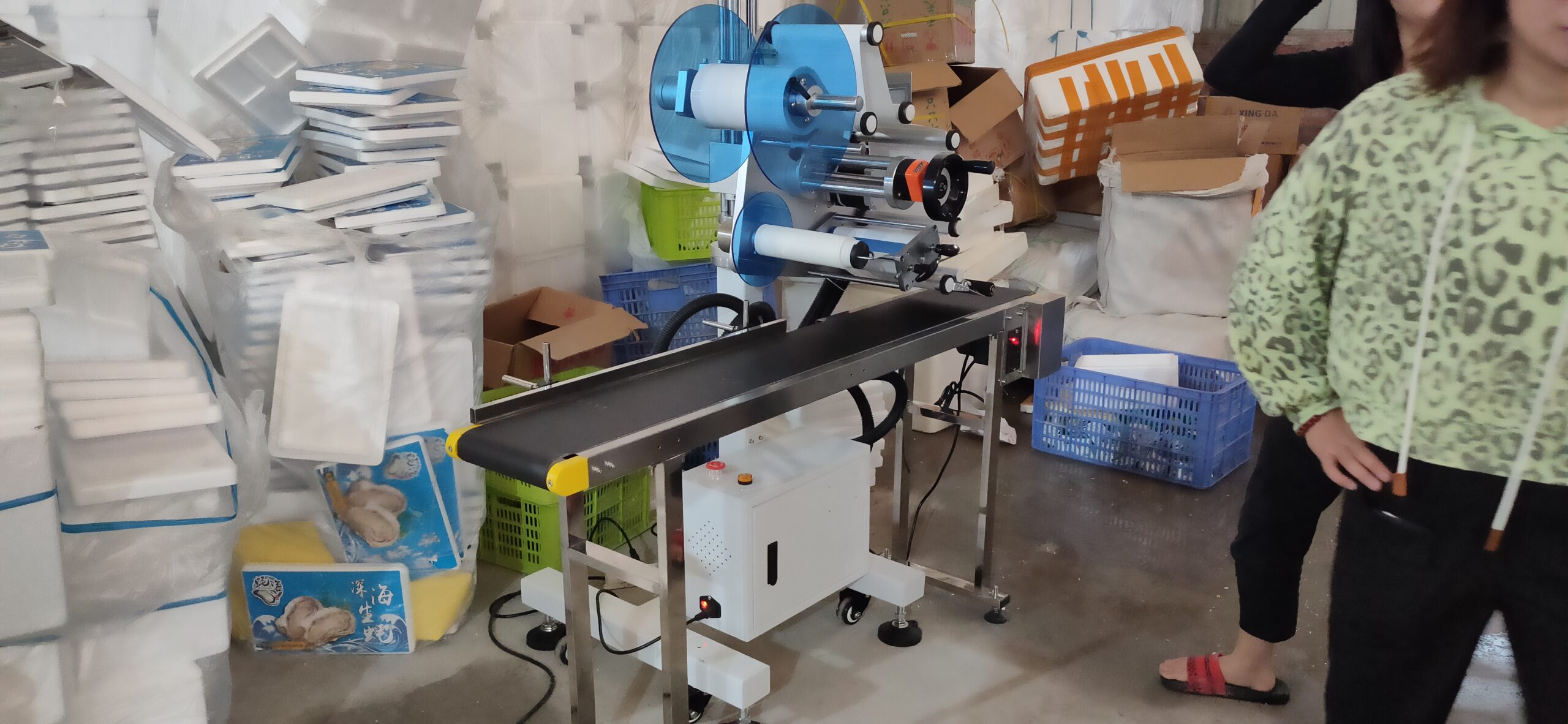
Line integration: the four interfaces
Mechanical. Conveyor top height, transfer plate, and the gap between the labeler’s infeed and your existing conveyor. Most filling lines sit between 750mm and 900mm, and a mismatch of 20mm is a step that tips bottles. Ask for the machine’s conveyor height in the quotation, not in the manual.
Electrical. Voltage, phase, frequency, and total connected load, plus the air supply if the machine is pneumatic. A machine built for 380V three phase will not run on 220V single phase without a change, and that change is cheaper at the factory than on your floor.
Control. The handshake between the labeler and the rest of the line: a start signal, a run signal, a fault signal, and a container-present sensor. Without a handshake the labeler either labels empty conveyor or stops when the filler stops, and both look like machine faults to an operator.
Safety. Joining two machines into one line changes the risk assessment, because a guard that was adequate for a standalone unit may leave a reach-in point at the transfer. The EU machinery rules, summarised on the European Commission’s machinery pages, treat an assembly of machinery as its own case in many situations, which is why an integrator asks for the declaration of conformity of every unit before signing off the line.
The line retrofit guide covers the mechanical sequence in more detail. What matters at the specification stage is that all four interfaces are written down before the machine is built, because three of them cannot be fixed by a software setting after arrival.
What an acceptance test should measure
| Test | Method | Pass condition to agree in writing |
|---|---|---|
| Placement deviation | Measure 30 consecutive containers on two axes | Stated tolerance on your container and label, with the sample size named |
| Sustained speed | Run 10 minutes without stopping | Target rate held for the full run, recorded on the HMI |
| Reject rate | Count rejects in the same run | A number agreed before the test, not after |
| Changeover time | Time a full format change | Minutes, with one operator, documented |
| Label splice | Run through a roll splice | No misplacement after the splice |
| Handshake | Stop and start the upstream conveyor | Labeler follows without labelling empty space |
The factory acceptance test page shows how this becomes a signed record with photographs. The point of writing the pass conditions before the test is that a test without them becomes a demonstration, and a demonstration always passes.
Reading a spec sheet without being misled
Ask what container the speed was measured on. Diameter, height, and material. A speed quoted without a container is a ceiling, not a capability.
Ask whether the accuracy figure includes the label. If the supplier says the machine holds 1mm, ask what happens with a 0.3mm die-cut tolerance and a bottle with a 0.2mm diameter spread.
Ask for the derating on your container. A good supplier will quote a lower number for a tapered bottle and explain why. A supplier who quotes the same number for every container has not modelled your product.
Ask what the machine needs from the line. Air consumption, connected load, conveyor height, and the signal interface. These four answers decide whether installation is a day or a month.
Ask for a video at your target rate. Not at the maximum. A machine holding your rate for a full minute, with a caliper in frame, answers more than a specification table. HiPaks keeps a library of recorded runs, currently 362 filmed and 250 published, and a buyer can ask for the run that matches their container class rather than watch a generic clip.
Two frozen reference points are worth carrying into any comparison. The automatic class spans 40 to 300 pcs/min, and rotary hot melt lines reach 10,000 to 15,000 bottles per hour on a 12 station carousel, or 10,000 to 12,000 on a 16 station frame where the extra stations buy label placement options rather than raw speed. If a quotation sits outside those bands without an explanation, the explanation is the thing to ask for.
Next step: send your container dimensions, label size, and the line rate you need, and the quote form returns a speed figure with the derating written out. The automatic labeling machine range shows which model covers which band, and the parts and diagram page identifies the sensors and drives that decide both speed and accuracy.
FAQ
What speed can a labeling machine actually hold over a shift?
Plan on 85% to 92% of the rated figure for a well set up automatic machine on a stable container, and lower if you change formats during the shift. The loss comes from label roll changes, micro-stops, and infeed gaps rather than from the machine’s top speed.
Is plus or minus 1mm good enough for a pressure-sensitive label?
For most consumer packaging, yes, provided the artwork has enough bleed to absorb it. It becomes a problem when the label sits inside a printed panel with a 1mm margin, or when the container diameter varies. Measure the total tolerance stack before accepting the machine figure.
Why does my automatic machine label some containers off-centre?
Usually the container, not the machine. Diameter variation, a mould seam, or an oval cross section changes where the wrap starts. Run 30 containers from different parts of the batch and measure the spread before adjusting the machine, because a machine tuned to a bad sample will be wrong on the good ones.
Can a labeling machine be integrated into an existing line without a new conveyor?
Often yes, if the existing conveyor height, speed, and gap control match the labeler’s requirements. The three things that force a new conveyor are a height mismatch, no accumulation before the labeler, and a transfer that cannot hand over containers without tipping them.
What is the difference between 120 pcs/min and 10,000 BPH?
A unit conversion and a machine class. 120 pcs/min is 7,200 bottles per hour, which is an inline automatic labeler. 10,000 to 15,000 bottles per hour is a rotary carousel with 12 stations, a different machine with a different price band and a different floor requirement.
