
The short answer. The seven mistakes are consistent enough to name: buying the head before anyone measured the conveyor, comparing equipment prices instead of installed cost per thousand labels, reading a certification that is in progress as a certification that is issued, skipping the trial run on your own container and label, specifying the label but not the liner, accepting a spare parts list with no brand names and no wear items, and leaving the trigger, sensor position and supply voltage for site day. None of them is exotic. All of them are cheap to avoid at inquiry stage and expensive to fix after the crate is open, which is why a sourcing process that closes them early usually lands a working station at the first attempt.
Mistake 1: buying the head before anyone measured the conveyor
An applicator head is a fixed geometry that has to meet a moving product at a known height. The bracket is built to a number, and that number comes from the conveyor, not from the product. Buyers routinely send a photo of the bottle and nothing about the belt, then discover that the head sits 40 mm too high or that the web has to run on the far side because the line travels right to left.
Five measurements prevent it: conveyor surface height from floor to belt top, direction of travel as you stand at the infeed, product spacing at its tightest and loosest, a workable sensor position with a clear line of sight, and supply voltage and frequency at the point of use. HiPaks builds brackets to those five inputs and documents them in the integration drawing. A supplier who quotes a head without asking for all five is quoting a catalogue item rather than a station.
Mistake 2: comparing equipment price instead of installed cost
Two quotations for the same class of head can differ by a few hundred dollars and produce installed costs that differ by several thousand. The gap is made of freight, duty, the bracket, the air drop, the electrician, the guard and the format parts for the second SKU. Buyers who compare only the equipment line are comparing the smallest number in the project.
Build the comparison on four lines instead: equipment, integration labour, footprint, and downtime for installation. Then divide the total by the labels applied in a year. The number that comes out, cost per thousand labels installed, is the one that can be defended to a finance team and the one that survives a change of supplier. A low equipment price attached to a bracket that has to be re-made on site is not a low price, it is a deferred invoice.
Mistake 3: reading a certification in progress as issued
This mistake is made in both directions, by buyers who accept a logo as proof and by buyers who reject a supplier for saying “in progress”. The useful question is not whether a certificate exists, it is what the certificate covers and which document you will receive in the shipping carton.
ISO 9001 is a quality management standard for the manufacturer’s processes, not a statement that any individual machine meets a tolerance. The ISO 9000 family overview describes what the standard governs, and it is worth reading before treating a logo as evidence about label placement. CE is a separate matter: it is a declaration by the entity placing the product on the market, and the technical file behind it is what an authority would ask for.
HiPaks states its position without decoration: ISO 9001 and CE are in progress, not issued. That sentence costs a supplier some easy sales and buys the buyer something more useful, which is a supplier whose other statements can be taken at face value. Ask every supplier the same three questions: which standard, which scope, which document ships with the machine. The answers separate the careful from the casual faster than any factory video.
Mistake 4: skipping the trial on your own container and label
A demonstration on the supplier’s sample bottle proves that the machine works on a sample bottle. Your container has a different shoulder radius, a different wall stiffness and a different label stock, and the interaction between those three is exactly what the purchase depends on. Buyers who accept a generic video are buying a machine that has never met their product.
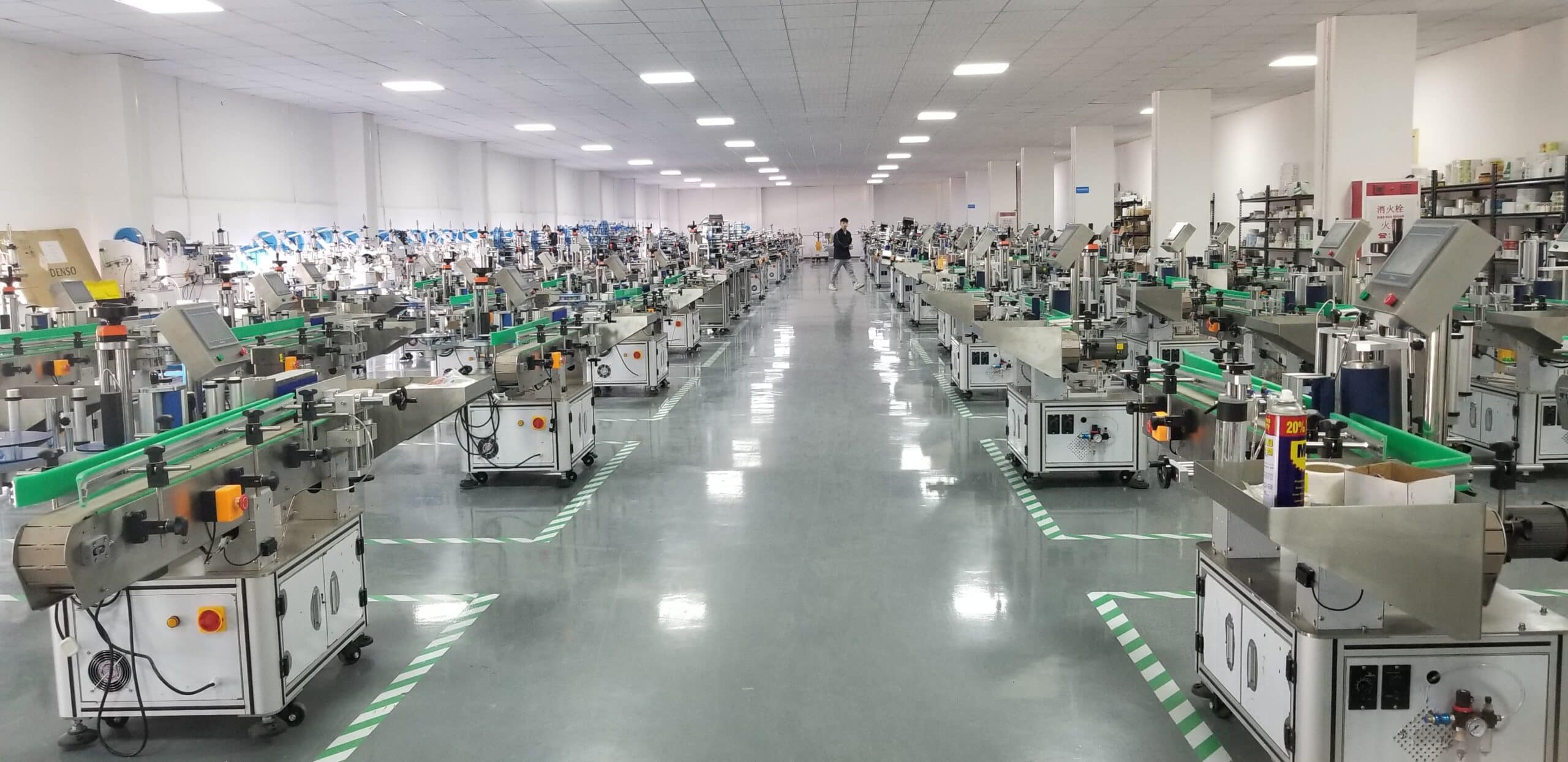
The trial is the cheapest risk reduction available, and it should be specific: your container, your label roll, your target speed, filmed in one continuous take with the reject bin visible. A cut video proves the machine can label one unit. A continuous take proves it can label forty in a row without an operator intervention. HiPaks runs that pass on customer containers and labels before shipment and sends the footage back, which is also the point at which a mismatch in liner width or label stiffness shows up while it is still a conversation. The factory acceptance test page sets out what a full test covers when the order justifies a visit.
Mistake 5: specifying the label but not the liner
Buyers send artwork dimensions and label material and stop there. The head does not see artwork. It sees a web: a liner of a given width on a core of a given diameter, carrying labels of a given length, releasing at a given force. Get any of those wrong and the machine runs, badly, in a way that looks like a tuning problem.
The numbers to confirm are concrete. The T95x heads take labels from 6 to 300 mm long on liner widths from 25 to 125 mm, on 76 mm cores with outer roll diameters up to 280 mm. Clear film on a clear liner needs a sensor that reads the liner boundary rather than the label edge, and that sensor is fitted at build. A liner 3 mm outside the range will not track, and no amount of guide adjustment fixes a web that is wider than the head was designed for. Send one roll with the inquiry. The cost of the courier is trivial against the cost of a re-specified head.
Mistake 6: accepting a parts list with no brand names and no wear items
A spare parts list that reads “sensor, drive, controller” tells you nothing about what happens in year two. The components that fail on a labelling station are specific: the label sensor, the peel plate edge, the tamp pad or the wipe-on brush, the web drive rollers, the belt on the transfer, and the pneumatic valve if the method uses air. Ask for those by name, with part numbers and lead times.
Brand names matter for a practical reason. If the sensor is a globally stocked industrial part, a failure is a counter purchase. If it is a proprietary board, a failure is an air freight and a week of downtime. HiPaks fits SICK sensing from Germany, Panasonic controls from Japan, MEAN WELL power supplies and Leadshine steppers, and publishes a parts diagram so the maintenance team can see which part lives where before anything fails. A supplier who will not name the brands is usually protecting a margin rather than a design.
Mistake 7: leaving the trigger, the sensor position and the voltage to site day
The head needs to know when a product is present, where its leading edge is, and how fast it is moving. Those three answers come from your line, and if they are not settled before the machine ships, they get settled by an electrician improvising at commissioning. That is how a two day installation becomes a two week one.
Decide in the purchase order who owns the cycle: your PLC or the head’s controller. Decide what happens on a web break, whether the head stops the conveyor or the conveyor stops the head, and how a reject is flagged. Then confirm the voltage and frequency at the actual point of use, not at the building entrance. A machine built for 380 V three phase will not run on 220 V single phase without a change, and the change is always more expensive after the crate is open.
The ten-line pre-order sheet
Copy this into the inquiry and the seven mistakes close themselves:
- Conveyor height, direction of travel, product spacing range.
- Sensor position and supply voltage at the point of use.
- Product photo on the belt, taken from the head position, with a ruler in frame.
- Label roll: length, liner width, core, outer diameter, material, adhesive grade.
- Target output per shift and the busiest hour.
- Transfer method, named, with the reason it was chosen.
- Accuracy figure plus the measurement point where it will be checked.
- Changeover parts and their prices for every SKU.
- Spare parts list with brands, part numbers and wear items.
- Lead time, Incoterm, payment terms, warranty scope and the certification documents that ship with the machine.
On the commercial side, the terms to expect are unremarkable: MOQ one unit, 30% TT deposit with 70% before shipment and 50/50 on some models, FOB Shenzhen, semi-automatic machines in 7 to 10 days, automatic machines in 7 to 25 days by configuration, custom builds from 25 days, one year on the machine plus lifetime technical support with wear parts excluded. A supplier who cannot put those in writing is not ready to take a deposit.
What a good sourcing process looks like
Four steps, and none of them is a negotiation tactic.
First, shortlist on documentation rather than on price: drawings, I/O list, parts list, test footage. Second, request the trial on your own stock before discussing the discount. Third, price the integration separately so the two numbers can be compared honestly. Fourth, agree the acceptance criteria in writing, including how a reject is defined and what happens if the first week does not hit the number.
That sequence takes about two weeks longer than sending a photo and accepting the lowest quote. It also removes the four failure modes that turn a cheap purchase into an expensive year: a bracket that does not fit, a liner that will not track, a sensor that cannot see the label, and a certification nobody can produce.
FAQ
Is it risky to buy a label applicator from China?
It carries the same risks as buying any capital equipment at a distance: geometry that was described rather than measured, documentation that arrives late, and a warranty that is hard to enforce. Each has a control. Send the five line inputs, insist on a trial on your own stock, and get the parts list with brands before the deposit.
How do I verify a factory rather than a trading company?
Ask for three things that a trading company finds awkward: the I/O drawing for the specific model, the spare parts list with part numbers, and a continuous video of your product running on the quoted model. Then ask who signs the warranty. A factory answers all four from its own files.
What should the trial run prove?
That your container, your label stock and the quoted method work together at the target rate. Watch for placement on the first, twentieth and fortieth unit at the same setting, and watch the reject bin. A trial that only shows the first label is a demonstration, not a test.
Which certification documents should ship with the machine?
Whatever the supplier claims, in document form, with a scope. HiPaks ships ISO 9001 and CE as in progress rather than issued, and says so before the order. A declaration that cannot be produced on request is a claim, not a document.
How long should the whole purchase take?
Two to three weeks for specification and trial, then 7 to 10 days for a semi-automatic machine or 7 to 25 days for an automatic one by configuration, plus transit and clearance. Custom builds start at 25 days. A supplier who promises a custom build in a week is promising something the workshop cannot do.
If you already have the seven items on the pre-order sheet, the quotation will be short and specific. If you have three, send those and mark the gaps. The China buying guide covers the commercial side, and the manufacturer page shows how the heads are built and tested.
Prefer to see the evidence first? Request a Free Test-Run Video on your own container, or read the rest of the cluster under label applicator guides.
