
Hot melt glue labeling is a roll-fed film process. A thermoplastic adhesive, held molten at 120 to 160 degrees Celsius in a heated pot, is transferred to the leading and trailing edges of an OPP label, and the label is pressed onto a rotating bottle so it wraps under tension and bonds as the adhesive cools. There is no liner, no release paper and no water in the bond. On this build a 12 station rotary machine runs 10,000 to 15,000 bottles per hour, and a 16 station machine runs 10,000 to 12,000. What follows is the mechanism in order, the film it needs, the five stations a bottle passes, the temperature window that decides whether the trailing edge flags, and the questions to settle before a quotation is written.
What hot melt actually means at the glue wheel
The name describes the adhesive, not the label. Hot melt adhesive is a solid at room temperature, melted in a pot and held at process temperature, then picked up by a heated roller and transferred to the label in the few centimetres between the cutting station and the bottle. It grabs on contact and reaches handling strength within a fraction of a second, because it sets by cooling rather than by drying or by a chemical cure.
That single property explains most of the behaviour buyers see later. The bond is a surface bond, not a saturated one, so it does not need the label to absorb anything. It can be applied to a coated film, to a metallised film, to paper with a high gloss finish, and to labels printed on the reverse. It does not need drying tunnels, and it does not shrink the label as water-based glue shrinks paper on the bottle.
The trade is precision. Adhesive that reaches the wrong part of the label shows on the bottle, adhesive that is too cool does not grab, and adhesive that is too hot carbonises on the roller and eventually drops onto the web. The whole discipline of the process sits inside a narrow temperature band and a narrow timing window.
Why the label is OPP film and not paper
OPP, oriented polypropylene, is the default face stock for hot melt because it behaves well under tension. It is strong enough to be pulled around a bottle without tearing at the wrap point, it holds print sharply, and it is waterproof, which matters on a water line where bottles are wet from the filler and pass through a warmer or a chiller afterwards.
Film also carries the economics. A thinner film yields more labels per kilogram, and because there is no liner, the roll is almost entirely label. That is the structural advantage over pressure-sensitive: the same printed area arrives on the line with no silicone-coated carrier to buy, ship and throw away.
Where the bottle is filled with food or drink, the adhesive and the printed film both sit in the food contact discussion, and quality teams usually check the proposed adhesive against the European Commission’s database of substances assessed for food contact materials before the first production run.
Paper is not excluded. Some hot melt machines run paper labels with a hot adhesive, and the choice is legitimate where the brand wants a paper feel and the bottle pool is single trip. But paper on a hot melt machine gives up the water resistance that film provides, and the wrinkle behaviour is less forgiving on a lightweight bottle. Confirm the face stock and the caliper against your own bottle before the machine is specified, because the cutting registration and the glue timing are set up around a specific film thickness.
The five stations a bottle passes
A rotary hot melt labeler is a carousel. Bottles enter on a feed screw, are captured by the rotating table, and pass fixed stations in sequence. The station count is the number of bottle positions on the table, and it is the main determinant of output.
- Infeed and spacing. A feed screw sets the pitch between bottles. If the pitch is wrong, the bottle is not centred under the label and the wrap starts off register.
- Label feed and cut. The web is pulled from the roll, printed registration is read by a sensor, and the label is cut to length. A servo driven cut is what allows a label length change without a mechanical changeover.
- Glue application. The glue wheel or nozzle deposits adhesive on the leading edge, the trailing edge, or both, depending on the pattern chosen for that label and bottle.
- Wrap and press. The bottle rotates against a brush or a belt. The label is wiped on from the leading edge, carried around the circumference, and the trailing edge is pressed down last.
- Discharge and inspection. Bottles leave to the outfeed conveyor. On a line with a vision check, missing or skewed labels are rejected here rather than at the case packer.
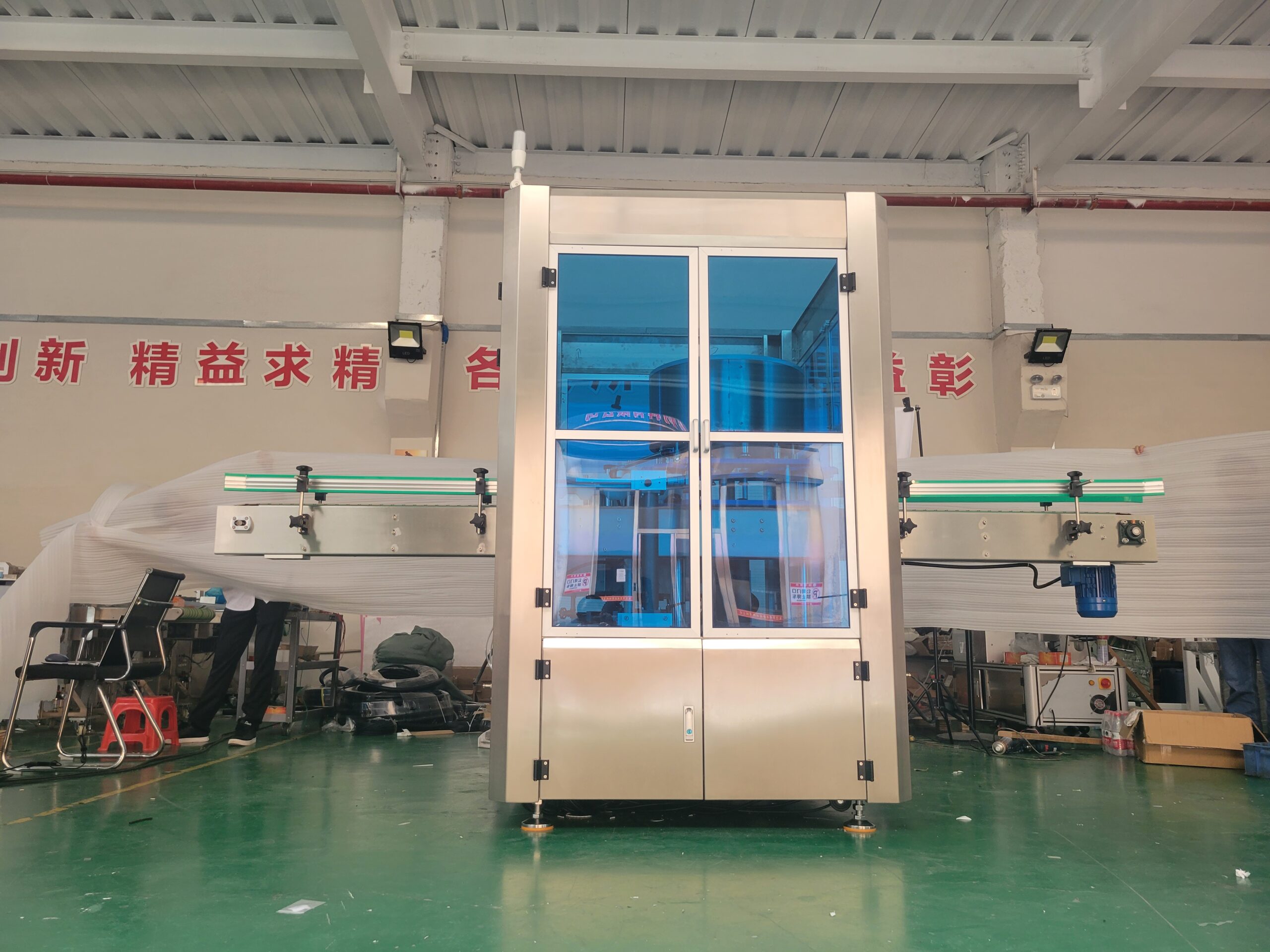
The physical distance between station three and station four is short, and that is deliberate. Adhesive that sits on a label for too long before contact cools and loses tack, so the machine is laid out to minimise the gap. It is also why a hot melt machine is less tolerant of a slow bottle than a pressure-sensitive applicator: the process assumes the bottle arrives at the wrap point on schedule.
Where the adhesive goes: three patterns
Glue placement is a design decision that is made once per label and then fixed in the recipe. Three patterns cover most work.
| Pattern | Adhesive position | Used for |
|---|---|---|
| Two strip | Leading and trailing edge only, 8 to 15 mm wide | Standard wrap label on a rigid bottle; fastest to run, easiest to strip |
| Three strip | Lead, tail and a centre strip | Large label area where the middle can lift, or a lightweight bottle that flexes |
| Full pattern | Continuous film across the label back | Heavy labels, textured glass, or a bond that must survive a wet tunnel |
More adhesive is not automatically better. A full pattern raises consumption, complicates cleaning if a bottle jams, and makes the label harder to remove for a returnable pool. A two strip pattern on a stable bottle at 10,000 bottles per hour is usually the lower cost per thousand labels, and it is the pattern to ask about first when a supplier quotes consumption.
The 120 to 160 degree window
Adhesive suppliers publish a working range, and the machine is set inside it. On this equipment the process band is 120 to 160 degrees Celsius at the pot, with the wheel and the transfer path held close to the same value. Where a specific adhesive sits inside that band depends on its viscosity curve, not on a preference.
Run cool and the adhesive is thick. It transfers unevenly, grabs late, and the trailing edge lifts, which is the defect the industry calls flagging. Run hot and the adhesive is thin. It penetrates the film edge, shows through on a clear label, and oxidises in the pot, forming a skin and then carbon deposits that break away and mark the web.
The practical settings are three: pot temperature, wheel temperature and dwell time at the wrap point. A machine that holds the pot within a degree or two but lets the wheel drift will still produce intermittent flagging, which is why the temperature loop is usually closed on more than one point. Ask for the control scheme, not just the setpoint.
Ambient conditions matter as well. A line running in an unheated hall in winter loses heat from the transfer path, and the same setpoint that worked in summer produces weak bonds in January. If the plant has wide seasonal temperature swings, ask how the machine compensates, and plan to re-check the first article each shift rather than once a month.
What the roll specification controls
The roll is not a consumable detail. It sets the run length between splices, the web tension the machine must hold, and the floor space the label feed needs. On the 12 station build the machine accepts a label roll up to 600 mm outside diameter on a 152 mm core. That is a large roll, and it is what makes a long uninterrupted run possible on a water or CSD line.
Three numbers follow from it. First, run time between roll changes: a bigger outside diameter carries more labels, so the changeover interval lengthens and the operator is free for other work. Second, splice handling: every roll change introduces a splice, and a splice that is not detected produces one unlabeled or double-labeled bottle. Third, web tension: a 600 mm roll has significant inertia, and the unwinder has to hold tension as the diameter falls from full to core.
Web width and label repeat belong in the same conversation, because they decide how many labels fit across the web. A narrow web with a single lane is simpler to control. A wider web with two lanes raises output per revolution but doubles the cutting and registration work. For most beverage work the single lane is the sane choice, and the roll diameter is where the extra run time is bought.
Defects that trace back to the glue system
Most hot melt problems are diagnosed at the trailing edge, because that is where the bond is weakest and the timing is tightest.
- Flagging. The tail lifts within minutes of labeling. Usually adhesive too cool, too little adhesive on the tail, or the wrap belt not pressing long enough.
- Dog ears. The corners of the leading edge fold back. Usually the label is being wiped on before the bottle is rotating at line speed, or the brush is set too hard.
- Wrinkles across the middle. The label is longer than the circumference it has to cover, or the film is being stretched during feed. Check label repeat against the bottle diameter before touching the glue.
- Glue smear on the bottle. Adhesive has reached the face of the label or the bottle outside the wrap area. Usually a wheel height or a doctor blade setting, and it is a cleaning problem as much as a quality one.
- Missing label. Registration sensor has lost the eye mark, or the splice passed without a reject. On a line with a SICK or Panasonic registration sensor this is usually a setup issue rather than a hardware failure.
The diagnostic order that saves time is: bottle diameter and label repeat first, then wrap belt and brush, then temperature, then glue pattern. Most plants start at temperature because it is the easiest dial to turn, and most of the time the answer was in the label geometry.
Where hot melt sits against the alternatives
Hot melt is one of three ways to get a label onto a bottle, and the comparison is worth making explicitly rather than by assumption.
Pressure-sensitive applies a pre-glued film label from a liner. It needs no pot, no temperature control and no glue clean-up, and it changes over in minutes. It also costs more per label, because the liner and the adhesive are bought and the liner is discarded, and it is slower at the top end.
Wet glue applies paper with a water-based adhesive. It is the cheapest consumable route on a returnable glass pool, and it is closed to film, which rules it out for most water and CSD work.
Hot melt sits between them: film capability at a consumable cost below pressure-sensitive, with the speed and the footprint of a rotary carousel. The full trade-off, including the cases where pressure-sensitive wins outright, is set out in the hot melt versus pressure-sensitive comparison. Buyers who have already decided on film usually end up comparing hot melt against pressure-sensitive on volume: below a few thousand bottles a day, the pressure-sensitive line is often the better fit, and above it the hot melt consumable saving starts to pay for the machine.
What to send a supplier before quoting
A quotation written without the following is a guess, and it will be revised. Send all five items together.
- Bottle drawing with body diameter at the label, height, and the weight of a full bottle.
- Label artwork with the repeat length, the web width, the face stock and the caliper.
- Required sustained output at the labeler, taken from production records rather than from the filler nameplate.
- Label position on the bottle, including the gap between leading and trailing edge, and whether a neck or back label is also needed.
- Site data: available line length, power supply and compressed air.
On this equipment the electrical supply is 380 V three phase, and a full 12 station line occupies roughly 31 metres from infeed to discharge once the conveyor runs are included. That figure drives building layout more often than buyers expect, and it is worth checking against the space between the filler and the packer before the machine is ordered.
The last item is the one that separates suppliers. A machine can be quoted from a drawing, but it cannot be proven from one. HiPaks runs the customer’s own bottles and labels before shipment and sends the video back, which is the only way to see the wrap, the registration and the glue behaviour at production speed with the real container. That practice is standard across the 500 plus factories in more than 50 countries supplied from this factory, and it is the reason the first article on site usually matches the trial rather than starting a new tuning cycle. The machine ranges are listed on the hot melt glue labeling machine page, and the hot melt labeling machine manufacturer page explains how a build is scoped from the bottle and the label.
Frequently asked questions
Does hot melt labeling need a liner?
No. The label is supplied as a plain roll of printed film, and the adhesive is applied by the machine at the point of use. That is why a hot melt roll carries more label per kilogram than a pressure-sensitive roll, and why there is no liner waste to handle on the line.
Can a hot melt machine run paper labels as well as film?
Some configurations can, with a hot adhesive and the right cutting setup. Paper gives up water resistance and is less forgiving on a lightweight bottle, so the choice should be made against the bottle pool and the fill, not only against label price. Confirm the face stock with the machine builder before ordering.
Why does the trailing edge lift after labeling?
Flagging is almost always a tail bond problem: adhesive too cool, too little adhesive on the tail, or insufficient press time at the wrap belt. Check the tail glue strip and the belt pressure before raising the pot temperature, because raising temperature can thin the adhesive and make the problem worse.
How much floor space does a 12 station line need?
Plan on roughly 31 metres for the full line from infeed to discharge, including conveyor runs, plus access space at the glue pot and the label roll. The exact figure depends on the conveyor layout, so it should be confirmed against your building drawing at quotation.
