
A hot melt labeler running at 10,000 to 15,000 bottles per hour is a line component, not a standalone machine. Above roughly 10,000 bottles per hour the labeler stops being something that can be fed by hand or buffered by a table, and becomes a device that must be matched to the filler on rate, on accumulation and on bottle condition. The 12 station rotary build covers that band, and the specification that matters is not the top speed figure but the four conditions the line has to hold for the figure to be real: a bottle that arrives on pitch, a bottle that arrives dry enough, a bottle that does not flex under the wrap, and an outfeed that never blocks. This page takes the water and CSD cases in turn and shows what changes between them.
What 15,000 bottles per hour actually requires
Fifteen thousand bottles per hour is 250 bottles per minute, or about four bottles per second. At that rate the labeler consumes a bottle every 240 milliseconds, and everything upstream has to deliver at that interval without gaps.
Three conditions follow. The filler must run at or above the rate, which sounds obvious but is where most projects start wrong: a filler rated at 15,000 on paper rarely holds it for a full shift, and a labeler sized to the nameplate spends its life waiting. The conveyor between filler and labeler must be able to accumulate, so that a short filler stop does not stop the labeler and a short labeler stop does not stop the filler. And the outfeed must never block, because a blocked outfeed at four bottles a second backs up into the carousel within seconds and produces a jam that takes minutes to clear.
On this equipment the quoted band for a 12 station hot melt carousel is 10,000 to 15,000 bottles per hour. The band is wide because the achievable figure depends on the bottle. A 60 mm still water bottle in lightweight PET sits at the top of the band; a 90 mm CSD bottle with a full wrap sits lower, because the pitch is larger and the index time buys less output per cycle. Any quotation should state the bottle the figure refers to.
Still water: the simplest case, and the one with the most hidden assumptions
Still water in PET is the case hot melt was popularised for. The bottle is a straight cylinder, the label is a single wrap, the fill is at ambient temperature, and there is no pressure inside the container after capping. On paper this is the easy application, and at 12,000 to 15,000 bottles per hour it usually is.
The hidden assumptions are worth listing, because each one has stopped a line.
Bottle wall thickness. A lightweight still water bottle at 9 to 12 grams deforms under wrap pressure. The label goes on, the bottle relaxes, and the label edge lifts a day later in the warehouse. The fix is a lower wrap force and a longer press, which is a station geometry question rather than a glue question.
Bottle dimensional spread. Blow moulded bottles vary by supplier and by cavity. A spread of a millimetre in diameter is enough to change the label overlap on a full wrap, and at 15,000 bottles per hour the machine cannot correct per bottle. Specify the diameter tolerance and hold the bottle supplier to it.
Wet bottles. Water lines spill. A bottle that arrives at the label with water on the label area will not hold adhesive, and the failure looks like a glue problem. Air knives before the labeler are the usual answer, and their air consumption belongs in the utility budget.
CSD: pressure, foam and condensation
Carbonated soft drinks add three problems that still water does not have.
The first is pressure. A filled and capped CSD bottle is under pressure, and a thin-wall bottle expands slightly after capping. Labeling happens after the filler and usually after the warmer, so the bottle has had time to settle, but a bottle that is still warm and pressurised is a different shape from the same bottle cold. Label position measured on a cold bottle in the lab may not match the line. Confirm the label position on a bottle taken from the line, not from a sample box.
The second is foam. Foam on the outside of the bottle comes from the filler and from the warmer, and a wet label area is a bond failure. Air knives and a controlled drip path are standard, and the distance from the filler to the labeler is a design decision: too close and the bottle is still wet, too far and the bottle has to be re-accumulated.
The third is condensation. A cold bottle entering a warm hall forms a film of water within seconds. On a line where the labeler sits in a warm room after a cold tunnel, this is a continuous condition rather than an occasional spill. The answer is either to label before the bottle gets cold, which means before the chiller, or to control the environment at the labeler. Both are layout decisions and both are cheaper to make on the drawing than on the floor.
Lightweight PET: the real constraint at high speed
Bottle lightweighting is the trend that most affects hot melt performance, and it is worth understanding why. A hot melt label is applied under tension: the film is pulled around the bottle and the trailing edge is pressed down while the adhesive cools. The tension that holds the label on is reacted by the bottle.
A rigid glass bottle resists that tension without deforming. A 10 gram PET bottle does not. Under wrap tension the bottle ovalises slightly, the label is applied to the ovalised shape, and when the bottle relaxes the label goes slack at the seam and tight at the sides. The result appears as a lifted tail or a wrinkle that shows up hours after labeling.
Two settings address it. Wrap force is reduced, which means the press element has to be compliant rather than rigid, and press time is increased, which means more dwell at the wrap station. That is exactly the trade a 16 station build makes: lower quoted output, longer dwell. A plant running very lightweight bottles at 15,000 bottles per hour on a 12 station build is asking the machine to do something the physics resists, and the usual outcome is a defect rate that is accepted rather than solved.
The practical rule: if the bottle weighs less than about 14 grams for a 500 ml format, run the trial at the target speed before committing to the build. A test on the customer’s own bottle is the only way to see this, which is why the pre-shipment run here uses the buyer’s containers and labels rather than a standard sample.
Layout at 31 metres, and where the accumulation goes
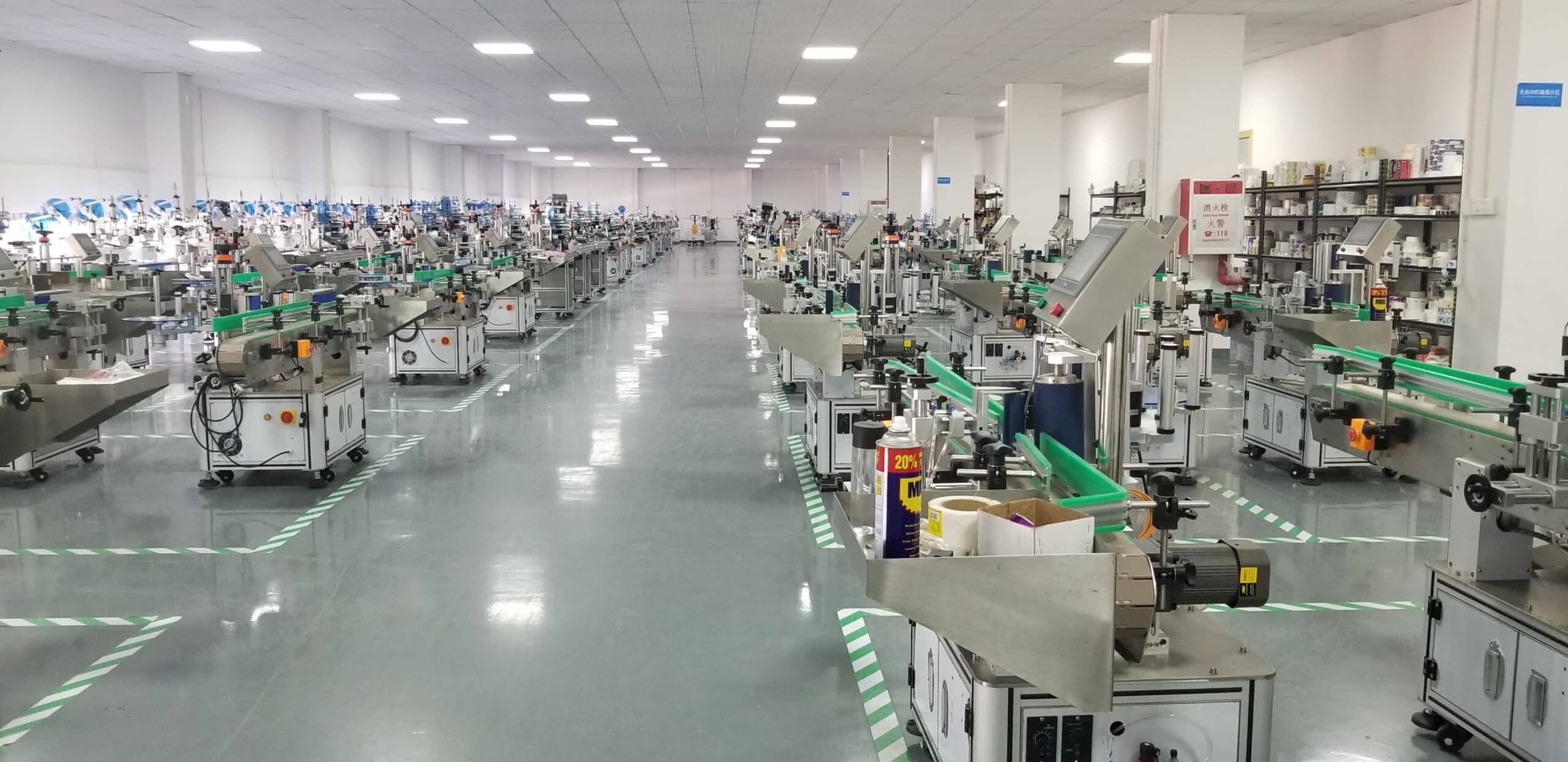
A 12 station hot melt line occupies roughly 31 metres from infeed to discharge including conveyor runs. On a water or CSD line that figure has to fit between the filler and the packer, and the accumulation that makes 15,000 sustainable has to fit inside it.
Two accumulation points matter. Before the labeler, a buffer of one to two minutes of output absorbs filler stops and lets the labeler run at a steady rate. After the labeler, a buffer absorbs packer stops, which are usually longer and more frequent than filler stops. Without the second buffer, every packer pause backs bottles into the carousel and the labeler stops and restarts, which is when most jams and most missed labels happen.
Accumulation is not free floor space. A minute of output at 15,000 bottles per hour is 250 bottles, and 250 bottles of 60 mm diameter on a single lane conveyor is roughly 15 metres of conveyor. That is why high speed lines use multi-lane accumulation tables rather than long single lanes, and why the 31 metre figure grows quickly once the buffers are drawn.
The layout also has to place the glue pot where an operator can reach it without walking around the machine, and the label roll where a full roll can be swung into the unwinder. The 12 station build takes a roll up to 600 mm outside diameter on a 152 mm core, and a full roll is heavy enough that the loading position matters for both safety and changeover time.
Utilities and environment
The electrical supply on this equipment is 380 V three phase. The connection, isolator and cable route should be on the layout drawing, and the supply should be sized for the whole line rather than the labeler alone, because the air knives, the conveyors and the reject system all draw from the same board.
Compressed air consumption and quality should be confirmed at quotation against the final configuration. Air knives, reject gates and pneumatic handling all consume air, and a line that runs short of pressure at peak produces intermittent reject failures that are hard to diagnose.
Ambient temperature belongs in the specification. The adhesive is held at 120 to 160 degrees Celsius, and the transfer path between the pot and the label loses heat to the room. A line in an unheated hall in winter behaves differently from the same line in summer, and the machine settings that were correct at commissioning may not hold in January. Ask how the temperature loop compensates, and plan a first article check at each shift start rather than a monthly audit.
For plants exporting to the European Union, the machine also has to fit the conformity route. The European Commission’s machinery legislation page sets out the current directive and the regulation that replaces it, and it is the reference a buyer’s compliance team will use when checking the declaration of conformity that arrives with the machine.
Quality checks that survive 250 bottles a minute
At four bottles a second, nobody inspects bottles. The checks have to be built into the machine or they do not happen.
Registration is checked by the sensor that reads the eye mark, and a lost mark should stop the feed rather than produce a run of misregistered labels. Missing label detection is usually a sensor at the discharge, and it should reject to a locked bin rather than a tray that fills in ten minutes. Wrap quality is the one that cannot be sensored reliably: a lifted tail is visible to a camera but expensive to detect, and the usual practice is a scheduled check of a fixed number of bottles per shift, recorded, with the trend watched rather than the individual result.
The first article check at shift start is the highest value habit on a line this fast. Ten bottles, checked for position, wrap and tail bond, catch a drift in temperature or a worn press element before it becomes a pallet of rework.
What to put in the enquiry
Five items make the difference between a quotation and a guess.
- Sustained bottles per hour required, from production records, and the peak the filler can deliver.
- Bottle drawing with diameter at the label, height, weight and wall thickness, plus the tolerance band across suppliers.
- Label artwork with repeat, web width, face stock and caliper, and the label arc as a percentage of circumference.
- Line layout with the distance between filler and packer, and whether accumulation exists today.
- Bottle condition at the labeler: temperature, condensation, water on the label area.
Send the bottles and labels as well, not only the drawings. A machine that has run the buyer’s own container before shipment arrives with the recipes close, and the commissioning visit becomes a verification. That is standard practice at HiPaks, and it is why the first article on site usually matches the trial. Lead time on an automatic machine is 7 to 25 days depending on configuration, and the commercial terms are one unit minimum with 30 percent deposit and 70 percent before shipment, FOB Shenzhen.
For the wider line context, the food and beverage labeling machine page covers the applications beyond water and CSD, and the wine and beverage labeling page covers glass and returnable formats where the bottle pool changes the adhesive decision. The hot melt glue labeling machine series lists the 12 and 16 station builds, and the hot melt labeling machine manufacturer page explains how a line is scoped from the bottle and the label.
Frequently asked questions
Can a hot melt labeler really hold 15,000 bottles per hour on a PET water bottle?
Yes, on a bottle that is stiff enough to take the wrap tension. The 12 station build is quoted at 10,000 to 15,000 bottles per hour, and the top of that band assumes a rigid cylindrical bottle. Very lightweight PET sits lower in the band because wrap force and press time have to be adjusted.
Why does condensation matter more on a CSD line than a water line?
A cold bottle entering a warm hall forms a water film within seconds, and adhesive will not bond to a wet label area. On a CSD line the bottle is cold after the warmer or chiller, so the labeler position relative to those units decides whether condensation is a continuous condition or an occasional one.
How much accumulation does a 15,000 BPH line need?
Enough to cover the shorter of the filler and packer stops, typically one to two minutes of output before the labeler and a similar buffer after it. One minute at 15,000 bottles per hour is 250 bottles, so the buffer is a layout item with real floor space attached, not a small table.
What power supply does the line need?
380 V three phase on this equipment, sized for the whole line rather than the labeler alone. Compressed air for air knives, reject gates and pneumatic handling should be confirmed at quotation against the final configuration.
