
Two numbers decide whether a hot melt rotary labeler fits your plant before any drawing is issued: a 380V supply and roughly 31 meters of line length. Both are confirmed against your layout before the order, because moving a rotary carousel six months after delivery is not a layout change, it is a rebuild. Around those two numbers sit the utilities that turn a machine into a running line: compressed air if the application is pneumatic, a glue system that holds adhesive at 120 to 160 degrees Celsius, a floor that carries the machine and the bottles on it, and enough bottle supply to feed 12,000 to 15,000 bottles an hour without stopping. Installation is therefore a site project with a machine attached, and the plants that plan it that way commission in days rather than weeks.
The two numbers that decide feasibility
The electrical supply is the first. A hot melt rotary is built for a 380V three-phase supply, and the site either has it at the proposed location or needs a transformer, a new distribution board and a cable run sized for the machine’s connected load. The second is length: the 12-station platform occupies roughly 31 meters of line including infeed and discharge conveyor. A plant that measures the machine frame and forgets the accumulation before and after it discovers the shortage on installation day.
Send the layout early. HiPaks confirms both numbers against the customer’s drawing before the order is placed, and the confirmation is more useful than a generic specification because it accounts for the conveyor arrangement you actually have. If the layout shows a 26 meter run with a column in the middle, the answer is a different conveyor arrangement or a different platform, and it is better to learn that during planning.
Power and electrical: what the site must provide
Three-phase power at 380V is the headline requirement, and four details sit under it. The distribution board needs a dedicated breaker sized for the machine, not a shared circuit that also feeds the filling line. The earth connection must be a proper protective earth, because the machine’s safety system depends on it and a floating earth causes sensor faults that look like labeling faults. The supply needs an isolator within sight of the operator, so maintenance can lock off without walking to the far end of the plant. And the voltage variant must be declared at order, because a machine built for one market’s supply is not converted by changing a plug.
Where the machine is exported to the European Union, the electrical and guarding design has to support the CE marking on the machine. The European Commission’s machinery legislation page sets out the framework: Machinery Directive 2006/42/EC governs machines placed on the EU market before 20 January 2027, and Regulation (EU) 2023/1230 applies from that date. A buyer importing into the EU should ask which framework the declaration of conformity references, because the answer belongs in the technical file.
Compressed air, glue pot and heat
Not every hot melt platform needs air, but pneumatic application and some handling functions do, and the site should have a dry, regulated air drop at the machine rather than a hose run across the floor. The consumption figure comes with the utility list for your configuration; do not size the compressor from a general rule.
The glue system is the part of a hot melt installation that is genuinely different from a self-adhesive line. Adhesive is applied at 120 to 160 degrees Celsius at the leading and trailing ends of the label, which means a heated tank, heated hoses and a heated application head, all at temperature before the first bottle runs. Plan three things around it: a power supply that can carry the heat-up load at shift start, a clear route for the hoses so they are not stepped on or kinked, and a cleaning routine for the tank and the application components at the intervals the manual specifies. Adhesive that sits at temperature for days carbonizes, and carbonized adhesive is the most common cause of a glue station that stops applying cleanly.
Heat also means ventilation. Local extraction above the glue pot is commonly specified by a plant’s own EHS assessment, and the requirement depends on the adhesive chemistry and the room. Treat it as a site decision made with your adhesive supplier’s safety data sheet, not a machine accessory.
Floor, access and rigging
A rotary labeler arrives crated and heavy, and the route from the loading dock to the line is part of the installation plan. Check the door widths, the floor loading on any mezzanine or ramp, and the turning radius for whatever will move the crate. Check also whether the floor is level where the machine will sit, because a carousel that is out of level labels consistently badly in a way that is hard to diagnose later.
Leave service access on both sides. The vacuum drum, the label feed and the glue station all need to be reachable by a person with tools, and a machine pushed against a wall to save 800 millimeters of floor is a machine that costs hours at every service visit. The layout drawing shows the service envelope; keep it clear.
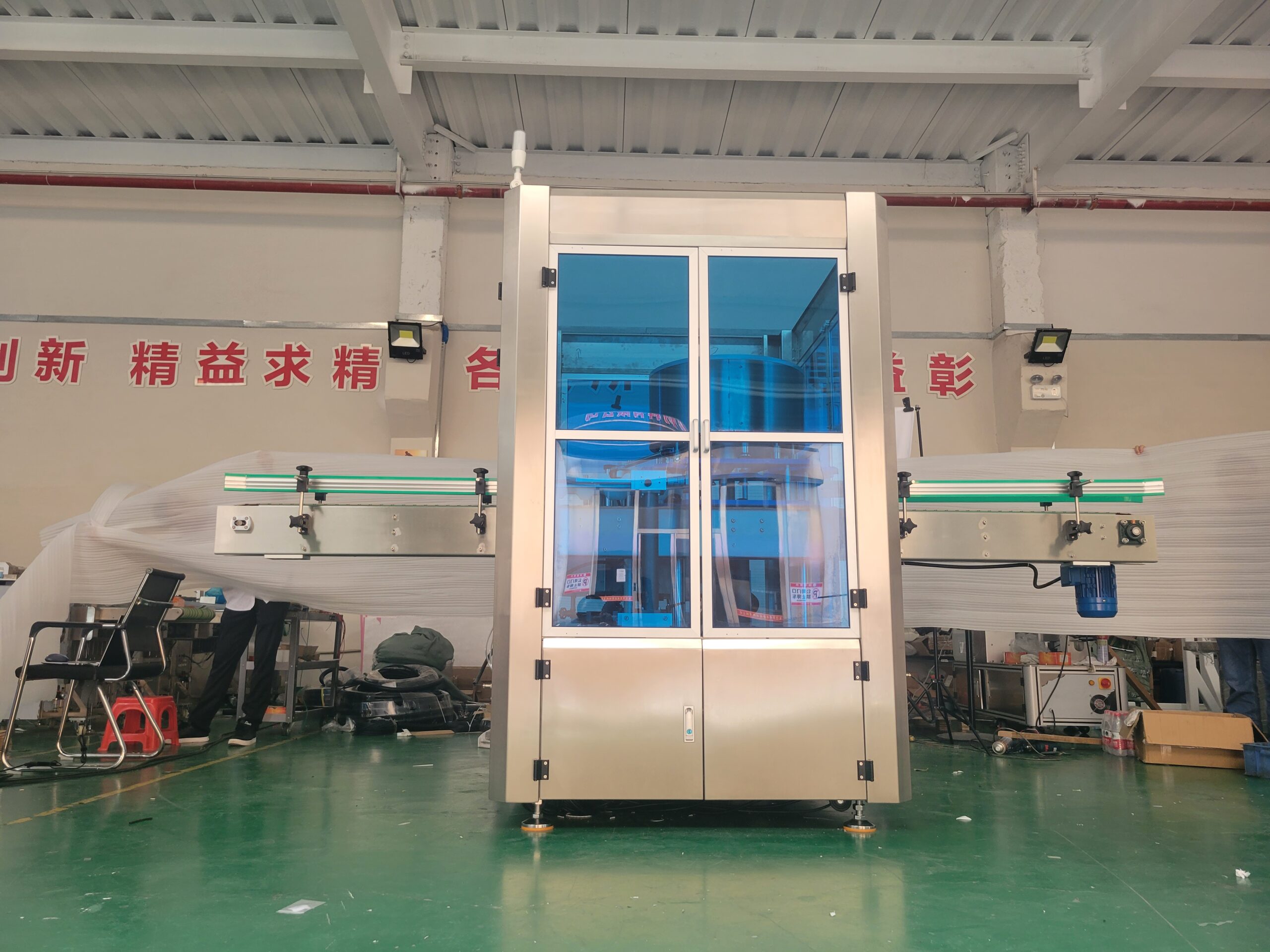
Bottle supply has to feed 12,000 bottles an hour
A 12-station rotary runs 12,000 to 15,000 bottles per hour and the 16-station platform covers ovals at 10,000 to 12,000. At those rates the labeler is rarely the constraint; the infeed is. Bottles arrive from a depalletizer, a rinser or an accumulator, and the buffer between that equipment and the labeler decides whether the machine runs continuously or starts and stops.
Three checks belong in the installation plan. The conveyor before the machine must be able to deliver bottles at a rate above the machine’s nominal speed, with a buffer that absorbs short upstream stoppages. The conveyor after the machine must clear labeled bottles fast enough that they do not back up into the discharge star wheel. And the label reel changes must be planned, because the servo feed runs up to 100 meters per minute and a reel change at that rate is a scheduled stop, not an emergency. Ask for the reel length and the expected change frequency for your label size, and put the answer in the shift plan.
The container band matters too: the 12-station configuration is built around round containers from 40 to 80 millimeters in diameter, which covers the standard water, CSD and juice bottle. A bottle outside that band needs a different drum or different tooling, and that is a pre-order conversation.
Commissioning, from arrival to approved first bottle
Commissioning follows a sequence, and each step has an owner. Power and air are connected and verified by the site electrician. The machine is leveled and the conveyors are aligned. The glue system is brought to temperature and the application pattern is set on sample labels. The vacuum drum and the label feed are timed to the bottle pitch. Then the first bottles run, and the first-article check decides whether production starts.
Plan on a couple of days for mechanical and electrical commissioning on a rotary platform, and add time for the glue system’s first heat-up and for the first-article adjustments. The machine does not need to be perfect on the first bottle; it needs to be repeatable by the hundredth. That is what the acceptance check is for: twenty consecutive bottles measured against the same reference, not one good bottle photographed for the file.
Who does what: remote, on-site and the factory test
Remote installation support is included on every machine from this factory: commissioning guidance over WhatsApp with the engineer who knows the configuration, plus the operating manual and the wiring diagram. For a standard installation with an experienced maintenance team, that is enough. On-site commissioning is available for line integration projects, where the labeler has to handshake with a filler, a capper or a site PLC, and it is quoted as a separate scope rather than assumed.
The part that reduces installation risk happens before the machine ships. Every rotary system is assembled and trial-run on the customer’s own bottles, and the test video is sent for approval. The factory acceptance test page explains what that covers. A machine that has already labeled your bottle in Guangdong is a machine whose installation is about utilities and alignment, not about whether the concept works.
After installation, the support terms are the ones that matter at 2 a.m.: a one-year whole-machine warranty, lifetime technical support, and a 12-hour response on working days for a video of the fault. The support center explains the diagnostic route, and the spare parts page lists what to keep on the shelf. For a rotary line, the shelf should include the wear parts at the glue station and the label feed, because those are the parts that stop a shift.
Site readiness checklist
| Item | Confirmed value | Who confirms |
|---|---|---|
| Supply voltage | 380V three-phase, dedicated breaker, protective earth | Site electrician, against the machine’s utility list |
| Line length | Roughly 31 m for the 12-station platform, including conveyors | Layout review with the factory before order |
| Compressed air | Dry, regulated drop at the machine if the application is pneumatic | Site utilities, consumption from the utility list |
| Glue system | Heat-up power available at shift start, hoses routed clear of traffic | Site electrical and maintenance |
| Ventilation | Local extraction if the EHS assessment requires it | Site EHS with the adhesive safety data sheet |
| Floor and access | Level pad, service envelope clear on both sides, crate route measured | Site engineer |
| Bottle supply | Infeed buffer able to sustain machine rate, discharge able to clear it | Line engineer |
A rotary hot melt line is a capital project with a machine inside it, and the plants that treat the utilities as part of the project are the ones that run bottles the week after the crate is opened. If you have a layout drawing and a bottle, send both and we will confirm the two numbers that matter before anything else is discussed. The hot melt labeling machine manufacturer page covers the platform range, and the hot melt labeling guides go deeper on station count, glue systems and speed.
Frequently asked questions
Does a hot melt labeling machine always need 380V?
The rotary platforms are built for a 380V three-phase supply, and the voltage variant is fixed at order. A site with a different supply needs a transformer or a machine built for its voltage. Confirm the supply at the quotation stage rather than at installation, because the electrical design follows it.
How much floor space does a rotary hot melt labeler need?
Roughly 31 meters of line length for the 12-station platform including infeed and discharge, plus the service envelope shown on the layout drawing. The service access on both sides is part of the requirement, not optional clearance, because the glue station and the label feed are reached from those sides.
Can the machine be commissioned without an engineer on site?
Yes for a standard installation. Remote commissioning support is included, with guidance from an engineer who knows the configuration, plus the manual and wiring diagram. On-site commissioning is quoted separately for line integration projects where the labeler must handshake with other equipment.
What has to be ready before the machine arrives?
Power at the machine with a dedicated breaker and earth, air if required, a level floor with the service envelope clear, the crate route measured, and the glue system’s heat-up supply available. Bottle supply and the infeed buffer should be running before commissioning starts, so the first-article check happens on production containers.
