
Label cost per bottle is not the label price. It is the label, the adhesive, the energy, the labour, the waste and the capital, divided by the bottles that actually leave the line. Hot melt and pressure-sensitive differ on every one of those lines, and they differ in opposite directions: hot melt carries the higher machine cost and the lower consumable cost, pressure-sensitive the reverse. This page gives the formula, the six blocks that go into it, and the ranges each block typically falls in, so a buyer can build the model with their own quotation instead of accepting a rule of thumb. No absolute prices appear here on purpose. Label prices move with film grade, print and freight, and any number published on a web page is wrong by the time it is read.
The formula, in one line
Cost per labeled bottle equals total cost of labeling divided by total bottles accepted by the customer:
Cost per bottle = (label cost + adhesive cost + energy cost + labour cost + waste cost + amortised capital) divided by accepted bottles.
Two terms in that expression cause most of the argument between the two systems. Waste cost includes bottles that had to be relabeled, and hot melt and pressure-sensitive fail differently, so the waste term is not the same number with a different label price attached. Amortised capital depends on volume, so the same machine is cheap per bottle at 40,000 bottles a day and expensive at 4,000.
Everything else is arithmetic. The discipline is to fill each block from a quotation or a meter reading, and to mark every number that came from a brochure as an assumption rather than a fact.
Block one: the label itself
The structural difference is the liner. A pressure-sensitive label is supplied on a silicone-coated carrier web. The buyer pays for that carrier, ships it, stores it, and then discards it. A hot melt label is supplied as a plain printed film roll with no carrier and no adhesive layer, because the adhesive is applied by the machine.
That is why the hot melt label is the cheaper of the two at the same face stock, print and finish. The range is wide because film grade, print process and order quantity dominate, but the direction is consistent: for a comparable OPP label, the hot melt roll typically lands somewhere in the region of 30 to 50 percent below the pressure-sensitive equivalent, and the gap widens as the label area grows, because the liner scales with area.
| Cost element | Hot melt | Pressure-sensitive |
|---|---|---|
| Face stock | OPP or paper, printed | OPP or paper, printed |
| Adhesive | Bought separately as melt | Built into the label |
| Liner | None | Silicone-coated carrier, discarded |
| Relative label price | Lower | Higher, roughly 1.3 to 2 times |
| Minimum order | Set by the converter, often by roll | Set by the converter, often by roll |
The multiplier is a range rather than a figure because it moves with label size and order volume. A small label bought in large volume can sit near the bottom of the range; a large label bought in modest volume can exceed it. Ask two converters for the same artwork on both formats and the real multiplier for your SKU appears in a week.
Block two: adhesive, energy and the pot
Hot melt buys adhesive by the kilogram and melts it on the machine. Pressure-sensitive buys adhesive inside the label and needs none of the equipment. That is the whole trade in this block, and it cuts both ways.
The hot melt adhesive cost per bottle is small but not zero. It is grams per label at the chosen pattern, priced per kilogram. A two strip pattern uses less than a full pattern, and a large label uses more than a small one. Ask the adhesive supplier for grams per square metre at the recommended coat weight, multiply by the glued area, and convert to cost. The figure is usually a minor share of the label cost, but on a high-volume line a small share of a large number is still a number worth measuring.
Energy is the term buyers forget. A hot melt pot holds 120 to 160 degrees Celsius for the whole shift, including breaks, and the energy is consumed whether or not a bottle is being labeled. On a two-shift operation the pot is on for sixteen hours; on a single shift with a cold start it is on for nine and takes time to stabilise. Pressure-sensitive consumes no melt energy at all, only the motors and the controls.
The honest way to model it is to meter the line for a week. A clamp meter on the labeler supply and a note of the hours the pot is on gives a number in kilowatt hours that is specific to the plant, the shift pattern and the tariff. Anything else is an estimate with a wide error bar.
Block three: labour and changeover
Labour is where pressure-sensitive wins clearly, and where the case for hot melt depends on run length.
A pressure-sensitive applicator has no glue kitchen, no pot to bring to temperature, no wheel to clean and no adhesive to store dry. Changeover is a roll swap and a recipe recall, and on a well set up machine it is minutes. A hot melt machine adds a temperature discipline, a daily cleaning routine at the pot and the wheel, adhesive storage that has to stay dry, and a changeover that includes re-stabilising the temperature.
Model it as minutes per shift plus minutes per changeover, multiplied by a loaded labour rate:
Labour cost per bottle = (routine minutes per shift + changeover minutes per week divided by shifts per week) times loaded rate per minute, divided by bottles per shift.
A plant running one SKU for a month sees almost no changeover term and the routine minutes dominate. A plant running four SKUs a week sees the changeover term dominate, and at that point pressure-sensitive is usually cheaper per bottle even at the higher label price. This is the single most common reason a buyer who expected hot melt to win ends up choosing pressure-sensitive.
Block four: waste and rework
The two systems fail differently, and the failure mode determines what the waste term costs.
A hot melt failure is usually a bond failure: a lifted tail, a dog ear, a label that was applied with adhesive too cool. It is caught at the discharge or, worse, at the customer. Rework means removing the label, cleaning the bottle and running it again, and a film label on a hot melt bond does not strip cleanly. Some plants scrap the bottle.
A pressure-sensitive failure is usually a placement or a missing-label failure: the label was applied off register, or the liner ran out and the machine labelled air. Rework is often a peel and re-label, because the adhesive is on the label and the bottle surface is untouched.
Put a number on it rather than an adjective. Yield is accepted bottles divided by bottles started, measured over a month. A line at 99.5 percent and a line at 97 percent look similar in a brochure and differ by a factor of six in rework cost. The gap between the two systems in this block is usually smaller than the label price gap, which is why the label price tends to decide the comparison, but only after the yield numbers are real.
Block five: capital, amortised honestly
Capital is the block where the comparison is most often distorted, because machines are compared at purchase and not per bottle.
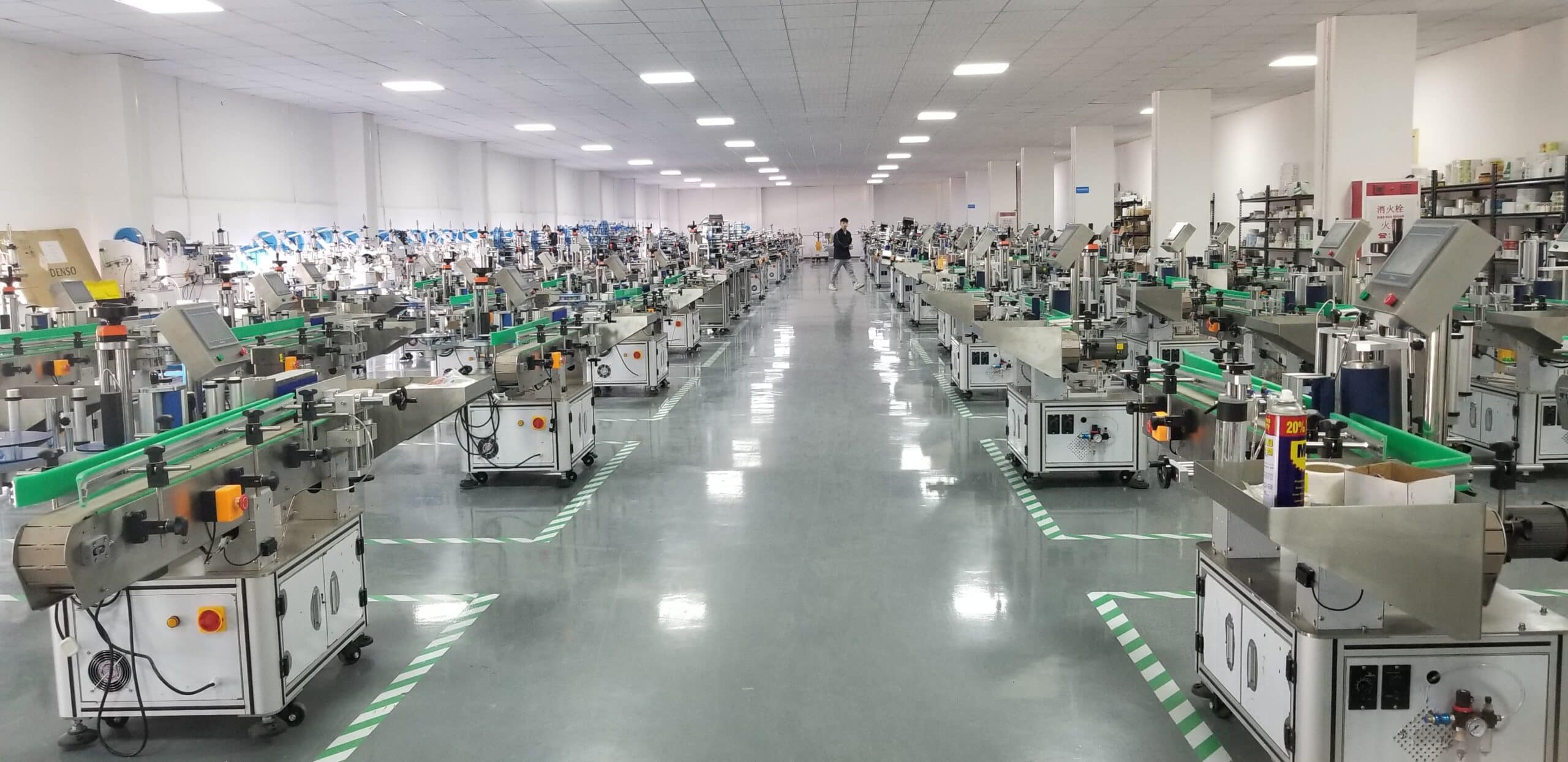
A rotary hot melt line carries a higher capital cost than a pressure-sensitive applicator of similar output. It also has a longer physical life in most plants, because the carousel and the glue system are rebuilt rather than replaced, and because the label supply is not tied to a liner format. Neither of those points settles the question; they only mean the amortisation period should match the plant’s actual replacement cycle rather than a default five years.
The formula is simple and the inputs are not:
Capital cost per bottle = (machine price minus residual value) divided by (annual bottles times years of service).
Run it at two volumes. At 10,000 bottles a day, six days a week, a year is about 3 million bottles, and the capital term per bottle is small enough that the consumable difference dominates. At 2,000 bottles a day, a year is about 600,000 bottles, the capital term multiplies by five, and pressure-sensitive usually wins even though its label costs more. That crossover is the whole argument, and it is arithmetic rather than opinion.
For the capital input itself, the labeling machine price guide sets out what drives the figure rather than quoting one, and the break-even calculator runs the volume term with your own numbers.
Running the model at two volumes
The same six blocks produce opposite answers at different volumes, which is why a single recommendation is useless. Work the two cases below with your own quotations.
Case A, 30,000 bottles a day, one SKU, long runs. The label block is large and the hot melt discount applies to all of it. Labour is small per bottle because changeovers are rare. Capital is spread over roughly 9 million bottles a year. In this case the hot melt advantage is usually decisive, and the size of the advantage is roughly the label saving minus the adhesive, energy and cleaning cost. The label saving dominates.
Case B, 4,000 bottles a day, four SKUs, weekly changeovers. The label block is a quarter of the size, so the same percentage saving is a quarter of the money. Labour per bottle rises because changeovers are frequent. Capital is spread over about 1.2 million bottles a year, so the capital term is roughly seven times larger per bottle. Pressure-sensitive usually wins here, and it wins on labour and capital rather than on label price.
Case C, the one buyers rarely model, sits between them: a plant with one high-volume SKU and a long tail of small ones. The answer is usually two lines, not one compromise. A hot melt carousel for the volume SKU and a pressure-sensitive applicator for the tail is often cheaper than either single machine, and it is the configuration most co-packers converge on.
Where pressure-sensitive wins even at volume
Four conditions override the label price arithmetic.
High SKU count. When changeovers per week run into double figures, the labour block swamps the label block. No label discount survives forty changeovers a week.
Short campaigns. Seasonal packs and promotional labels are made in quantities that never amortise a hot melt setup.
Operator turnover. A hot melt pot rewards consistency. A plant that replaces operators every few months pays for that in defects, and the cost lands in the waste block rather than the labour block.
Small bottles with large labels. A wide label on a small bottle is where hot melt wrap tension is hardest to control, and the defect rate can erase the consumable saving.
The full qualitative comparison, including bottle pool and wash-off, is on the hot melt versus pressure-sensitive page. The cost model above is the quantitative half of the same decision.
What to measure for thirty days
Most cost models fail because four of the six blocks are filled with estimates. These are the measurements that turn the model into evidence.
- Bottles started and bottles accepted, by shift, for a month. That is the denominator and the yield.
- Labels consumed from purchase records, not from a theoretical count per roll.
- Adhesive consumed in kilograms, if hot melt, with the pot hours logged alongside.
- Changeover count and duration, timed from last good bottle to first good bottle.
- Energy at the labeler supply, metered over a week that includes a cold start.
- Rework hours, separated from routine operation, because they belong in the waste block.
Thirty days of those six numbers will settle a question that a year of supplier brochures will not. Where the line does not exist yet, the equivalent is a trial: run the buyer’s bottle and label on the candidate machine before shipment and time the changeover during the visit. That is standard practice at HiPaks, and the recording that comes back is evidence rather than a claim.
Import classification is worth a line in the model as well, because it changes the landed cost of both the labels and the machine. The Harmonized Tariff Schedule published by the US International Trade Commission is the reference for US imports, and the equivalent national tariff schedule applies in other markets. A percentage point or two on a label that is bought by the million is a real number in the per bottle calculation.
The hot melt glue labeling machine page covers the 12 and 16 station builds that make the volume case work, and the hot melt guides index collects the related sizing and application pages.
Frequently asked questions
Is hot melt always cheaper per bottle than pressure-sensitive?
No. It is cheaper on consumables at the same label specification, because there is no liner and no built-in adhesive. It is more expensive on capital and on changeover labour, so at low volume or high SKU count pressure-sensitive usually wins per bottle despite the higher label price.
How much cheaper is a hot melt label than a pressure-sensitive label?
For a comparable OPP label, the hot melt roll typically lands in the region of 30 to 50 percent below the pressure-sensitive equivalent, and the gap widens with label area because the liner scales with area. Ask two converters for the same artwork on both formats to get your own multiplier.
What volume makes a hot melt line pay off?
There is no universal figure, because it depends on the label price gap, the loaded labour rate and the machine price. Run the formula at your own volume, and run it twice, once at current output and once at the output you expect in three years. The crossover usually appears where the capital term per bottle falls below the label saving per bottle.
Does the adhesive cost change the answer?
Rarely on its own. Adhesive is a small share of the label cost, and it is offset by the liner that pressure-sensitive buys and discards. It matters at the margin when the glue pattern is generous or the label is large, which is why grams per label is worth measuring rather than assuming.
