
MT-50 / MT-60 / MT-130
Desktop entry units for small round bottles (MT-50/130) and small flat pieces (MT-60).
Find the volume where hand labeling starts costing you orders, then climb the four-stage upgrade path with real prices.
Stop hand labeling when batches regularly exceed 100–200 bottles, or when labeling eats more than an hour a day. At that point a semi-automatic machine (15–30 bottles per minute against a hand pace of 60–150 per hour) usually pays for itself within a handful of months, because the machine costs from about $600 while the labor it replaces is a recurring wage. Entry desktop units start at $600–1,200, floor-standing precision models at $1,500–4,500, and fully automatic lines at $6,000–15,000. Run your own numbers in the calculator below.
Hand labeling looks free because nobody invoices you for it. Four costs hide inside it:
None of this means machines are always right. Make the decision with numbers.
Any one of these is a signal. Two or more together is a decision.
This is the practical ceiling where quality and morale both start sagging. Below it, hand labeling is honest work; above it, every additional bottle costs more patience than the last.
An hour a day is 20+ hours a month of skilled-you time spent on the least skilled task in the building. What else would you do with that time if a $600 machine did it?
If you are peeling and re-applying labels (or worse, discarding filled product), the reject rate is a silent tax on every batch. Machines apply with even pressure and do not get tired at bottle 300.
When labeling migrates to evenings and weekends to “catch up”, the bottleneck has started making decisions about your calendar.
The most expensive symptom. A wholesale order you decline because you cannot label 3,000 units in time is margin you never see again, and a retailer who stops asking.
Three inputs, no email gate. Quality gains and rejects are not counted, so the result is conservative.
How this works. Monthly hand-labeling hours = output ÷ your pace. Machine hours = output ÷ 1,200 (a semi-automatic at ~20 pcs/min). Hours saved × your labor rate = monthly savings. Payback = recommended machine price ÷ monthly savings. The machine tier is picked from your volume: under 3,000/month → desktop semi-automatic ($600–1,200); 3,000–30,000 → floor-standing semi-automatic ($1,500–4,500); above 30,000 → fully automatic ($6,000–15,000). Payback is estimated at the band midpoint. All price bands are market references: confirm before publish.
Most brands climb the same four steps. Skip a stage only when volume forces you to.
| Stage | Typical kit | Output | Price band | Fits |
|---|---|---|---|---|
| 0 · Hand | Jigs, squeegees, patience | 30–60/hr | $0 + labor | First batches, market tests |
| 1 · Desktop semi-auto | MT-50 / MT-60 / MT-130 class benchtop unit | 15–30 pcs/min | $600–1,200 | Kitchen-table brands, batches to ~2,000/day |
| 2 · Floor semi-auto | T801 round wrap · T803 front & back · T805 square/flat wrap · T807 ±0.2mm | 15–30 pcs/min, all day | $1,500–4,500 | 5,000–10,000/day, multi-SKU, shaped containers |
| 3 · Fully automatic | T921 wrap · T962 double-side · T932 page-fed | 40–300 pcs/min unattended | $6,000–15,000 | Line-speed volume, co-packers, export supply |
Of the $300–800 machines sold on Amazon and Alibaba, “some work fine, many don’t”: the failure pattern:
Our answer is structural rather than a discount: every machine is test-run with your bottles and filmed before the balance payment (FAT process), ships with an English manual and operation videos, and is backed by lifetime technical support with fast spare-parts dispatch. The proof lives in the test-run video library.
The cycle is three moves: place a bottle against the fixture, press the pedal, lift the finished bottle out. At a realistic 20 pcs/min, a 2,000-bottle day is roughly 80–100 minutes of trigger time. The rest of the shift is loading racks, unloading finished bottles and one label roll change. Watch the pacing in the video library. Rhythm and consistency are visible within ten seconds.
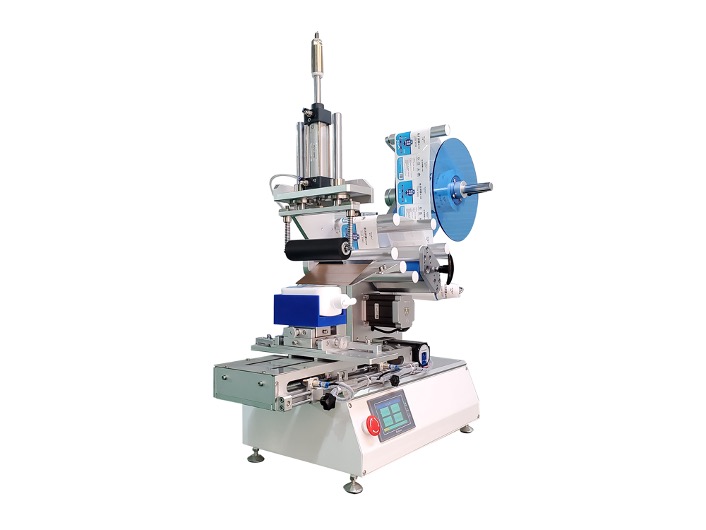
Two clips: a desktop wrap unit on small irregular bottles, and a floor-standing semi-automatic at production pace.
Cosmetics founders start with a desktop unit for serum bottles and graduate to front-and-back application as SKUs multiply (cosmetics & personal care). Hot-sauce makers replace their worst weekend of the year with a T801 wrap station (food & beverage). Candle studios label tins and jars in batches between pours (jar labeling).
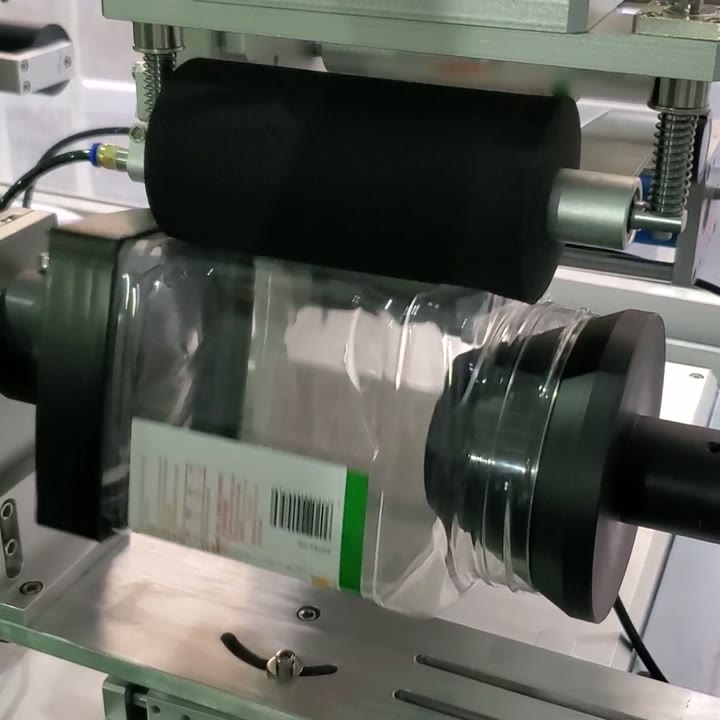
Desktop entry units for small round bottles (MT-50/130) and small flat pieces (MT-60).
±0.5mm, 20–30 pcs/min, φ10–150 × H 20–300mm: the workhorse for sauces, honey, beverages and cosmetics.
Full wrap-around for flat and square bottles at ±0.5mm, 15–30 pcs/min: the geometry specialist.
The working thresholds: batches over 100–200 bottles, or more than an hour of labeling a day. Below that, hand labeling is rational; above it, a semi-automatic machine at 15–30 pcs/min removes the bottleneck and usually pays back within months. Run your exact numbers in the calculator above.
It depends on your volume and labor rate, not on promises. Worked example: 5,000 bottles/month at 100 bottles/hour by hand is 50 labor-hours; a semi-automatic does the same in about 4 hours: 46 saved hours × $15/hour ≈ $690/month. Against a $1,500–4,500 floor machine, that is roughly a 2–7 month payback. The calculator above reproduces this with your figures.
Industry consensus is blunt: in the $300–800 band, some work fine, many don’t, and support is usually the missing piece. If you experiment at that level, treat it as tuition. When the volume is real, buy from a factory that proves the machine on your bottles first: test video before balance, English documentation, spare parts, lifetime support.
Stay semi-automatic while one operator covers your labeling within a normal shift. 15–30 pcs/min covers a lot of growth. Move to automatic when labeling must match an automatic filler’s pace, or when you would otherwise hire a second full-time labeling operator. The automatic range starts at 40 pcs/min; the calculator’s top tier shows when the $6,000–15,000 band makes sense.
Three things: your bottle (or its dimensions and a photo), your label (size, material, roll core), and your target output per day or per minute. Send those through contact & quote and you get a matched model, a price, and a free test-run video with your own product, in that order, within 48 hours for the video.
All eight machine classes compared: types, real price ranges, accuracy at speed and the 10-question supplier checklist.
If hand-labeled square bottles wrinkle at the corners, a machine alone will not fix it.